EKU clinical hours, program by program
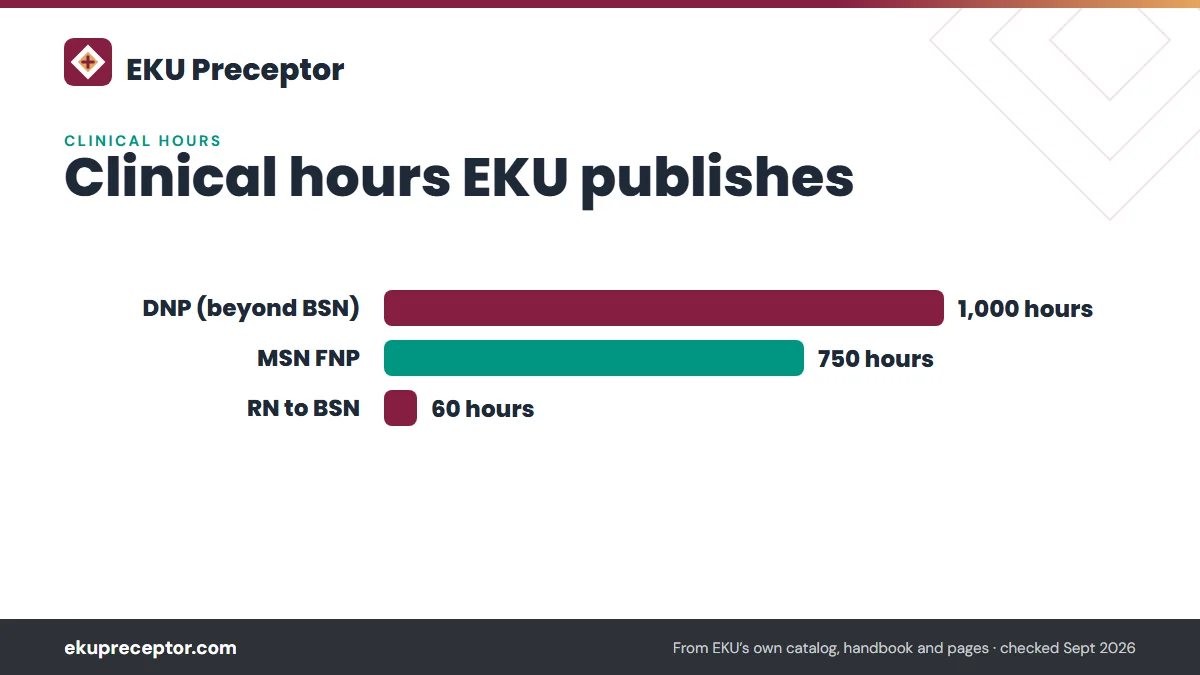
EKU puts a clinical hour number on three programs: 750 direct patient care hours for the MSN FNP, at least 1,000 hours beyond the BSN for the DNP, and 60 clock hours for the RN to BSN clinical in its most recent available handbook. It publishes no PMHNP total and no hours for individual courses. Pick your track in the planner below, then read on for where each figure comes from and how to confirm your own.
Get your placement plan
Tell us your EKU program and where you live. A placement advisor replies with preceptor and site options in your community that fit your EKU course.
Pick your EKU program
Your clinical courses and hours, who can precept you, where, and when to start looking. From EKU's own catalog, handbook and program pages.
- Who precepts
- A primary-care preceptor EKU approves, across family practice, adult, pediatric and women's health
- Where
- Primary care practices and rural clinics in your own community
- Start looking
- Before NSC 800 begins alongside FNP I; a synthesis preceptor for NSC 876 at the end
- Who precepts
- A psychiatric-mental health preceptor (PMHNP or psychiatrist) EKU approves
- Where
- Outpatient psychiatry, community mental health and behavioral health programs near you
- Start looking
- Before NSC 800 begins alongside PMHNP I; an internship preceptor for NSC 886
- Who precepts
- The same specialty preceptors as the matching MSN concentration
- Where
- Primary care (FNP) or psychiatric settings (PMHNP) in your community
- Start looking
- After the NSC 830, 832 and 834 prerequisites, before NSC 800
- Who precepts
- A practice site and site contact EKU's Clinical Placement Coordinator approves
- Where
- A health system, clinic or organization where your project and leadership hours can run
- Start looking
- Before each clinical course, through the site approval request
- Who precepts
- A nurse leader or clinical contact at a setting that fits the course
- Where
- A health system or community setting near you, sometimes your own employer
- Start looking
- Before the 8-week clinical course begins
The three hour figures EKU publishes
EKU states a clinical hour number in only three places, each from a different kind of source, and that tells you how much weight each deserves.
MSN FNP: 750 direct patient care hours. The FNP program page says graduates leave with 750 hours of direct patient care, and that the final 300 are there for synthesis of everything learned before them. What the figure means course by course, and how the 300 relate to the internship, is on the 750-hour FNP page.
DNP: at least 1,000 hours beyond the BSN. The 2026-27 graduate catalog asks post-master's DNP students to document a minimum of 1,000 clinical hours completed after the bachelor's degree. The hours you still owe at EKU are worked out when you are admitted and written into your plan of study. The detail, including the site approval request, is on the DNP hours page.
RN to BSN: 60 clock hours. EKU's 2023-24 RN to BSN Student Handbook, which the university no longer posts, gave NSC 442C Complex Health Systems Clinical 60 clock hours over 8 weeks. The course carried 2 credits then and carries 2.5 in the current catalog, so treat 60 as a starting point and confirm it. See the RN to BSN clinical page.
What EKU leaves unpublished
Several numbers students search for do not appear on any current EKU program page, catalog entry or handbook we could find. When a figure is missing, the answer belongs to your program, not to a forum thread.
- The PMHNP hour total. Neither the MSN PMHNP nor the post-MSN PMHNP certificate states one, in current or archived documents. The PMHNP hours page covers what to ask and whom.
- Hours per course. EKU gives no separate count for
NSC 800,NSC 876orNSC 886, and no ratio of clock hours to credits. - Certificate totals. The post-MSN FNP certificate carries exactly the clinical credits of the MSN FNP, which points to the same 750 hours, but EKU does not say so on the certificate page.
- A population split. No breakdown of FNP hours by age group, women's health or pediatrics is published.
- Telehealth. The archived MSN handbook lists an FNP Telehealth Checklist for
NSC 800andNSC 876, but not whether, or how far, telehealth visits count toward hours. - On-campus clock hours. The Pre-RN BSN, 2nd Degree BSN and AAS clinical courses list credits, not clock hours.
For any of these, ask the faculty member who leads your clinical course, read the syllabus in Canvas, and check the MSN Student Handbook your program gives you. Put the question in a myMail message, which leaves a written reply you can point back to in later terms.
EKU hour figures side by side
The planner above shows the courses, preceptors and timing for each track. This table shows the evidence behind the numbers instead: where each figure comes from and how current it is.
| Program | Hour figure | Where EKU says it | How current |
|---|---|---|---|
| MSN FNP | 750 direct patient care hours; last 300 for synthesis | FNP program page | Current |
| MSN PMHNP | Not published | No EKU source | Ask your faculty |
| Post-MSN FNP certificate | Not stated; same clinical credits as the MSN FNP (8 of NSC 800, 6 of NSC 876) | Certificate catalog page (credits only) | Confirm in your plan of study |
| Post-MSN PMHNP certificate | Not published; 8 of NSC 800, 5 of NSC 886 | Certificate catalog page (credits only) | Confirm in your plan of study |
| DNP (post-master's) | At least 1,000 beyond the BSN; hours owed at EKU set at admission | 2026-27 graduate catalog | Current; the 2020 handbook also set 200 at EKU |
| RN to BSN | 60 clock hours over 8 weeks in NSC 442C | RN to BSN Student Handbook 2023-24 | Archived; credits have since changed |
| Pre-RN and 2nd Degree BSN | Clock hours not published; seven clinical courses, 16.5 clinical credits by our count | Undergraduate catalog | Current credits |
| AAS | Clock hours not published; six clinical courses, 13 clinical credits by our count | Undergraduate catalog | Current credits |
Anything marked archived comes from a document EKU has since taken down. Read it as the most recent available word, not as settled policy, and check it against what your course tells you.
Why credits and hours drift apart at EKU
Hour questions are harder at EKU than they look because the clinical courses have been rebuilt more than once. The 2021-22 MSN handbook had FNP students take 9 credits of NSC 800 and a 5-credit internship; the current catalog sets 8 credits and a 6-credit NSC 876. PMHNP students moved from 7 credits of NSC 800 and a 6-credit internship to 8 and 5.
The catalog has not fully caught up with itself either. The NSC 886 course entry still asks for seven hours of NSC 800 even though the PMHNP program now requires eight. The NSC 800 page sets out each version, and the PMHNP internship page walks through the psychiatric sequence.
Timing adds a third layer. Core courses now run in 7-week terms, 6 weeks in summer, but EKU's archived 2022-23 curriculum plans spread NSC 800 and both internships across 16-week semesters, with one 12-week summer block. A weekly hour target built from an old plan may not fit yours, so rebuild it from your current plan of study.
How your hours get recorded
Where MSN hours are logged, and how a preceptor verifies them, is not described in any public EKU source; your clinical course will spell out both. In the meantime, write down every clinic day as it happens: the date, where you were, who precepted you and how long you stayed. A running record beats reconstructing a semester from memory.
The DNP is the one track with a named log. EKU's archived 2020 DNP handbook calls it the DNP Experience Log and asks for the date, the time, the nature of each learning activity and how it ties to the DNP Essentials. The same handbook said experience hours could not begin before the semester opened or before onboarding paperwork was complete.
On-campus BSN and AAS students deal with a different tool. EKU's current program pages say the School of Nursing manages clinical and compliance documents in Complio, which holds immunization, CPR and similar records rather than hour logs.
Before your first hour counts
Three things need to be in place before hours start in NSC 800. In the most recent available MSN handbook, FNP and PMHNP students show mastery of advanced health assessment in the semester right before their first clinical course; the health assessment page explains that gate. Each semester you also present current clinical documents, including the preceptor information form and proof of liability insurance bought through EKU. And you need a preceptor EKU has approved.
On that last point, Kentucky's rule for APRN programs gives EKU the job of securing preceptors and protects your right to input into the process; our Kentucky rule page quotes it in full. Many EKU students use that input to put forward a preceptor close to home or in the setting they want. We find that preceptor, prepare the details EKU asks for and stay on call through the term, so the option EKU reviews is complete the first time and your hours start on schedule.
EKU ties clinical hours to an active clinical course: documents and approval come first, then the hours. Settle your preceptor before the term opens, not after it starts.
Questions EKU students ask
Do my hours as a working RN count toward EKU clinical hours?
No EKU source says they do. The 750-hour FNP figure describes direct patient care earned in the program, and EKU ties its clinical documents and liability insurance to enrolled clinical courses. The one place earlier hours can count is the DNP, where the admission review can credit hours from your MSN program. Training at your own workplace during a clinical course is a separate question with its own rules.
How many clinical hours a week should an EKU FNP student expect?
EKU publishes no weekly figure. As rough arithmetic of our own: EKU's archived plans spread FNP clinicals over about 60 weeks (three 16-week semesters and one 12-week summer), so 750 hours averages about 12 to 13 a week. The load is uneven, with the internship the heaviest. The FNP hours page breaks this down by block.
Does EKU credit my MSN clinical hours toward the DNP?
Yes, where it can. The catalog asks for 1,000 clinical hours beyond the BSN and says the hours owed at EKU are assessed on admission. The archived 2020 DNP handbook described a gap analysis that credits MSN hours when possible and still required at least 200 hours at EKU. Whether that minimum stands today is not public, so confirm it in your plan of study.
Does simulation count toward EKU NP clinical hours?
EKU does not say. Its FNP figure is worded as direct patient care, which by its plain meaning is time with patients. EKU describes a Clinical Skills Lab and Simulation Center for on-campus BSN students, but publishes no rule on simulation for NP courses. Ask your clinical course faculty before counting any simulated or observation time.
Do EKU's hour rules change if I live outside Kentucky?
The hour figures apply program-wide, wherever you train. What changes by state is whether EKU can enroll you and place you there at all: its state authorization page lists states it does not accept online NP students from, and the catalog asks you to report where any clinical outside Kentucky will happen.
Related pages
Last checked 2026-09-25
We check these pages against EKU's own catalog, program pages and handbooks, and Kentucky's regulations. The current MSN Student Handbook, your course and your faculty have the final word.
EKU secures your preceptor. Your input decides how well it fits your life.
Tell us your EKU program, where you live and when your next clinical course starts. We find preceptors in your community who fit the course and prepare everything EKU reviews, so the option you put forward is ready to approve.
- Preceptors matched to the course: family primary care for
NSC 800andNSC 876, psychiatric care forNSC 886 - Preceptor, license and site details organized for EKU's preceptor information form
- In your own community, wherever EKU enrolls students and you hold your RN license
Start your placement plan
Program, city and start date is all we need to begin.