EKU's MSN Psychiatric Mental Health NP: the clinical sequence and how to plan it
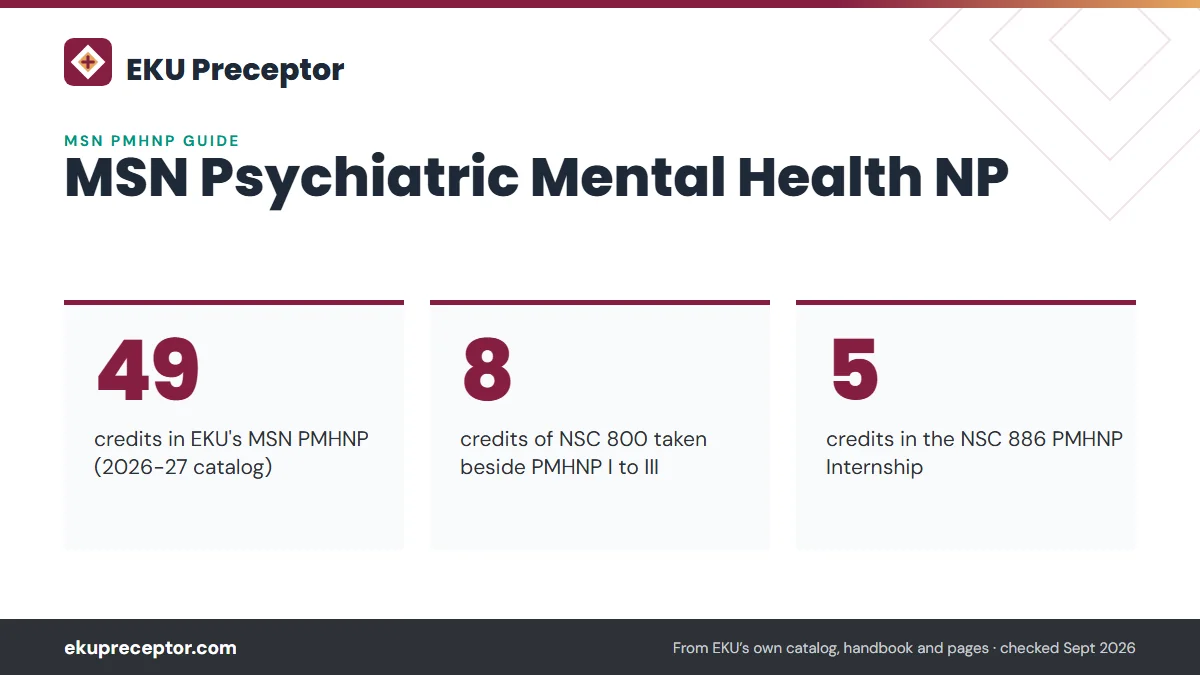
EKU's online MSN PMHNP totals 49 credits: the shared MSN core, which holds the NSC 800 Advanced Practice Role clinical, plus 17 credits of psychiatric courses ending in the 5-credit NSC 886 PMHNP Internship. EKU does not post a clinical hour total for this track. This guide sets out what is published, what is missing, and how to line up psychiatric preceptor input for each clinical term.
Plan your PMHNP clinicals
Tell us your start term and when your first NSC 800 term begins.
What the PMHNP track looks like
The Psychiatric Mental Health Nurse Practitioner concentration is one of two MSN tracks in EKU's School of Nursing, and like the FNP it runs online with no campus visits, 7-week terms for core courses and starts in spring, summer and fall. EKU states that it designed the program around the Consensus Model for APRN Regulation, the national framework for NP education and licensure.
The naming is untidy. EKU Online's landing page is headed MSN Rural PMHNP, while the catalog calls the concentration Psychiatric Mental Health Nurse Practitioner. The catalog link on EKU's PMHNP program page still points to an address with the rural name, and it returns an error, so read requirements from the main MSN catalog page instead. The course list also keeps NSC 883 Rural PMHNP Child Adolescent, which requires current certification as an adult PMHNP and belongs to no current program, so it will not show up in your plan.
All 49 credits in one table
The core is identical to the FNP track, so it is grouped here. The psychiatric courses are listed one by one, because their pairings with NSC 800 decide your clinical calendar.
| Course | What it is | Credits | Clinical role |
|---|---|---|---|
NSC 830, NSC 832, NSC 834 | Advanced pharmacology, health assessment, pathophysiology | 9 | Foundations before clinicals |
NSC 840, NSC 890, NSC 843, NSC 857, NSC 855 | Theory, evidence, informatics, leadership and quality, population health | 15 | Didactic |
NSC 800 | Advanced Practice Role | 8 in total | Clinical, split across PMHNP I, II and III |
NSC 880 | PMHNP I (corequisite NSC 881) | 3 | Didactic, paired with NSC 800 |
NSC 881 | Applied Psychopharmacology | 3 | Didactic |
NSC 882 | PMHNP II (corequisite NSC 800) | 3 | Didactic, paired with NSC 800 |
NSC 884 | PMHNP III | 3 | Didactic, paired with NSC 800 |
NSC 886 | PMHNP Internship | 5 | Final psychiatric clinical |
| Total | 49 | Hour total not published |
That is 32 core credits and 17 in the concentration. Thirteen credits are clinical: NSC 800 and NSC 886, each needing a psychiatric-mental health preceptor and an approved site.
How NSC 800 pairs with PMHNP I, II and III
In the PMHNP track, NSC 800 Advanced Practice Role is taken in parts: the catalog footnote pairs it with NSC 880, NSC 882 and NSC 884 until the total reaches 8 credits. Each of those psychiatric courses therefore comes with clinical time, and your psychiatric preceptor relationship starts with PMHNP I rather than at the end of the program.
The most recent PMHNP curriculum plans EKU posted, dated 2023 and now available only in archive copies, spread the 8 credits as 2 credits over 16 weeks with PMHNP I, 2 credits with PMHNP II, and 4 credits over 16 weeks with PMHNP III. The heaviest clinical load lands in the third course. Check the current pattern with your advisor before you commit a preceptor's schedule.
Older and newer documents disagree. The 2021-22 MSN Student Handbook set 7 credits of NSC 800 for PMHNP students and a 6-credit internship; the current catalog says 8 and 5. The catalog governs. For the course itself, see the NSC 800 guide.
NSC 886 PMHNP Internship
The internship is the last clinical course and carries 5 credits. The archived 2023 plans ran it over a 16-week term. Its catalog entry has two loose ends worth raising with your advisor: it asks for NSC 884 and seven hours of NSC 800, although the program now requires eight, and it names NSC 842 as a prerequisite or corequisite even though that course has left the MSN core.
Because it is the final clinical before graduation, continuity helps: a preceptor who already knows you from NSC 800, or a site with steady psychiatric patient volume, makes the term easier to plan. Whether you stay with one preceptor or move is a question for your faculty. The internship guide has more on the sequence.
Clinical hours: the number EKU has not posted
No current EKU page gives a clinical hour total for the MSN PMHNP, and no archived EKU document found in research does either. That sets this track apart from the FNP, where EKU states 750 direct patient care hours. Resist the urge to borrow the FNP figure: the PMHNP clinical credits differ (13 against the FNP's 14), and EKU has not said how credits convert to clock hours.
The places that do hold the number are your course syllabi, the current MSN Student Handbook, which EKU no longer posts publicly, and your faculty. Ask for the total and for the share in each NSC 800 enrollment before your first clinical term, since that split tells a preceptor how many days you need. The PMHNP hours page tracks what is known.
The mistake to avoid is quoting 750 hours to a psychiatric preceptor. That is EKU's FNP figure. Get the PMHNP number for your own plan of study in writing from your faculty first.
Psychiatric settings that fit the sequence
Kentucky's APRN regulation defines a preceptor as an APRN, a physician or a physician assistant. EKU does not publish its own rules on specialty fit, credentials or experience for PMHNP preceptors, so the course and your faculty decide what qualifies. The course titles, from PMHNP I to III through Applied Psychopharmacology, point to settings where psychiatric clinicians assess, diagnose and prescribe, and these are the settings we look at first:
- Outpatient psychiatry practices and behavioral health clinics
- Community mental health centers, including those serving rural counties
- Inpatient psychiatric units and crisis stabilization programs
- Substance use treatment programs with prescribing clinicians
- Integrated primary care practices with an embedded psychiatric clinician
The need is real in EKU's home region: Madison County, where Richmond sits, carries a federal mental health shortage designation for its low-income population. Our full notes on who can precept cover what EKU checks and what it keeps private.
Starts, deadlines and admission items
The PMHNP shares the MSN calendar: apply by July 1 for an August start, by November 1 for January, or by March 15 for May. The archived 2023 plans ran 7 semesters from a spring start, 8 from fall and 9 from summer.
Admission asks for a BSN, a 3.0 GPA, a statistics course and one year of RN experience. The license wording differs from the FNP page: an unrestricted RN license from an approved state, which EKU defines as never subject to reprimand, revocation, probation, suspension, restriction, limitation, disciplinary action, discretionary review or hearing, or encumbrance, and with no complaint of any kind filed against it. EKU also does not enroll online MSN students from eight states, listed on the state authorization page.
How we help EKU PMHNP students
A head start pays off most in psychiatric placements. Your placement advisor searches your community for a psychiatric-mental health clinician who fits NSC 800 with PMHNP I, has the patient mix EKU's courses call for, and can plan around your work schedule. We keep the internship in view from the start, so the NSC 886 option is taking shape before you need it.
Kentucky's rule leaves securing preceptors to EKU and lets you have input; we make your input count. We collect the preceptor's license and credentials and the site facts EKU's preceptor information form asks for, so your faculty receive a complete option to review and approve. If a preceptor withdraws, the placement desk goes straight to work on the next one. Start with the form below.
Questions EKU students ask
Is EKU's PMHNP program fully online?
Yes. EKU's PMHNP page lists no campus visits and 7-week terms for core courses. The last posted MSN handbook (2021-22) mentioned some live class sessions by video conference, with attendance expected. Clinical hours happen at approved psychiatric sites near you, so the only regular travel is to your preceptor's practice.
Can an FNP-certified nurse practitioner join EKU's PMHNP track?
EKU built the post-MSN PMHNP certificate for that case: the catalog describes it for nurses with an MSN or higher who want a second specialty. It keeps the same psychiatric courses and clinicals, and the last posted handbook said repeating pharmacology was decided case by case for students already certified in another population. Compare both routes with an EKU enrollment counselor.
How many transfer hours does EKU's MSN PMHNP accept?
EKU's program page allows up to 12 transferred hours into the MSN PMHNP. Ask your advisor which of your earlier graduate courses can count before your first registration, since transferred work changes your plan of study and with it the term when NSC 800 and PMHNP I begin.
Does EKU report a PMHNP certification pass rate?
EKU reports a 98.6% first attempt pass rate on its MSN PMHNP page. It is EKU's own figure, the page gives no date for it, and it says nothing about clinical placements. If the number matters to your choice, ask an EKU enrollment counselor which graduating years it covers and how many graduates sat the exam.
Can I do PMHNP clinicals where I already work?
EKU has not published an MSN rule on clinicals at an employer, though an EKU Online story featured an FNP graduate who trained where she worked. If your workplace has a psychiatric clinician who could precept you, raise it with your faculty early and ask what separation between your job and your student role EKU expects. More on clinicals at your workplace.
Related pages
Last checked 2026-09-25
We check these pages against EKU's own catalog, program pages and handbooks, and Kentucky's regulations. The current MSN Student Handbook, your course and your faculty have the final word.
EKU secures your preceptor. Your input decides how well it fits your life.
Tell us your EKU program, where you live and when your next clinical course starts. We find preceptors in your community who fit the course and prepare everything EKU reviews, so the option you put forward is ready to approve.
- Preceptors matched to the course: family primary care for
NSC 800andNSC 876, psychiatric care forNSC 886 - Preceptor, license and site details organized for EKU's preceptor information form
- In your own community, wherever EKU enrolls students and you hold your RN license
Start your placement plan
Program, city and start date is all we need to begin.