NSC 800 Advanced Practice Role: how EKU's clinical course runs
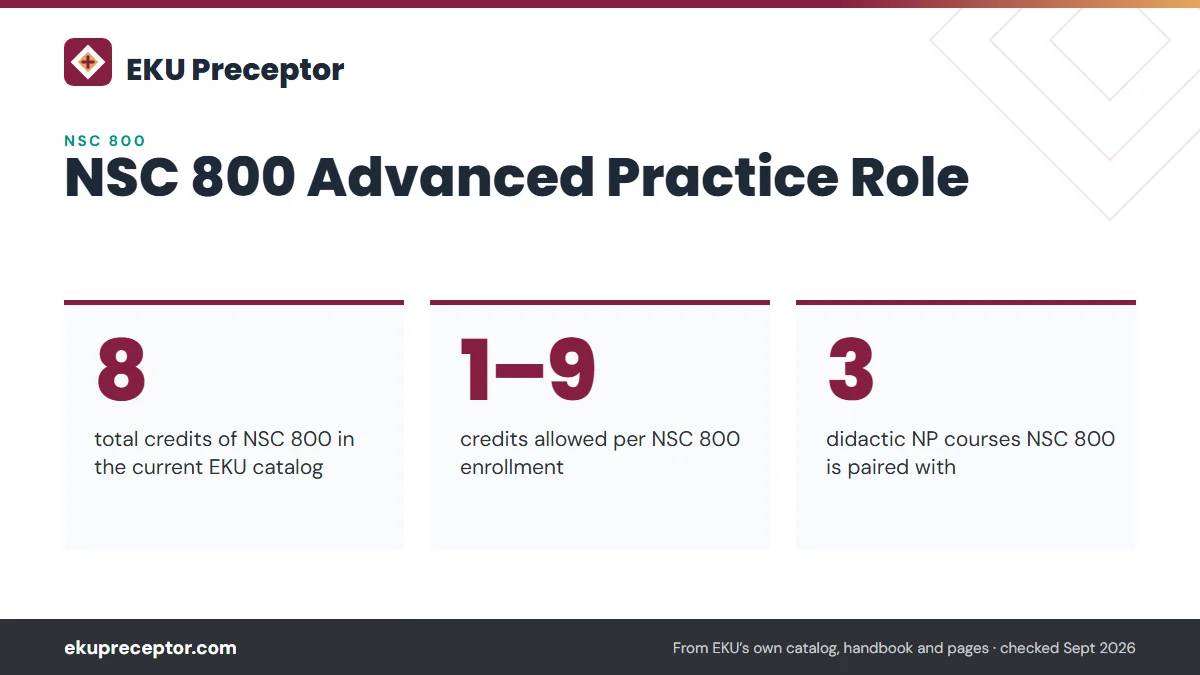
NSC 800 Advanced Practice Role is the clinical course EKU's FNP and PMHNP students register for more than once: 1 to 9 credits per enrollment, repeated until they reach 8, each time alongside one of the three didactic NP courses. Most of your supervised hours before the internship happen here, and every enrollment needs an approved preceptor and current clinical documents before the first clinic day.
Get your placement plan
Tell us your EKU program and where you live. A placement advisor replies with preceptor and site options in your community that fit your EKU course.
What the catalog says about NSC 800
NSC 800 is a variable-credit clinical course. Each registration carries between 1 and 9 credits, and you repeat it until your total reaches what your track requires. In the 2026-27 catalog that total is 8 credits for both NP concentrations, and the course is always taken at the same time as a didactic NP course.
For FNP students the catalog note reads: “Concurrent enrollment in NSC 800 Advanced Practice Role enrollment with NSC 870 FNP I, NSC 872 FNP II, NSC 874 FNP III for a total of 8 hours.” The PMHNP note pairs it the same way with NSC 880, NSC 882 and NSC 884. Two of those courses, NSC 874 and NSC 882, list NSC 800 as a formal corequisite.
| Track | Paired didactic courses | NSC 800 total | Internship that follows |
|---|---|---|---|
| MSN FNP and post-MSN FNP certificate | NSC 870 FNP I, NSC 872 FNP II, NSC 874 FNP III | 8 credits | NSC 876 FNP Internship, 6 credits |
| MSN PMHNP and post-MSN PMHNP certificate | NSC 880 PMHNP I, NSC 882 PMHNP II, NSC 884 PMHNP III | 8 credits | NSC 886 PMHNP Internship, 5 credits |
Before the first enrollment, FNP I asks for NSC 830, NSC 832, NSC 834 and NSC 840, and PMHNP I is taken with NSC 881 Applied Psychopharmacology.
How EKU split the 8 credits in its last posted plans
EKU's archived curriculum plans (FNP 2022, PMHNP 2023) show how the 8 credits were spread. Both tracks started light and ended heavy, and most blocks ran a full semester rather than a 7-week term.
| Enrollment | FNP (2022 plans) | PMHNP (2023 plans) |
|---|---|---|
| First | 2 credits over 16 weeks, with FNP I | 2 credits over 16 weeks, with PMHNP I |
| Second | 3 credits over a 12-week summer term | 2 credits, with PMHNP II |
| Third | 3 credits over 16 weeks, with FNP III | 4 credits over 16 weeks, with PMHNP III |
| Total | 8 credits | 8 credits |
These plans are no longer posted by EKU, so your own plan of study decides the pattern. For FNP students, what those blocks mean in hours and weekly load is worked out on the 750-hour page. PMHNP students can read what is known about their totals on the PMHNP hours page.
Where EKU's documents disagree
The total has moved, and not every catalog entry has moved with it. Knowing the versions helps if an advisor, a classmate or an old PDF gives you a different number.
| Item | MSN Handbook 2021-22 (archived) | 2026-27 catalog |
|---|---|---|
FNP credits of NSC 800 | 9 | 8 |
NSC 876 FNP Internship | 5 credits | 6 credits; requires eight hours of NSC 800 |
PMHNP credits of NSC 800 | 7 | 8 in the program requirements |
NSC 886 PMHNP Internship | 6 credits | 5 credits; course entry still requires seven hours of NSC 800 |
The PMHNP line is the live conflict: the program asks for 8 credits while the internship entry still says 7. Both internship entries also still name NSC 842, which the current MSN core no longer includes. Follow your plan of study, and before you register for an internship ask your advisor by myMail to confirm which count applies to you.
The preceptor each stage needs
Kentucky's regulation lets three kinds of clinician precept NP students: APRNs, physicians and physician assistants. EKU's own rules on specialty match, experience and credentials are not public; the preceptor requirements page sets out what is known. Within that, each NSC 800 stage asks something different of the person teaching you.
- First enrollment, the lightest block. You are new to the NP role. A patient, steady primary care preceptor (FNP) or psychiatric-mental health preceptor (PMHNP) who is comfortable with a first-term student matters more than a high-volume clinic.
- FNP summer block. Three credits in 12 weeks means more clinic days per week. The preceptor needs a summer schedule without long vacations, and your employer needs to know early.
- PMHNP middle block. Two credits alongside PMHNP II keeps the load moderate, a good point to broaden into therapy-heavy or community mental health settings if your faculty agree.
- Final enrollment, the heaviest for PMHNP. Four credits with PMHNP III, or three with FNP III, leads straight into the internship. A preceptor who could carry on into
NSC 876orNSC 886, or a clear plan for the internship site, saves a scramble at the end.
What must be current before each enrollment
Because NSC 800 repeats, so does the paperwork. The archived 2021-22 MSN handbook listed what students had to show, every semester they enrolled, before seeing patients:
- an RN license, unencumbered, for each state that has licensed you
- professional liability insurance bought through EKU
- any documents your clinical site requires
- the Clinical contract and preceptor information form, covered on its own page
- a Clinical Waiver form
- for FNP students, the Telehealth Checklist
Before your very first enrollment there is one more gate: showing mastery of advanced health assessment in the semester just before, explained on the health assessment page. Confirm the current list with your faculty, since the handbook that set it is no longer posted.
Three enrollments, one steady plan
Kentucky's rule for APRN programs puts securing preceptors on EKU while letting you take part in the choice; the Kentucky rule page explains it. Across three NSC 800 enrollments, that input is worth using well, because a preceptor who fits your stage, your days and your drive makes every block easier.
That is the work we take on. Your placement advisor finds a preceptor in your community for each enrollment, ideally one practice that can keep you across several blocks, and puts together the preceptor and site information EKU needs so its review goes smoothly. If a preceptor steps away mid-semester, we find a replacement quickly and send the new details for EKU's approval. Tell us your term and track through the request form.
Questions EKU students ask
Why is NSC 800 on my EKU schedule three times?
It is designed that way. NSC 800 is a variable-credit clinical course that you repeat, 1 to 9 credits at a time, until you reach the 8 your track requires. Each enrollment runs alongside FNP I, II or III, or PMHNP I, II or III, so the clinical work tracks what you are learning in the didactic course that term.
Is NSC 800 graded satisfactory or unsatisfactory?
The archived MSN handbook required a satisfactory grade in every practicum or internship course and said an Unsatisfactory meant immediate dismissal from the MSN program. The current catalog keeps the B-or-higher rule for required coursework. Check your syllabus for how NSC 800 is graded now, and see grades and progression for the details.
Can I keep the same preceptor for every NSC 800 enrollment?
No public EKU rule forbids it. The archived handbook asked for a current preceptor information form each semester, so each enrollment is reviewed on its own. Staying with one practice works well when the preceptor fits each course's focus and your faculty approve. Many students still move to a new site for the internship.
Do post-MSN certificate students take NSC 800 too?
Yes. Both EKU post-graduate certificates include 8 credits of NSC 800, paired with the same FNP or PMHNP courses as the MSN, and every MSN policy covers certificate students too. The certificate saves you several MSN core courses, not any of the clinical ones.
What happens if my preceptor drops out partway through NSC 800?
Tell your clinical faculty straight away. The archived handbook counted more than two missed clinical experiences as grounds for failure, so a long gap is a real risk. A replacement preceptor needs EKU's approval before you continue, which is why complete details sent quickly matter so much.
Related pages
Last checked 2026-09-25
We check these pages against EKU's own catalog, program pages and handbooks, and Kentucky's regulations. The current MSN Student Handbook, your course and your faculty have the final word.
EKU secures your preceptor. Your input decides how well it fits your life.
Tell us your EKU program, where you live and when your next clinical course starts. We find preceptors in your community who fit the course and prepare everything EKU reviews, so the option you put forward is ready to approve.
- Preceptors matched to the course: family primary care for
NSC 800andNSC 876, psychiatric care forNSC 886 - Preceptor, license and site details organized for EKU's preceptor information form
- In your own community, wherever EKU enrolls students and you hold your RN license
Start your placement plan
Program, city and start date is all we need to begin.