Putting your own preceptor forward vs leaving the search to EKU
Both routes are legitimate at EKU. Under 201 KAR 20:062, securing your preceptor is EKU's responsibility, so you can leave the search entirely in EKU's hands; the same rule lets you have input, so you can also put a specific preceptor and site forward. Here is how the two compare, who each suits, and why many working nurses choose to use their input.
Weigh your options with us
Tell us your EKU program, where you live and your work schedule. Your placement advisor shows you what a preceptor option near you could look like.
Two routes, one rule
Whichever route you take, the endpoint is the same: a preceptor and site that EKU has approved for your course. Kentucky's regulation makes EKU the party that secures preceptors for its APRN students and gives students a right to input, as the Kentucky rule page sets out in full. Nothing about using that input shifts the duty onto you.
What differs is who proposes the preceptor and site, and how much of the where and when you shape yourself. Everything else runs identically on both routes: professional liability insurance bought through EKU, the site's own screening, health assessment mastery before NSC 800, and EKU's review of the final placement. Both also lead through the same clinical courses, NSC 800 and then NSC 876 or NSC 886, under the same attendance and grading rules.
Side by side
This comparison describes each route in general terms. EKU does not publish how it matches NP students with preceptors, so the right-hand column says only what can fairly be said.
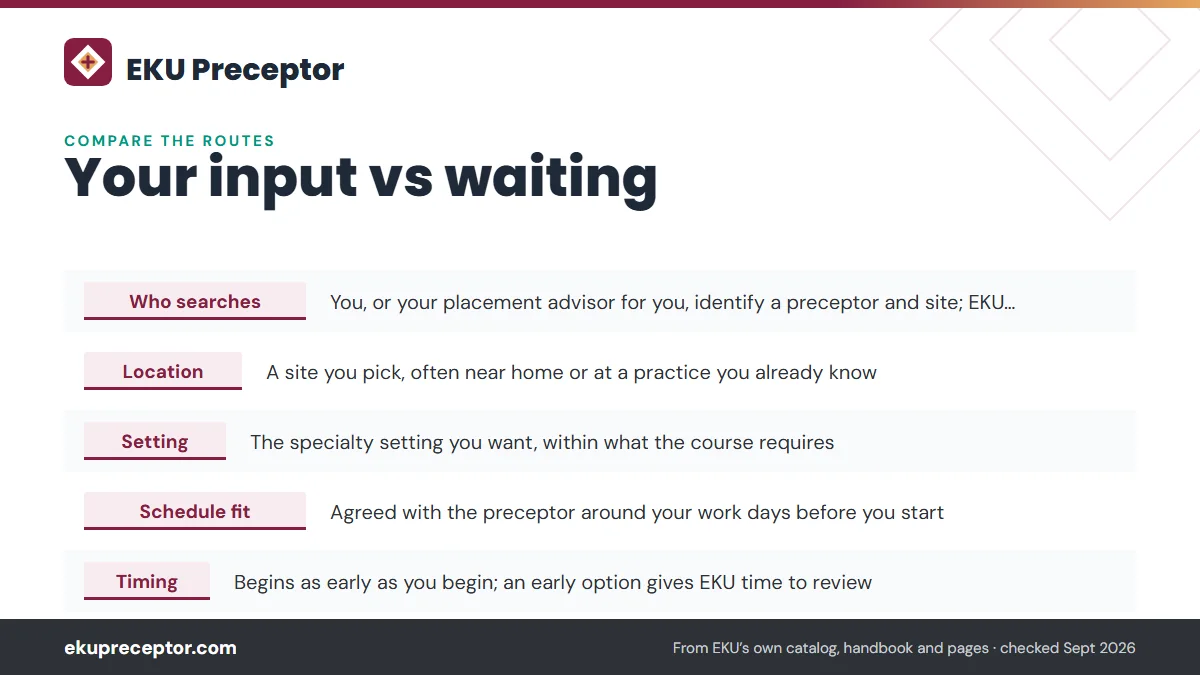
| Putting your own option forward | Leaving the search to EKU | |
|---|---|---|
| Who searches | You, or your placement advisor for you, identify a preceptor and site; EKU reviews and approves | EKU identifies and secures the preceptor and site |
| Location | A site you pick, often near home or at a practice you already know | Where EKU has a suitable preceptor; ask your faculty how location is weighed |
| Setting | The specialty setting you want, within what the course requires | A setting that fits the course among the options EKU secures |
| Schedule fit | Agreed with the preceptor around your work days before you start | Set by the preceptor EKU secures, with you adjusting to it |
| Timing | Begins as early as you begin; an early option gives EKU time to review | Follows EKU's internal timeline, which is not published |
| What you do | Gather preceptor and site details, complete EKU's preceptor information form, meet site requirements | Keep your compliance documents current, meet site requirements, respond when EKU confirms |
Putting a preceptor forward does not transfer Kentucky's duty to you. EKU still secures and approves the placement; you have simply told it where you would like to train.
Who leaving it to EKU suits
Leaving the search to EKU is the rule's default, and for some students it is the natural choice. It suits you if your schedule can bend around a preceptor's clinic days, if you are comfortable traveling within reason, and if you have no strong preference about the practice or setting as long as it fits the course.
It also suits students who do not yet know the local practices, perhaps because they recently moved, work in a setting far from primary care or psychiatry, or simply prefer to let the program handle the match. The trade-off is control: you learn where and when you will train once EKU confirms it, and you plan your work and family life around that answer.
Who putting an option forward suits
Offering your own option suits students whose lives have fixed points. A nurse on a set rotation needs clinical days that fall on days off. A parent needs a site within a reasonable drive. A student living far from Kentucky knows the practices in their own region better than any outside list can capture.
It also suits students with a clear clinical goal: an FNP student who wants a rural primary care practice ahead of NSC 876, which EKU describes as a rural primary care practicum, or a PMHNP student who wants one psychiatric practice from NSC 800 through NSC 886. And it suits students whose own employer could host them in a different role, which one EKU FNP graduate described in a 2021 EKU Online story; our page on clinicals where you work explains what makes that work.
Why many working nurses use their input with our help
EKU's 2021-22 MSN handbook was direct about the load: "extensive clinical practice hours are required," and students were told to weigh them when deciding on employment. For a working nurse, the question is rarely whether to do the hours but whether the days can be predicted months ahead. A preceptor chosen around your schedule answers that question before the course starts.
Doing it well takes time most working nurses do not have: calling practices, confirming the preceptor's specialty and license, checking the site's screening and contract needs, and assembling the details for EKU's form. That is the work your placement advisor takes on. We search your area, match the preceptor to your exact EKU course, prepare everything for your input, keep a backup in view, and stay on call through the internship. EKU makes the decision; you arrive with a strong, complete option. See how it works or start with the form below.
Questions EKU students ask
Is it a problem if I never suggest a preceptor to EKU?
No. Kentucky's regulation says no student can be required to obtain a preceptor, so leaving the search to EKU is a normal route rather than a fallback. You can still share preferences with your faculty, such as your location or the days you can train, without naming anyone.
Can I switch from waiting to proposing partway through?
EKU publishes no cutoff for offering input, so ask your faculty. The practical limit is time: the 2021-22 handbook expected the preceptor form to be up to date before each semester's clinical practice. An option raised a term ahead of a clinical course has room to be reviewed; one raised in week one has far less.
Is a preceptor I propose approved faster than one EKU finds?
EKU publishes no approval times for either route, so no honest answer can promise speed. What helps any proposal is completeness: a preceptor in the right specialty, a clean license, a site ready to meet its contract and screening needs, and every detail EKU's form asks for, all ready before the term begins.
Does putting my own option forward cost more?
Using a service is your choice. If you ask us to run the search and prepare the details, our fee covers that work, and the cost page explains what shapes it. EKU's own requirements apply on both routes: professional liability insurance purchased through EKU, and any screening a clinical site asks for, which EKU's catalog says is at the student's expense.
What if the preceptor I propose falls through?
Tell your clinical faculty right away. Because Kentucky's rule leaves the duty to secure a preceptor with EKU, a proposal that falls through does not leave you on your own. If you are working with us, your placement advisor finds a replacement and prepares it for EKU's review while EKU's own process continues.
Related pages
Last checked 2026-09-25
We check these pages against EKU's own catalog, program pages and handbooks, and Kentucky's regulations. The current MSN Student Handbook, your course and your faculty have the final word.
EKU secures your preceptor. Your input decides how well it fits your life.
Tell us your EKU program, where you live and when your next clinical course starts. We find preceptors in your community who fit the course and prepare everything EKU reviews, so the option you put forward is ready to approve.
- Preceptors matched to the course: family primary care for
NSC 800andNSC 876, psychiatric care forNSC 886 - Preceptor, license and site details organized for EKU's preceptor information form
- In your own community, wherever EKU enrolls students and you hold your RN license
Start your placement plan
Program, city and start date is all we need to begin.