NSC 876 FNP Internship: EKU's rural primary care finish
NSC 876 FNP Internship closes out EKU's FNP clinical sequence: 6 credits that the catalog describes as a concentrated rural primary care practicum. It is where the final 300 of your 750 hours most likely fall, and it calls for a primary care preceptor who can take you for a long, steady stretch. Line that preceptor up a full semester ahead.
Get your placement plan
Tell us your EKU program and where you live. A placement advisor replies with preceptor and site options in your community that fit your EKU course.
What EKU says the internship is
EKU's course description says NSC 876 “allows synthesis” of the program's learning “in a concentrated rural primary care practicum.” Each of those words tells you something practical about the semester ahead.
Concentrated means denser than the NSC 800 blocks that came before. You carry more clinic days per week, often with one preceptor, for the whole course. Rural signals the setting EKU has in mind, in keeping with the program it still markets as Rural Health FNP; EKU's rural focus explains where that emphasis shows up. Primary care means a family practice population across ages rather than a specialty clinic.
The course carries 6 credits in the 2026-27 catalog, up from 5 in the 2021-22 MSN handbook. The archived handbook also listed the FNP Telehealth Checklist for this course, so telehealth likely plays some defined part. Ask your faculty how, since the checklist's contents are not public.
The final 300 hours
EKU states that FNP graduates finish with 750 direct patient care hours and that the last 300 are for synthesis. EKU does not print an hour count for NSC 876 itself. We read the internship as the home of those 300 hours because it comes last, requires every earlier clinical credit, and is described in the catalog in terms of synthesis. The 750-hour page walks through that reasoning and the weekly arithmetic.
The short version for planning: EKU's archived 2022 plans ran the internship over 16 weeks, and 300 hours across 16 weeks is close to 19 hours a week. In a primary care clinic that usually means two full days, every week, with no quiet stretch in the middle of the term.
If the term ends before your hours do, EKU's catalog allows an In Progress (IP) grade for approved courses such as practicums, but an IP in a practicum or internship has to be finished within the calendar year or it turns into an NC grade.
Prerequisites, and one that looks out of date
The catalog lets you into NSC 876 only after the full clinical sequence. The listed requirements are:
NSC 870FNP I,NSC 872FNP II andNSC 874FNP III- “eight hours of NSC 800”, meaning all 8 credits of the Advanced Practice Role
NSC 842Advanced Nursing Practice Issues, as a prerequisite or corequisite
The last item is the problem. NSC 842 has dropped out of the MSN core, replaced there by NSC 843, NSC 857 and NSC 855, so the internship entry appears not to have been updated. Ask your advisor how registration handles it before your internship term, and keep the answer in your myMail.
Grades matter here as well. Every required course needs at least a B under the current catalog, and the archived handbook added that each practicum or internship must be graded satisfactory.
Settings that fit a rural primary care practicum
The strongest internship sites are primary care practices that see a broad family caseload and run full clinic days. In rural areas that typically means:
- Rural health clinics, small primary care practices built for rural communities
- Federally qualified health center sites, many of them in small towns, seeing patients of every age
- Clinics tied to critical access hospitals, the small rural hospitals that anchor care in many counties
- Independent family practices in small towns, where an NP or physician may be the main provider for the area
EKU does not publish a definition of rural for the internship. If you live in a city or suburb, ask your faculty before you commit whether your proposed site meets the course's expectations, or whether a site in a nearby rural county would serve better. That one question can save a semester of rework.
Confirm that your internship site counts as rural primary care for EKU's purposes before you settle on it. The course description sets the expectation, and only your faculty can say how it applies to your site.
Planning the internship preceptor early
The internship is the hardest placement to find late: it needs a preceptor with room for a concentrated schedule across a full semester, often in a small practice where agreements take time.
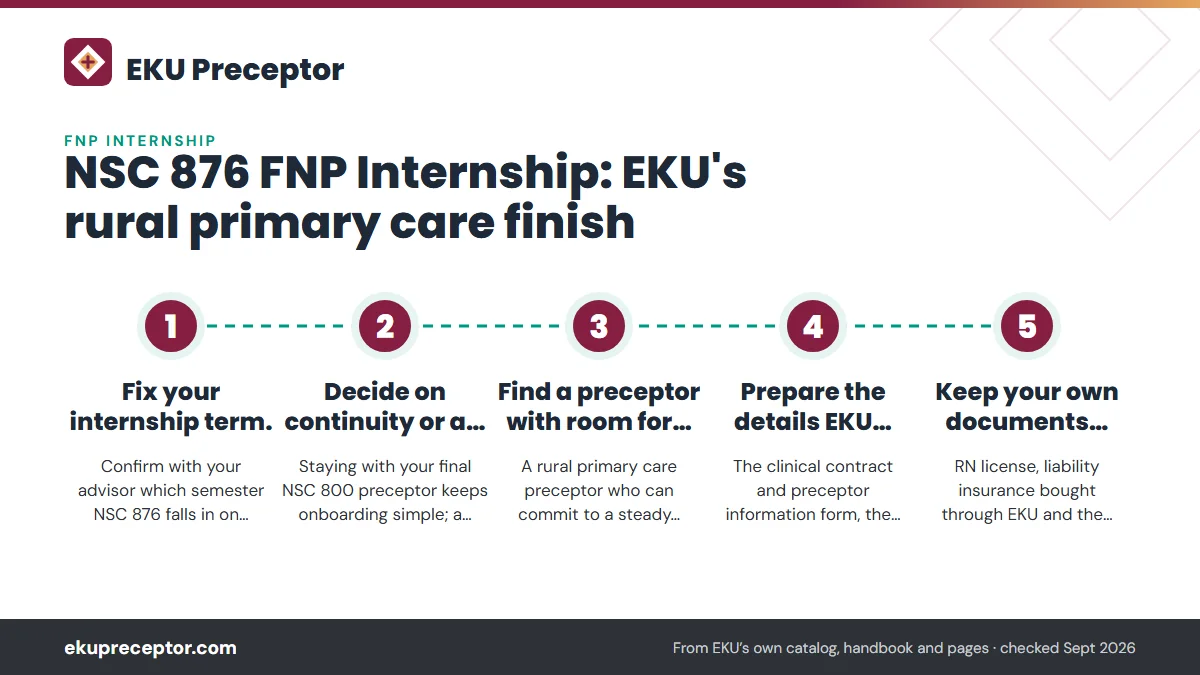
- Fix your internship term.Confirm with your advisor which semester
NSC 876falls in on your plan of study. - Decide on continuity or a new site.Staying with your final
NSC 800preceptor keeps onboarding simple; a new rural site may fit the course description better. Ask your faculty which they prefer for you. - Find a preceptor with room for two days a week.A rural primary care preceptor who can commit to a steady schedule for the whole term, including any holidays that fall inside it.
- Prepare the details EKU reviews.The clinical contract and preceptor information form, the site's own documents and any agency agreement. Agency agreements explains why these take time.
- Keep your own documents current.RN license, liability insurance bought through EKU and the Telehealth Checklist, presented before clinical work begins.
Why FNP students bring us in for the internship
Kentucky's regulation for APRN programs assigns EKU the task of securing preceptors and keeps room for your input; the Kentucky rule page sets out the text. For the internship, that input carries weight: you know where you can drive twice a week for 16 weeks and which rural clinics serve your area.
We turn that local knowledge into a complete proposal. A placement advisor locates a rural primary care preceptor near you with the schedule the internship needs, gathers what EKU needs about the preceptor and the site, and stays on call through the term, with a replacement lined up fast if anything changes. EKU makes the approval decision; our job is to hand it a complete, well-fitted option early. Start through the request form during your last NSC 800 enrollment, or sooner.
Questions EKU students ask
Is EKU's FNP Internship completed in one semester?
In EKU's archived 2022 curriculum plans, NSC 876 ran as a single 16-week course at the end of the program. The current catalog lists it as one 6-credit course. Your plan of study shows the current timing, and your faculty can say whether a split or extended schedule is ever allowed.
Do I have to complete NSC 876 in Kentucky?
EKU enrolls online FNP students from many states, and its catalog asks you to tell the university where any supervised clinical work outside Kentucky will happen. A handful of states carry restrictions on EKU clinicals, so check EKU state authorization before you settle on a site across a state line.
Can a physician be my NSC 876 preceptor?
Kentucky law allows it: the APRN program regulation counts physicians as preceptors alongside APRNs and physician assistants. EKU's own preferences for the internship, such as whether it favors an NP, are not public. If your best rural option is a family physician, raise it with your faculty early.
Can I do my FNP internship at the clinic where I work?
EKU has published a graduate's account of doing clinicals where she worked, but no current MSN rule on employer sites is public, including whether a different unit or supervisor is needed. See clinicals where you work and confirm your plan with your faculty.
What if my internship preceptor cancels right before the term?
Tell your clinical faculty at once, because a replacement needs EKU's approval before you start and a late start squeezes a concentrated course. Having a backup rural practice in mind helps. We line up a replacement and get its paperwork ready fast, so EKU's review can start right away.
Related pages
Last checked 2026-09-25
We check these pages against EKU's own catalog, program pages and handbooks, and Kentucky's regulations. The current MSN Student Handbook, your course and your faculty have the final word.
EKU secures your preceptor. Your input decides how well it fits your life.
Tell us your EKU program, where you live and when your next clinical course starts. We find preceptors in your community who fit the course and prepare everything EKU reviews, so the option you put forward is ready to approve.
- Preceptors matched to the course: family primary care for
NSC 800andNSC 876, psychiatric care forNSC 886 - Preceptor, license and site details organized for EKU's preceptor information form
- In your own community, wherever EKU enrolls students and you hold your RN license
Start your placement plan
Program, city and start date is all we need to begin.