EKU's 750 FNP hours, and what the last 300 are for
EKU's FNP program page promises that graduates will have “obtained 750 direct patient care hours, the last 300 of which allow synthesis of all prior clinical and didactic courses.” EKU does not publish how those hours divide by course. Our reading of the catalog puts about 450 in NSC 800 and 300 in NSC 876, and we label that clearly as inference. Below: what the sentence means, where the hours fall in the calendar, and how to fit them around a job.
Get your placement plan
Tell us your EKU program and where you live. A placement advisor replies with preceptor and site options in your community that fit your EKU course.
Reading EKU's sentence closely
The 750-hour line sits in EKU's list of what FNP graduates will have achieved, so it reads as a program outcome rather than a course rule. In practice it works as your target: every clinical course you take is building toward it.
“Direct patient care” means time spent caring for patients under your preceptor. EKU does not say whether telehealth visits, observation days or simulation count toward it. The archived 2021-22 MSN handbook does list an FNP Telehealth Checklist for NSC 800 and NSC 876, which suggests telehealth has a defined place in those courses, but its contents are not public, so ask before you count a single virtual visit.
“The last 300 … allow synthesis” describes the end of the program, when you pull pharmacology, assessment, pathophysiology and FNP I through III together and manage patients with more independence. Those hours come last in the sequence, after every earlier clinical block, and that ordering is what makes them synthesis hours.
“All prior clinical and didactic courses” is a reminder that the final stretch assumes the earlier work is done. The internship's prerequisites, covered on the NSC 876 page, enforce that order.
How the 750 likely divide: our inference
EKU publishes no hour count for individual courses and no ratio of clock hours to credits. What it does publish lets you make a reasonable estimate, as long as you treat it as an estimate.
| Course | Credits (2026-27 catalog) | Hours, our inference | Why we read it this way |
|---|---|---|---|
NSC 800 Advanced Practice Role, taken with FNP I, II and III | 8 in total | About 450 | 750 minus the final 300 |
NSC 876 FNP Internship | 6 | About 300 | The catalog calls it the synthesis course, and it comes last |
| Total | 14 clinical credits | 750 | Stated by EKU |
Notice that the estimate does not divide evenly by credit: 300 hours over 6 credits works out to 50 per credit, while 450 over 8 comes to about 56. That is one more sign the split is a model, not a rule. Your syllabus for each course sets the real number, and the NSC 800 page explains how that course is built.
The 450 and 300 split is our reading of EKU's catalog, not a number EKU prints. Use it to plan, then confirm each course's count with your faculty.
Where the hours fall in the calendar
EKU's core courses run in 7-week terms, with 6-week terms in summer, as the terms page explains. The clinical courses have not followed that rhythm. EKU's archived 2022 FNP sample curriculum plans ran every clinical block across a full semester.
Those plans broke NSC 800 into three registrations: a 2-credit block paired with FNP I across 16 weeks, a 3-credit block squeezed into a 12-week summer, and a final 3-credit block paired with FNP III across another 16 weeks. NSC 876 followed over another 16 weeks. That adds up to roughly 60 weeks of clinical time. EKU's academic calendar confirms the frame: fall and spring semesters run 16 weeks and summer runs 12.
Start term changed the length of those plans: seven semesters for a spring entry, eight for fall, nine for summer. EKU no longer posts them, and the catalog has changed since, so ask your advisor for your current plan of study and map your clinical semesters from that.
Weekly hours: a planning estimate
If hours track credits within NSC 800, which EKU does not state, the archived block lengths give a rough weekly picture. Every number in this table is our arithmetic.
| Block | Weeks | Hours if they track credits | Average per week |
|---|---|---|---|
NSC 800, 2 credits with FNP I | 16 | About 112 | About 7 |
NSC 800, 3 credits in summer | 12 | About 169 | About 14 |
NSC 800, 3 credits with FNP III | 16 | About 169 | About 10 to 11 |
NSC 876 FNP Internship | 16 | About 300 | About 19 |
Two patterns stand out. The summer block is dense because it packs 3 credits into 12 weeks, and the internship roughly doubles the early load. Primary care clinics tend to schedule students by the day, so 19 hours a week usually means two full clinic days, every week, for a whole semester.
Fitting 750 hours around a job
EKU raises this before you are even admitted: the FNP application asks for your specific plans for life changes that will let you meet class and clinical demands in a fully online program. The archived MSN handbook adds that extensive clinical hours are required and asks students to weigh them when deciding how much to work.
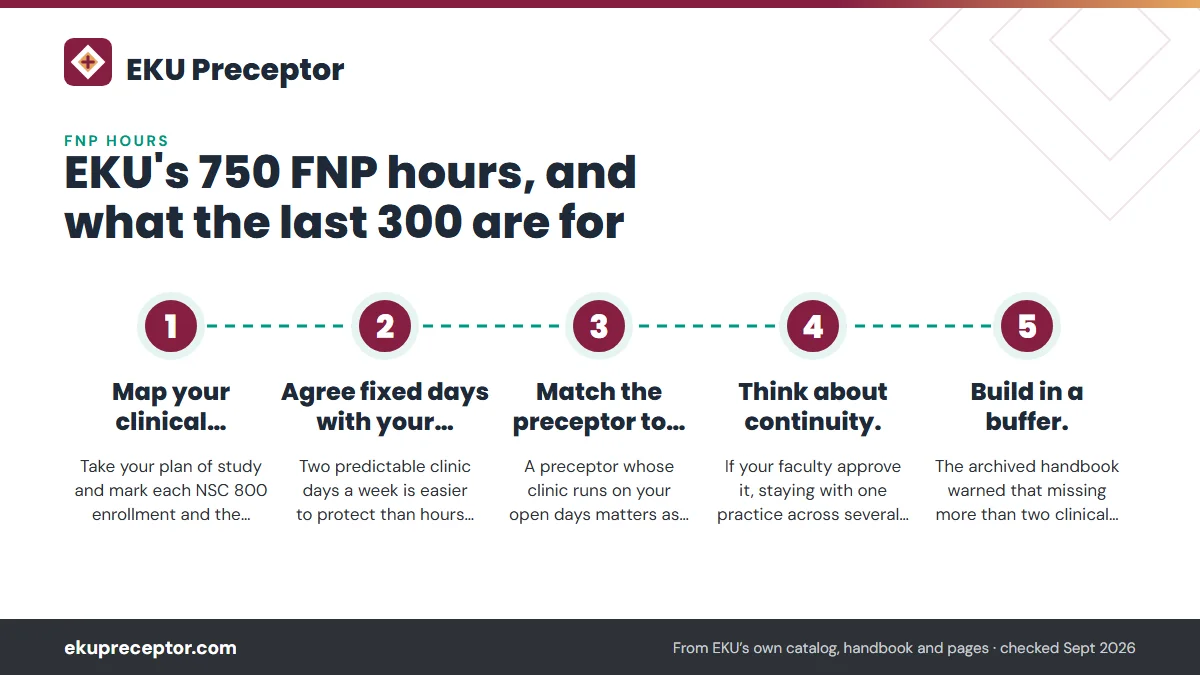
- Map your clinical semesters.Take your plan of study and mark each
NSC 800enrollment and the internship term. Those are the semesters your work schedule has to flex. - Agree fixed days with your employer early.Two predictable clinic days a week is easier to protect than hours scattered across the week, especially for the summer block and the internship.
- Match the preceptor to those days.A preceptor whose clinic runs on your open days matters as much as the location. This is where your input counts most.
- Think about continuity.If your faculty approve it, staying with one practice across several
NSC 800blocks saves repeated onboarding. Plan separately for a rural primary care internship site. - Build in a buffer.The archived handbook warned that missing more than two clinical experiences could mean failure, so leave room for a sick day or a closed clinic.
Getting the right preceptor behind your hours
Kentucky's regulation places the duty to secure preceptors on EKU, and it also protects your input into the process; the Kentucky rule page has the exact wording. That say is what lets you steer your 750 hours toward a clinic near home that runs on days you can keep. Using your input well covers the approach.
We do the finding for you. Your placement advisor searches your community for a family practice or rural primary care preceptor whose clinic days fit your job, assembles everything EKU's preceptor information form calls for, and stays on call if a preceptor drops partway through a block. EKU reviews and approves every option; what reaches it from us is complete and fits its rules on the first pass. Start with the request form a full semester before your first NSC 800 enrollment.
Questions EKU students ask
Is 750 hours the minimum or just a target for EKU FNP students?
EKU words it as an outcome every FNP graduate will have reached, so treat it as the requirement. Your individual clinical courses set their own counts inside that total, and those counts appear in each syllabus. If a syllabus figure seems to fall short of or exceed your share of 750, ask the course faculty before the term begins, not at the end.
Do EKU's FNP hours have to include pediatrics and women's health?
EKU does not publish a breakdown of FNP hours by age group or population. The FNP is a family, across-the-lifespan role, so a preceptor in a family practice that sees children, adults and older patients covers the most ground in one place. Ask your faculty whether any course expects a set share of pediatric or women's health visits.
Can I split my FNP clinical hours across more than one site?
EKU publishes no rule against it. Each preceptor and site goes through EKU's review, and the archived handbook required a current clinical contract and preceptor information form plus any site-specific documents each semester. More sites mean more paperwork and more onboarding, so most students aim for one strong primary care site per block.
Does the post-MSN FNP certificate also need 750 hours?
EKU does not state an hour total on the certificate page. The certificate does require the same clinical courses and credits as the MSN FNP, 8 credits of NSC 800 and the 6-credit NSC 876, and EKU holds certificate students to MSN policy, so 750 is the likely figure. Confirm it in your plan of study.
Do hours in the advanced health assessment course count toward the 750?
EKU publishes no clinical hours for NSC 832 Advanced Health Assessment. It sits before the clinical sequence as a prerequisite, and the archived handbook added a separate mastery check in the semester before NSC 800. The 750 direct patient care hours build from NSC 800 onward.
Related pages
Last checked 2026-09-25
We check these pages against EKU's own catalog, program pages and handbooks, and Kentucky's regulations. The current MSN Student Handbook, your course and your faculty have the final word.
EKU secures your preceptor. Your input decides how well it fits your life.
Tell us your EKU program, where you live and when your next clinical course starts. We find preceptors in your community who fit the course and prepare everything EKU reviews, so the option you put forward is ready to approve.
- Preceptors matched to the course: family primary care for
NSC 800andNSC 876, psychiatric care forNSC 886 - Preceptor, license and site details organized for EKU's preceptor information form
- In your own community, wherever EKU enrolls students and you hold your RN license
Start your placement plan
Program, city and start date is all we need to begin.