How the placement desk works with EKU nursing students
Kentucky gives EKU the duty to secure nurse practitioner preceptors and gives you a say in who and where. Our work lives inside that say. We find a preceptor near you who suits the exact EKU clinical course, assemble the details EKU asks for, and stay with you until the course's hours are complete.
Start with your EKU course
Your program, your town and the term your next clinical course opens.
Where our work sits in EKU's process
Because EKU is a Kentucky school, a Kentucky Board of Nursing regulation, 201 KAR 20:062, governs how preceptors for its nurse practitioner students are arranged. It places responsibility for securing preceptors on the program and allows each student input into the process.
Input is the part we serve. Many EKU students already know what they want: a clinic close to home, a psychiatric practice in their own county, clinical days that miss their shifts. We turn that preference into a named preceptor and a full set of details, which you share through EKU's own channels. EKU still secures and signs off on the placement. The Kentucky rule guide walks through the regulation itself.
The six steps, from first message to last clinical day
Every EKU student moves through the same six steps, whether the next course is NSC 800, an internship, a DNP experience course or the RN to BSN clinical.
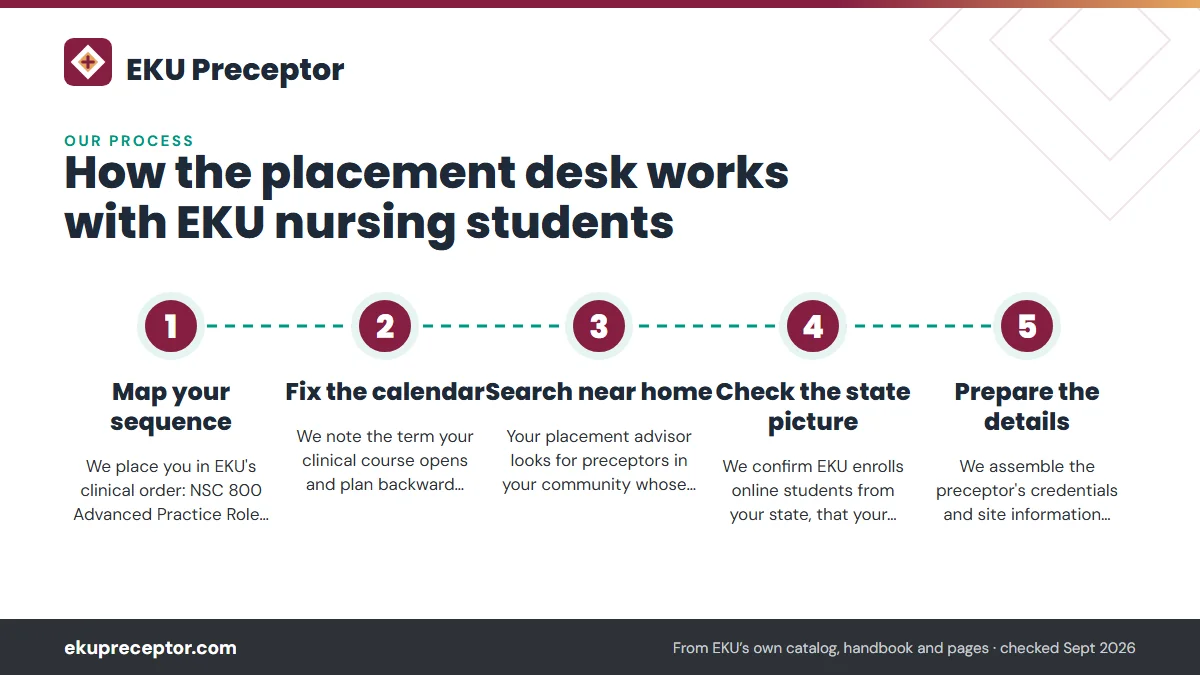
- Map your sequenceWe place you in EKU's clinical order:
NSC 800Advanced Practice Role taken alongside FNP I to III or PMHNP I to III, thenNSC 876orNSC 886. DNP students start from the hours EKU set at admission; RN to BSN students start fromNSC 442C. - Fix the calendarWe note the term your clinical course opens and plan backward, allowing for the semester before
NSC 800, when EKU's most recent available handbook expected mastery of advanced health assessment. - Search near homeYour placement advisor looks for preceptors in your community whose practice matches the course, then checks specialty, license, clinic hours and the drive.
- Check the state pictureWe confirm EKU enrolls online students from your state, that your RN license is valid where the site sits, and whether EKU's state notes add a condition.
- Prepare the detailsWe assemble the preceptor's credentials and site information for the clinical contract and preceptor information form, or for a DNP site approval request, so what you submit is complete.
- Stay on callOnce clinical days begin, we remain a message away. If a preceptor's plans change, a replacement search starts the same day.
What each EKU clinical course asks of a preceptor
The course number decides the search. A family practice that suits NSC 800 may be the wrong place for a psychiatric internship, so we match each course on its own terms, using EKU's 2026-27 catalog.
| EKU course | Credits (2026-27 catalog) | Setting we look for |
|---|---|---|
NSC 800 with FNP I to III | 8 in total | Family primary care |
NSC 876 FNP Internship | 6 | Primary care, which EKU frames as a concentrated rural practicum |
NSC 800 with PMHNP I to III | 8 in total | Psychiatric and mental health services |
NSC 886 PMHNP Internship | 5 | Psychiatric and mental health services |
NSC 900 and NSC 901 DNP Experience I and II | 1 to 3 each | A host organization for your DNP project |
NSC 442C Complex Health Systems Clinical | 2.5 | A healthcare setting for the RN to BSN clinical project |
On hours, EKU says FNP graduates finish with 750 hours of direct patient care and keeps the final 300 for synthesis. It publishes no split by course and no PMHNP total, and the clinical hours guide sets out what is public.
Timing around EKU's 7-week terms
EKU's online programs split each fall and spring semester into a pair of 7-week sessions for core courses, and summer into a pair of 6-week sessions. Clinical work has run longer: EKU's 2022-23 curriculum plans, now available only in archived form, spread NSC 800, NSC 876 and NSC 886 across 16-week blocks. A preceptor who can commit for a whole semester is worth more than one who can offer a few weeks.
On the 2026-27 calendar, fall classes began August 24, 2026 and spring classes begin January 25, 2027. Writing to us a term or two before your clinical course opens leaves room to find the right person, settle site onboarding and finish EKU's documents. Shorter runways still work, with a wider search radius. The 7-week terms guide explains the part-of-term codes in the Colonel's Compass.
Clearance we track while the search runs
A strong preceptor can still be held up by one lapsed document. While we search, we keep a list of what EKU and the site will expect, drawn from the 2026-27 catalog and the 2021-22 MSN Student Handbook, which is the newest edition EKU posted. Confirm the current version with your faculty.
- Professional liability insurance, purchased through the university, for any clinical practicum course, on a coverage year the handbook ran from August 15 to August 14.
- An RN license in good standing, with no encumbrance, in every state that licenses you, plus one valid where your site is.
- Nursys e-Notify enrollment, which the handbook tied to admission.
- Site extras such as drug screens, background checks and immunization records, which EKU's catalog places at the student's expense.
- A heads-up to EKU about the location of any clinical you complete beyond Kentucky's borders, which the catalog requires.
The compliance guide explains each item in depth.
If a clinical plan changes mid-course
Preceptors change jobs, clinics pause students and family life intervenes. When that happens, tell your placement advisor the same day. We restart the search near you, prepare the new preceptor's details and help you update your faculty, since any replacement passes through EKU's approval just as the first one did.
Speed matters because EKU treats clinical attendance seriously. The 2021-22 handbook asked students to alert the preceptor and the clinical faculty member no less than an hour before an absence, and warned that more than two missed clinical experiences could lead to a failing result. The attendance guide covers making time up.
The decision on every preceptor and site belongs to EKU. What we control is how ready your option is when it arrives.
Questions EKU students ask
Can one preceptor take me through both NSC 800 and my internship?
Possibly. EKU's public pages set no rule either way. The FNP internship centers on rural primary care and the PMHNP internship on psychiatric care, so a preceptor whose practice fits both stages can make sense. We plan the two together and flag anything to confirm with your faculty before you commit.
Who sends my preceptor's details to EKU?
You do, through EKU's own process: the preceptor information form (MSN and post-MSN certificate students), the site approval request for DNP students, and your faculty or the Clinical Placement Coordinator for questions. We prepare every detail you send, so the submission is complete the first time.
I live outside Kentucky. Does anything change?
Two things. EKU must enroll online students from your state, and it currently lists eight states it does not enroll MSN and post-MSN students from, including Tennessee and Mississippi. EKU's catalog also expects you to tell the university where supervised clinical work beyond Kentucky's borders will happen. We check both first. Your state guide has the details.
Can my clinicals happen where I work?
Sometimes. A 2021 EKU Online story quotes an FNP graduate who chose EKU partly so she could do clinicals where she worked, but no public EKU rule sets the conditions for MSN students. Read the workplace guide and check the specifics with your faculty before you build a schedule on it.
What if EKU asks for changes to the option I submit?
Tell your placement advisor exactly what EKU raised. We gather the missing detail, adjust the plan or line up another preceptor near you, and prepare the revised option quickly so your clinical start stays as close to schedule as possible.
Related pages
Last checked 2026-09-25
We check these pages against EKU's own catalog, program pages and handbooks, and Kentucky's regulations. The current MSN Student Handbook, your course and your faculty have the final word.
EKU secures your preceptor. Your input decides how well it fits your life.
Tell us your EKU program, where you live and when your next clinical course starts. We find preceptors in your community who fit the course and prepare everything EKU reviews, so the option you put forward is ready to approve.
- Preceptors matched to the course: family primary care for
NSC 800andNSC 876, psychiatric care forNSC 886 - Preceptor, license and site details organized for EKU's preceptor information form
- In your own community, wherever EKU enrolls students and you hold your RN license
Start your placement plan
Program, city and start date is all we need to begin.