EKU's NSC 886 PMHNP Internship and the psychiatric clinical sequence
NSC 886 PMHNP Internship is the 5-credit course that closes EKU's psychiatric clinical sequence, reached only after PMHNP III and the full run of NSC 800 Advanced Practice Role. Its catalog entry lists prerequisites that don't quite match the current program, and EKU posts no hour count for it. Here is what the catalog and EKU's most recent available plans show, and how to have a psychiatric preceptor ready in time.
Plan your NSC 886 preceptor
Tell us your internship term and where you live. Your placement advisor will map the psychiatric search to your plan of study.
Where NSC 886 sits in the PMHNP program
The internship is the last clinical course in EKU's MSN Psychiatric Mental Health NP concentration, a 49-credit program in the 2026-27 catalog, and it carries 5 of those credits. Every clinical day before it happens in NSC 800, the Advanced Practice Role course EKU pairs with each PMHNP course, so you arrive with a full run of psychiatric clinicals behind you.
Post-MSN students meet the same course. EKU's 34-credit post-MSN PMHNP certificate includes NSC 886 at 5 credits, and the catalog applies all MSN policies to certificate students, so the paperwork, grade and approval rules below cover both groups.
The path starts with NSC 830 Advanced Pharmacology, NSC 832 Advanced Health Assessment and NSC 834 Advanced Pathophysiology, each passed with a B, plus the health assessment mastery step EKU's archived 2021-22 handbook placed just before NSC 800. The health assessment guide explains that gate.
The psychiatric sequence, course by course
EKU's catalog note for the concentration ties the clinical course to the concentration courses: NSC 800 is taken concurrently with NSC 880, NSC 882 and NSC 884 until it reaches 8 credits. That makes three paired terms of theory plus clinical, then the internship.
| Course | Title | Credits | Clinical role |
|---|---|---|---|
NSC 880 | PMHNP I (co-requisite NSC 881) | 3 | Didactic; taken with NSC 800 |
NSC 881 | Applied Psychopharmacology | 3 | Didactic |
NSC 882 | PMHNP II (co-requisite NSC 800) | 3 | Didactic; taken with NSC 800 |
NSC 884 | PMHNP III | 3 | Didactic; taken with NSC 800 |
NSC 800 | Advanced Practice Role | 8 in total | Clinical, split across PMHNP I, II and III |
NSC 886 | PMHNP Internship | 5 | Clinical; hours not published |
EKU's 2023 PMHNP curriculum plans (archived copies) show the split in practice: 2 credits of NSC 800 over 16 weeks with PMHNP I, 2 with PMHNP II, 4 over 16 weeks with PMHNP III, then NSC 886 at 5 credits over 16 weeks. They predate the current catalog, so check your own plan of study. The NSC 800 guide explains how the clinical course runs.
Prerequisites, and two catalog lines that don't match
The NSC 886 course description sets three conditions: completion of NSC 884 PMHNP III, "seven hours of NSC 800", and NSC 842 as a prerequisite or co-requisite. The last two sit awkwardly beside the rest of the 2026-27 catalog.
- Seven hours against eight. The PMHNP concentration requires 8 credits of
NSC 800, but the internship entry asks for seven. EKU's 2021-22 handbook paired 7 credits ofNSC 800with a 6-credit internship; today's catalog has 8 and 5. The seven-hour line looks like a carryover, though EKU hasn't said so. - A course that left the core.
NSC 842Advanced Nursing Practice Issues is still named, yet the current MSN core listsNSC 843,NSC 855andNSC 857instead, andNSC 842is not required in either NP concentration.
Grades carry weight here too. The catalog requires a B or higher in all MSN coursework, and EKU's archived handbook treated an Unsatisfactory in a practicum or internship as grounds for dismissal. See the grades and progression guide.
Plan to finish all 8 credits of NSC 800 that the PMHNP program requires before the internship, whatever the course entry says, and ask your advisor how the NSC 842 line reads against your plan of study before you register.
What EKU asks for before internship days begin
EKU's most recent available MSN handbook (2021-22, archived) lists the documents a PMHNP student keeps current in every semester of NSC 800 or NSC 886, presented before clinical practice starts. EKU no longer posts that handbook, so confirm the present list with your faculty.
- An unencumbered RN license for every state in which you are licensed
- Professional liability insurance purchased through EKU
- The clinical contract and preceptor information form
- A Clinical Waiver form
- Whatever documents your internship site requires of students
The handbook's Telehealth Checklist is attached to FNP courses only, and EKU hasn't published whether video visits count toward psychiatric clinical time, so ask your faculty before building a schedule on telehealth days. The preceptor information form guide explains each document.
Choosing a psychiatric setting for the internship
Coming last, the internship is where you can take on the widest range of psychiatric patients your preceptor will hand you, so the best setting is one that fills a semester of clinic days with that range. Each common option brings something different:
| Setting | What it offers | What to check first |
|---|---|---|
| Outpatient psychiatric practice | Evaluations, medication management and follow-up across a steady panel | Enough clinic days a week to cover your hours |
| Community mental health center | Broad diagnoses, serious mental illness, often rural reach | Onboarding steps and the agency's student agreement process |
| Inpatient psychiatric unit | Acute presentations, admissions and discharge planning | Whether an NP or psychiatrist can precept on the unit's schedule |
| Substance use treatment program | Co-occurring disorders and addiction medicine | That a prescribing clinician will act as your preceptor |
| Telepsychiatry service | High visit volume across a wide area | How EKU counts telehealth time, before you commit |
Under Kentucky's APRN program regulation, the people who may precept are APRNs, physicians and physician assistants, so a psychiatric-mental health NP or a psychiatrist qualifies at the state level. EKU keeps its own rules on specialty match and experience out of public view, which means the check happens when EKU reviews the preceptor you put forward. The preceptor requirements guide covers what is known.
Kentucky prescribing and why your preceptor's practice matters
If you plan to practice in Kentucky, prescribing rules will shape your first PMHNP years, and the internship lets you watch them work. AANP classes Kentucky as a Reduced Practice state. Under KRS 314.042, a new APRN prescribes nonscheduled legend drugs through a written collaborative agreement with a Kentucky physician, the CAPA-NS, and Schedule II through V controlled substances through a second one, the CAPA-CS.
Four-year rules decide when they end. After four years of prescribing in a population focus, an NP notifies the Kentucky Board of Nursing and can drop the CAPA-NS; after four years under a CAPA-CS, an APRN can ask the Board to review an exemption. In a CAPA-CS's first year, APRN and physician meet at least quarterly to review the APRN's reverse KASPER report.
Psychiatric prescribing often involves controlled substances such as stimulants and benzodiazepines, so a Kentucky preceptor working under these agreements shows you the KASPER checks and reviews you will carry yourself. Licensing elsewhere? Read your own state's rules; the Kentucky guide and the other state guides cover each one.
How we line up your NSC 886 preceptor
Many PMHNP students already know where they want to finish: a clinic near home, a practice serving the patients they plan to treat, or a psychiatric service in their own health system. Kentucky's rule gives EKU the job of securing preceptors and gives you a say, and your placement advisor turns that say into a finished option. See the student input guide.
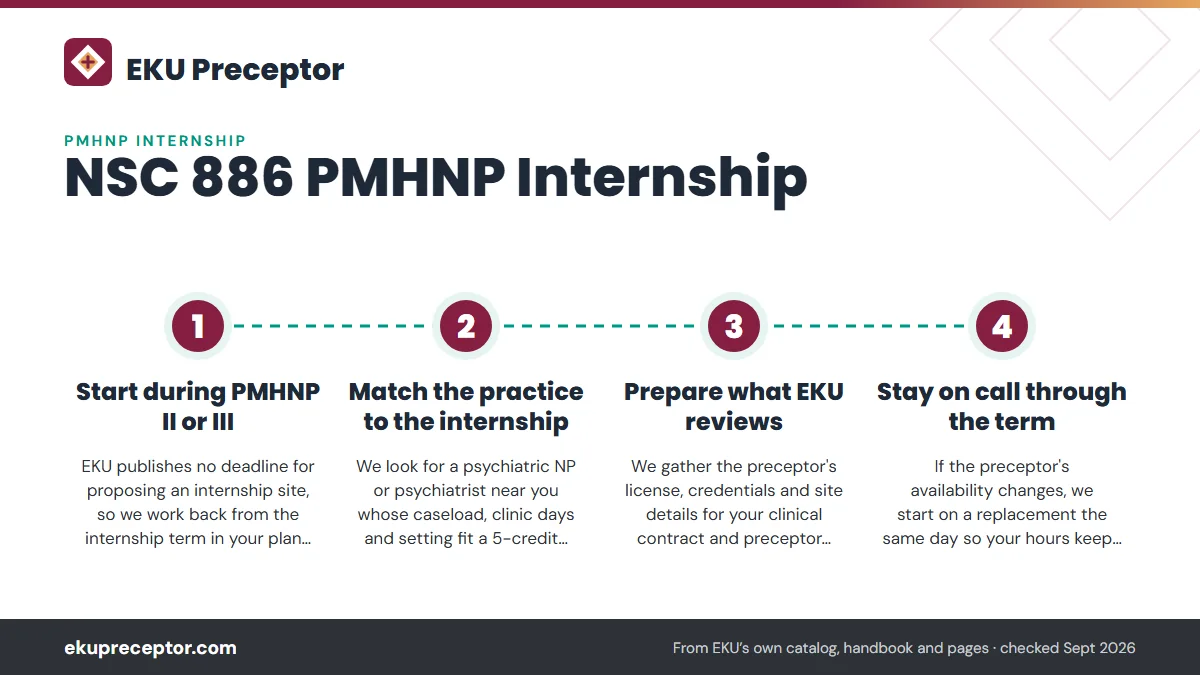
- Start during PMHNP II or IIIEKU publishes no deadline for proposing an internship site, so we work back from the internship term in your plan of study and begin early.
- Match the practice to the internshipWe look for a psychiatric NP or psychiatrist near you whose caseload, clinic days and setting fit a 5-credit internship and your work schedule.
- Prepare what EKU reviewsWe gather the preceptor's license, credentials and site details for your clinical contract and preceptor information form, complete on arrival.
- Stay on call through the termIf the preceptor's availability changes, we start on a replacement the same day so your hours keep moving.
Send your internship term and county through the form below to get the timing mapped.
Questions EKU students ask
How many clinical hours is NSC 886 at EKU?
EKU hasn't published an hour figure for NSC 886, and the PMHNP program as a whole has no posted total either. The catalog lists the internship at 5 credits, and EKU's archived 2023 plans ran it over 16 weeks. Your syllabus, plan of study and faculty hold the number; our PMHNP hours guide sets out what is public.
Can I start NSC 886 before finishing all 8 credits of NSC 800?
The internship entry names seven hours of NSC 800 as a prerequisite, but the PMHNP program requires 8 in total, taken with PMHNP I, II and III. Because the two catalog lines disagree, confirm with your advisor before registering rather than reading the lower figure as permission to start early. EKU's archived plans placed the internship after the final NSC 800 credits.
Does the post-MSN PMHNP certificate include the internship?
Yes. The 34-credit post-MSN PMHNP certificate includes NSC 886 at 5 credits, along with PMHNP I, II and III, Applied Psychopharmacology and 8 credits of NSC 800. EKU's catalog applies all MSN policies to certificate students, so the same documents, grade rules and preceptor approval steps govern your internship.
Can a psychiatrist precept my PMHNP internship?
Kentucky's regulation for APRN programs counts physicians, APRNs and physician assistants as preceptors, so a psychiatrist meets the state definition. EKU hasn't published its own specialty or experience rules for PMHNP preceptors, and EKU approves every preceptor and site, so check with your faculty that a physician preceptor suits the internship before asking one to commit a semester.
Is NSC 886 a 7-week course?
EKU's core courses run in 7-week sessions, but its most recent available PMHNP plans (2023, archived) scheduled NSC 886 across 16 weeks, like the larger NSC 800 blocks. Check the part of term for your section in the Colonel's Compass and your plan of study, because the length decides how many days a week your preceptor must offer.
Related pages
Last checked 2026-09-25
We check these pages against EKU's own catalog, program pages and handbooks, and Kentucky's regulations. The current MSN Student Handbook, your course and your faculty have the final word.
EKU secures your preceptor. Your input decides how well it fits your life.
Tell us your EKU program, where you live and when your next clinical course starts. We find preceptors in your community who fit the course and prepare everything EKU reviews, so the option you put forward is ready to approve.
- Preceptors matched to the course: family primary care for
NSC 800andNSC 876, psychiatric care forNSC 886 - Preceptor, license and site details organized for EKU's preceptor information form
- In your own community, wherever EKU enrolls students and you hold your RN license
Start your placement plan
Program, city and start date is all we need to begin.