Texas and EKU: enrollment, board rules and NP clinicals
Nothing on EKU's state authorization page holds a Texas nurse back: both licensure tables read Meets Requirements, EKU publishes no Texas nursing note, and the DNP is open. Texas aims its out-of-state approval machinery at schools preparing new nurses, which leaves an EKU NP student with two practical concerns: a preceptor who fits under restricted practice, and a license good in Texas.
Find a preceptor in your part of Texas
Give us your metro or county, your EKU program and your next clinical course, and your placement advisor starts there.
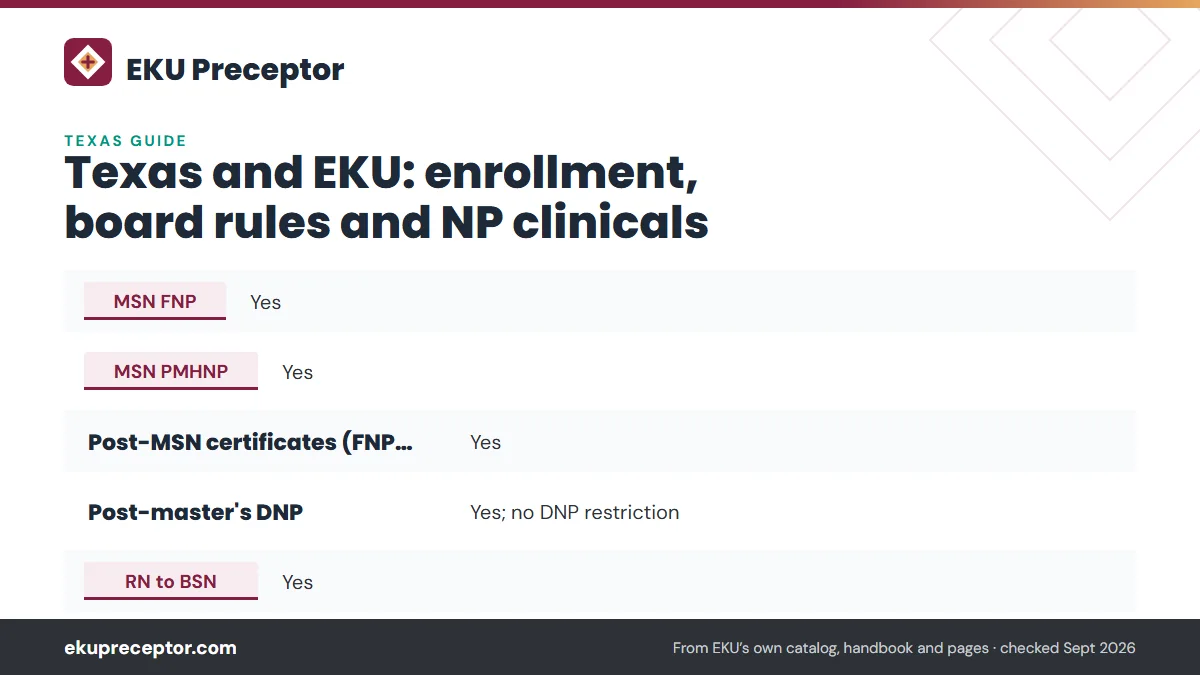
EKU's Texas status
| Program | EKU enrolls from Texas | Licensure table |
|---|---|---|
| MSN FNP | Yes | Meets Requirements |
| MSN PMHNP | Yes | Meets Requirements |
| Post-MSN certificates (FNP, PMHNP) | Yes | Meets Requirements, via the MSN table |
| Post-master's DNP | Yes; no DNP restriction | None published (not a licensure program) |
| RN to BSN | Yes | Meets Requirements |
Texas is on EKU's list of SARA member states without restrictions. The one duty EKU adds wherever you live sits in the graduate catalog: tell EKU the physical location of any supervised field placement outside Kentucky. The state authorization guide explains how EKU's tables work.
Texas BON approval rules and EKU students
Texas screens pre-licensure programs from other states closely. Sections 214.3(e) and 215.3(e) of the Board's rules, read with Education Guideline 3.1.3 (last revised May 1, 2026), make vocational and professional RN programs based in other states win Texas approval before their students start any clinical learning in Texas, even when the school takes part in NC-SARA, and the Board posts the programs it has cleared. Those rules leave out graduate nursing study and post-licensure RN to BSN study, which together cover everything EKU offers online in nursing.
Texas also has Chapter 219 for APRN education. It formally binds programs that want Texas approval, and nationally accredited programs such as EKU's, which CCNE accredits, sit outside that approval. The chapter still shows Texas's own expectations for APRN clinicals: APRN preceptors, or other currently licensed clinicians who can both supervise and teach, working under a written agreement among the program, the preceptor and the agency.
Restricted practice and preceptor fit
On AANP's map Texas is restricted: an NP there practices under physician delegation and supervision for the length of a career, bound by written protocols, and may prescribe Schedule II drugs only within limits tied to the practice setting. Your preceptor's prescribing therefore runs through a delegating physician, which is worth asking about before a PMHNP rotation.
Kentucky's regulation for APRN programs counts APRNs, physicians and physician assistants as preceptors, and EKU leaves course-by-course fit to your faculty. Kentucky law also assigns EKU the duty of lining up preceptors for its NP students, who may weigh in on the choice; the Kentucky rule shows how that input works from Texas.
Where Texas NP students look
Dallas-Fort Worth-Arlington, home to roughly 8.5 million, and the Houston-Pasadena-The Woodlands metro, near 7.9 million, far outsize the Austin and San Antonio metros, though each of those passes 2.6 million. Systems such as Houston Methodist, UT Southwestern Medical Center and Texas Health Resources, along with Baylor Scott & White Health and University Health in San Antonio, are named here only to orient a search, not as hosts for EKU students.
No Texas preceptor tax credit is on record, and the state's preceptor tuition exemption is limited to RNs precepting for public pre-licensure programs. Rural Texas practices can suit the NSC 876 FNP Internship; see EKU's rural health focus.
Your license for Texas clinicals
Texas nurses have held multistate compact licenses since the Nurse Licensure Compact started in Texas on January 19, 2018, and one of those licenses covers practice in other member states, Kentucky included. The APRN Compact has no Texas enactment. EKU's archived MSN Student Handbook (2021-22) asked for an unencumbered RN license in each licensing state, and your license has to be good wherever you train. Confirm the current wording with your faculty and read RN license and Nursys.
Why Texas EKU students pick us
In a state this size, distance decides whether a placement works. Your placement advisor searches inside your own metro or county, confirms the preceptor's Texas license and delegation arrangement, and puts together the preceptor and site file EKU asks for, so the option you put forward is ready for EKU's approval. Should a preceptor pull out mid-term, your advisor begins the hunt for a replacement at once. Request help.
Questions EKU students ask
Does EKU need to be on the Texas board's out-of-state program list?
Not for its online programs. The list shows out-of-state schools cleared to run clinical learning in Texas under the Board's pre-licensure rules, such as ADN and entry-level BSN programs. EKU's online nursing students are licensed RNs in post-licensure programs, which those approval rules do not cover. EKU's own rule on reporting placements outside Kentucky still applies.
Can a physician assistant precept my EKU NP clinicals in Texas?
Possibly. Kentucky's rule for APRN programs lists physician assistants with APRNs and physicians, and the Texas BON's APRN education standards accept other licensed clinicians who can both supervise and teach. EKU's own standards are not public and your faculty decide fit for each course, so ask before you put a PA forward.
Can I do EKU's RN to BSN clinical in Texas?
Yes. The RN to BSN table lists Texas as Meets Requirements, and the Texas BON's out-of-state approval rules do not reach post-licensure programs. The program's one clinical course is NSC 442C, and EKU has said RN to BSN students may complete the capstone clinical project at their current place of employment. See the RN to BSN clinical guide.
What does restricted practice mean for a PMHNP rotation in Texas?
Your Texas preceptor prescribes under physician delegation and written protocols, and Schedule II drugs follow the state's setting limits. For psychiatric care, that shapes how medication decisions are made during your NSC 886 hours. Ask a prospective preceptor how delegation works at the practice, and let your faculty confirm the setting fits the course.
Related pages
Last checked 2026-09-25
We check these pages against EKU's own catalog, program pages and handbooks, and Kentucky's regulations. The current MSN Student Handbook, your course and your faculty have the final word.
EKU secures your preceptor. Your input decides how well it fits your life.
Tell us your EKU program, where you live and when your next clinical course starts. We find preceptors in your community who fit the course and prepare everything EKU reviews, so the option you put forward is ready to approve.
- Preceptors matched to the course: family primary care for
NSC 800andNSC 876, psychiatric care forNSC 886 - Preceptor, license and site details organized for EKU's preceptor information form
- In your own community, wherever EKU enrolls students and you hold your RN license
Start your placement plan
Program, city and start date is all we need to begin.