How EKU clinical placement works, from Kentucky's rule to your internship
As a Kentucky APRN program, EKU is responsible for securing preceptors for its nurse practitioner students, and Kentucky law gives you a say in the process. Between admission and your internship come a few fixed steps: your preceptor details on EKU's form, EKU's review, insurance and compliance, a health assessment gate, NSC 800 and the internship. Here they are in order, with the guide that covers each one.
Plan your EKU placement
Tell us your EKU program, where you live and the term your first clinical course starts. Your placement advisor replies with a plan built around EKU's steps.
Who secures the preceptor, and where your input fits
Kentucky's Board of Nursing requires every Kentucky-based APRN program to secure the preceptors its students need, and it bars programs from making a student find one. EKU's FNP and PMHNP tracks sit under that rule. The same regulation lets students have input, and that is where your knowledge of your own community, your specialty and your work schedule comes in. The Kentucky preceptor rule page quotes the regulation and explains its reach.
EKU does not post a student-facing account of how it matches individual NP students with preceptors. That day-to-day detail sits with your faculty and in the current edition of the handbook enrolled students receive. What EKU's archived handbooks do show is a chain of documents and approvals that every clinical course passes through, and that chain is the path below. For advice on offering a preceptor of your own, see using your input.
The EKU path, step by step
Most steps trace to EKU's 2021-22 MSN Student Handbook, now only an archived copy, and the 2026-27 catalog; check each against the current edition.
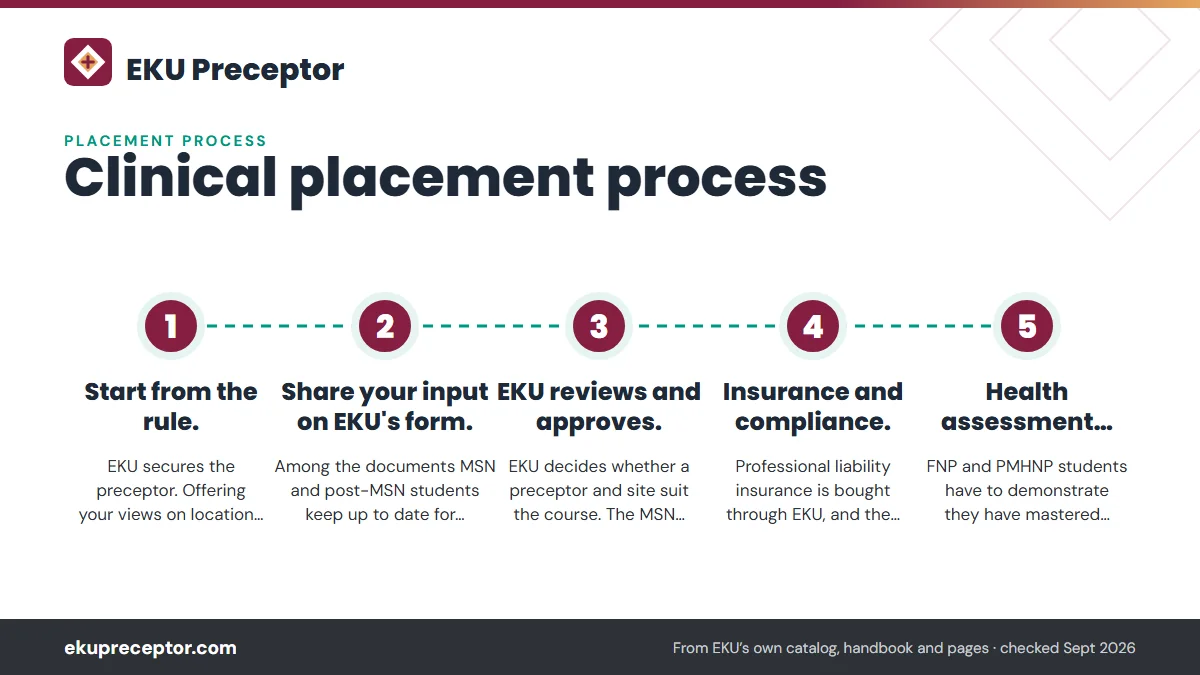
- Start from the rule.EKU secures the preceptor. Offering your views on location, setting and schedule is your choice, not your obligation.
- Share your input on EKU's form.Among the documents MSN and post-MSN students keep up to date for each clinical course, the handbook lists a "Clinical contract and preceptor information form". A preceptor or site you propose enters EKU's record here. See the preceptor information form guide.
- EKU reviews and approves.EKU decides whether a preceptor and site suit the course. The MSN handbook names a Clinical Coordinator; in the DNP, the Clinical Placement Coordinator emails each student cleared to begin. No public deadline exists, so ask your faculty when they want details.
- Insurance and compliance.Professional liability insurance is bought through EKU, and the receipt goes to faculty before any clinical experience. Add an unencumbered RN license in each state that has licensed you, Nursys e-Notify consent from admission, and the site's own requirements. More on liability insurance.
- Health assessment mastery.FNP and PMHNP students have to demonstrate they have mastered advanced health assessment and diagnostic reasoning during the term right before
NSC 800, with remediation and a second attempt available. See the health assessment gate. NSC 800Advanced Practice Role.The clinical course runs besideNSC 870,NSC 872andNSC 874(FNP) orNSC 880,NSC 882andNSC 884(PMHNP), 8 credits in all. See theNSC 800guide.- The internship.FNP students finish with
NSC 876FNP Internship, 6 credits of what the catalog terms "a concentrated rural primary care practicum". PMHNP students take the 5-creditNSC 886PMHNP Internship. TheNSC 876guide covers the final 300 FNP hours.
Before your first clinical day
The weeks before NSC 800 carry most of the work, and most of it is paperwork with a hard edge. The 2021-22 handbook had students show their clinical documents every term they were enrolled, ahead of any clinical practice, so one missing item holds up your start, not just your file.
Insurance runs on its own calendar. EKU's professional liability coverage ran from August 15 to August 14, was not pro-rated and was billed with tuition and fees. EKU's 2023 curriculum plans still list it as required for clinical practicum courses, so time the purchase to your first clinical term.
Clinical agencies add a layer of their own. EKU's catalog warns that a site may ask for drug screening, background and registry checks, fingerprinting, vaccination records and safety or privacy training certificates, paid for by the student, and that it can refuse a student who does not pass.
Health assessment mastery is a gate, not just a grade. Under the 2021-22 handbook, a student who failed the second attempt could not enter clinical courses and could be dismissed, so treat that semester as part of your placement plan.
NSC 800 and the internship, track by track
EKU's NP clinical time sits in two places: NSC 800 Advanced Practice Role, taken in pieces alongside the three didactic NP courses, and a final internship. The catalog sets the credits, and the FNP program page gives the one hour total EKU publishes.
| Track | Clinical course beside the didactic courses | Internship | Hours EKU publishes |
|---|---|---|---|
| MSN FNP | NSC 800 with NSC 870, NSC 872, NSC 874 (8 credits) | NSC 876, 6 credits, rural primary care practicum | 750 direct patient care hours, the last 300 for synthesis |
| MSN PMHNP | NSC 800 with NSC 880, NSC 882, NSC 884 (8 credits) | NSC 886, 5 credits | Not published |
| Post-MSN FNP certificate | Same as the MSN FNP | NSC 876, 6 credits | Not stated for the certificate |
| Post-MSN PMHNP certificate | Same as the MSN PMHNP | NSC 886, 5 credits | Not published |
EKU's own documents disagree on the split. In the 2021-22 handbook, the FNP track carried a 9-credit NSC 800 load with a 5-credit internship, and the PMHNP track 7 credits with a 6-credit internship. Even now, the NSC 886 prerequisite reads "seven hours of NSC 800" while the PMHNP program lists 8. Follow the current catalog and your plan of study. Archived EKU curriculum plans also ran clinical courses over 16 weeks, even though core courses use 7-week terms.
The DNP route: site approval comes first
EKU's post-master's DNP works on a different track. The catalog asks for documentation of at least 1,000 clinical hours completed beyond the BSN, with the hours still owed at EKU assessed when you are admitted. The DNP Student Handbook (revised June 2020, now archived) adds the approval step: every clinical course needs its own "Request for DNP Experience Site Approval Form", and nothing starts until the School of Nursing's Clinical Placement Coordinator emails approval.
Two timing rules in that handbook matter. No DNP Experience Hours count before the term opens or while onboarding paperwork is unfinished, and a student already onboarded at a site can flag a later request as continuing there. Each activity is recorded in a DNP Experience Log, and an EKU photo ID is worn on site. The Clinical Placement Coordinator page covers the approval role.
Where our help fits
Your placement advisor works inside this process. We find a preceptor and site in your own community that suit the course you are about to take, check specialty, license and site requirements against EKU's rules, and assemble everything the preceptor information form needs, so the option you offer is complete on its first submission. The approval of each preceptor and site remains EKU's.
We start early, ideally a term before your health assessment semester, and we stay on call through NSC 800 and the internship. Should a preceptor leave partway through, we source a replacement and ready it for EKU. For students outside Kentucky, we also check your state against EKU's state authorization rules and remind you to report where your clinicals will take place, which EKU's catalog asks of anyone with a field placement outside Kentucky. Start with the form below.
Questions EKU students ask
When should I start planning my EKU preceptor?
No published EKU deadline exists, so the practical marker is your health assessment term, which comes right before NSC 800. The 2021-22 handbook also wanted every clinical document, the preceptor form included, in order before clinical practice started. Starting a term or two earlier leaves room for site paperwork and a backup option.
Do EKU online NP students have to travel to Kentucky for clinicals?
None of EKU's online NP, certificate or DNP program pages calls for a campus visit. The graduate catalog even has students report where any out-of-state clinical placement will happen, which assumes many clinicals take place in students' home states. Where you live still matters, because EKU's state authorization page lists states it is not accepting online NP students from.
What if my preceptor cancels during NSC 800?
Tell your clinical faculty right away. Under the 2021-22 handbook, even a single missed clinical day needed notice to the preceptor and faculty at least one hour ahead. EKU does not publish a replacement procedure, and any new preceptor goes through EKU's approval just as the first did. If we are helping you, your placement advisor starts on a new option at once and gets it ready for EKU.
Is the process the same for post-MSN certificate students?
Largely, yes. EKU's catalog extends every MSN policy to post-graduate certificate students, and both certificates use the same NSC 800 credits and internships as the MSN tracks. One difference in the 2021-22 handbook: for certificate students who already held NP certification, the health assessment mastery requirement was decided case by case.
How long does EKU take to approve a preceptor or site?
EKU does not publish approval times. Its documents do show that approval comes before clinical time counts: a DNP student waits on the coordinator's email, and an MSN student's documents come before any clinical practice. Some sites also need a clinical contract with EKU, which adds time, so an early, complete proposal gives your start date the most room.
Related pages
Last checked 2026-09-25
We check these pages against EKU's own catalog, program pages and handbooks, and Kentucky's regulations. The current MSN Student Handbook, your course and your faculty have the final word.
EKU secures your preceptor. Your input decides how well it fits your life.
Tell us your EKU program, where you live and when your next clinical course starts. We find preceptors in your community who fit the course and prepare everything EKU reviews, so the option you put forward is ready to approve.
- Preceptors matched to the course: family primary care for
NSC 800andNSC 876, psychiatric care forNSC 886 - Preceptor, license and site details organized for EKU's preceptor information form
- In your own community, wherever EKU enrolls students and you hold your RN license
Start your placement plan
Program, city and start date is all we need to begin.