EKU's online DNP: post-master's, Organizational Leadership
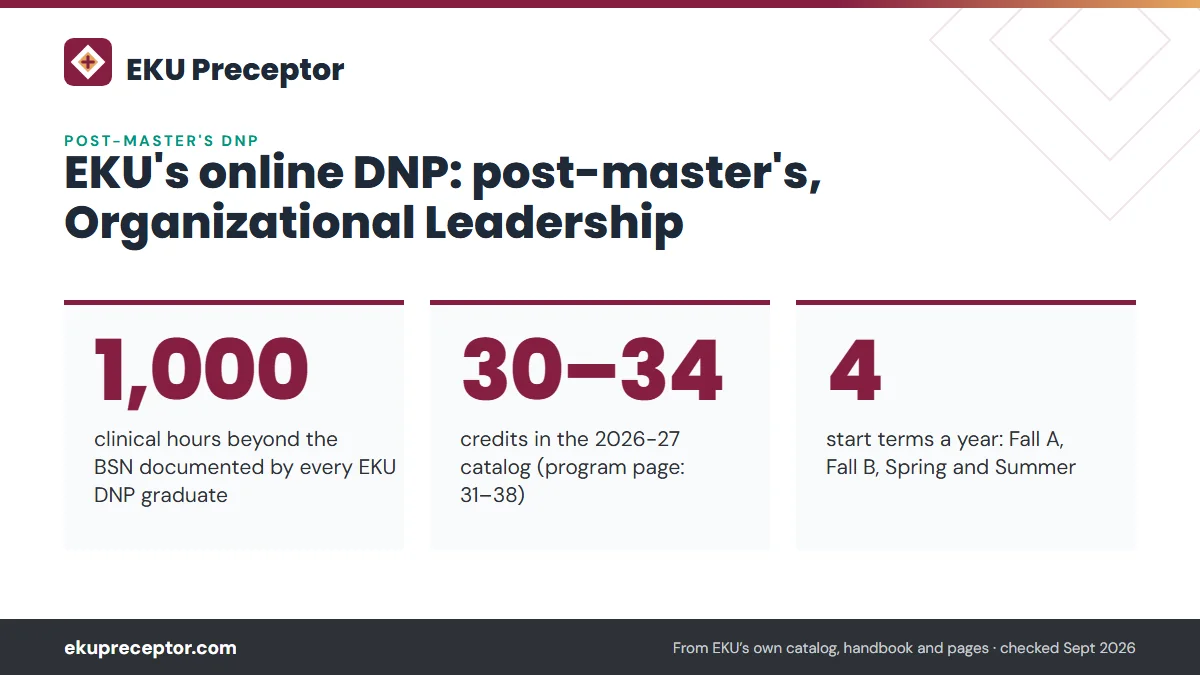
Eastern Kentucky University's Doctor of Nursing Practice is a post-master's program with one concentration, Organizational Leadership, taught online in accelerated 7-week terms with no campus visits. The catalog puts it at 30 to 34 credits while EKU's program page says 31 to 38, and every graduate needs documentation of 1,000 clinical hours beyond the BSN. Here is the whole program, from admission to the final project.
Plan your DNP practice site
Tell us your start term and the improvement project you have in mind. Your placement advisor will map the organization and approval timing.
The program at a glance
| Feature | EKU DNP |
|---|---|
| Route | Post-master's only; the 2026-27 catalog has no BSN to DNP route |
| Concentration | Organizational Leadership |
| Credits | 30–34 in the catalog; 31–38 on the program page |
| Format | Online, accelerated 7-week terms, no campus visits required |
| Starts | Fall A, Fall B, Spring and Summer |
| Clinical hours | 1,000 in total beyond the BSN; the share owed at EKU is set at admission |
| Final requirement | Complete and present a DNP project in NSC 994 |
| Accreditation | CCNE through December 31, 2028; Kentucky Board of Nursing approved |
EKU pitches the program on practicality: a project you can carry out where you already work or in your community, with individualized mentorship along the way. The archived 2020 DNP handbook described online classes with occasional synchronous sessions by web video conferencing and no on-campus class meetings. EKU's accreditation standing across programs is summarized in the accreditation guide.
Who EKU admits
EKU's DNP page and catalog agree on the core requirements:
- A master's degree in nursing, or in a related leadership or health field such as an MPH, MHA, MBA or MSc, from a nationally accredited program
- A BSN from an accredited program if your master's is not in nursing
- An unrestricted RN license from an approved state, plus an unrestricted APRN license if you hold one
- A graduate GPA of at least 3.0
- A DNP professional statement of no more than 750 words that includes a proposed improvement project
- A résumé or CV and three references; EKU may also ask for an interview
Give the proposed improvement project real thought. It is your first account of the change you want to make, it is likely to shape the project you carry through NSC 990, NSC 992 and NSC 994, and it points to the kind of organization where your clinical hours will happen. Applicants with a non-nursing master's should also read how hours are credited below, since it may change how much clinical time they owe.
Courses and credits
| Course | Title | Credits |
|---|---|---|
NSC 840 | Advanced Practice Nursing Theory | 3 |
NSC 843 | Healthcare Informatics and Resource Management | 3 |
NSC 855 | Population Health and Policy for Advanced Practice | 3 |
NSC 857 | Leadership, Quality and Safety for Healthcare Systems | 3 |
NSC 905 | Analytical Methods for EBP | 3 |
NSC 941 | DNP Project Seminar | 2 |
NSC 991 | Ethics in Research | 2 |
NSC 900 | Organizational Leadership: DNP Experience I | 1–3 |
NSC 901 | Organizational Leadership: DNP Experience II | 1–3 |
NSC 990 | DNP Project Development | 3 |
NSC 992 | DNP Project Implementation and Data Collection | 3 |
NSC 994 | DNP Project Analysis & Dissemination | 3 |
Four of these, NSC 840, NSC 843, NSC 855 and NSC 857, also sit in EKU's MSN core. The experience courses, NSC 900 and NSC 901, are where the organizational leadership practice happens, and the three project courses take your improvement project from design through data collection to dissemination.
30 to 34 or 31 to 38 credits: the conflict
EKU's two official descriptions disagree on length. The 2026-27 catalog lists the DNP at 30 to 34 credits, while the program page on eku.edu says 31 to 38. Neither source explains the gap, so the catalog, which sets EKU's requirements each year, is the safer reference.
What both sources share is that your total depends on you. The catalog adds that required hours will be individually evaluated on a planned program of study for each student, and the two experience courses carry 1 to 3 credits each. Treat your plan of study as the figure that counts, and ask your advisor to explain it if it falls outside the catalog's range. The same individual review decides the clinical hours you owe, covered next.
The 1,000-hour rule and your practice site
Every EKU DNP graduate has to show 1,000 or more clinical hours earned since the BSN. At admission EKU works out how many of those you still need and writes the result into your plan of study. EKU's archived 2020 handbook credited MSN hours where possible and required at least 200 hours at EKU; whether that floor still stands is something to confirm. The DNP clinical hours guide walks through the gap analysis, the log and the timing.
Hours also need an approved home. In the archived handbook, each clinical course begins with a Request for DNP Experience Site Approval Form, and hours start only once the Clinical Placement Coordinator's email arrives. For a DNP student the site is an organization where the improvement project can happen, whether that is your current employer or a new one. The Clinical Placement Coordinator guide explains who reviews those requests.
Where you can live and study
Because the DNP does not lead to a new license, EKU publishes no licensure table for it. The state notes on EKU's state authorization page still decide where it can enroll DNP students:
- Not accepting: Colorado, Louisiana and Washington, where EKU is not accepting nursing students into online programs, and Tennessee, where it is not accepting nursing students at this time.
- Not published: California, North Carolina, Oregon and Wisconsin. EKU's notes for these states don't settle DNP enrollment, so ask EKU before you apply.
- Conditions: Alabama and North Dakota, where EKU has to file notice and a state fee before any clinical placement; Maryland, where unpaid or low-paying placements must be approved before admission; Missouri, where site contracts must be short-term.
- Open, with notes: Massachusetts accepts EKU DNP students, New York exempts EKU to offer the DNP, and Mississippi is open for the DNP even though EKU's NP programs no longer enroll there; EKU hasn't said whether DNP practicum hours in Mississippi are affected.
EKU also warns that relocating after application or admission could lead to removal from a program, and asks students to tell their advisor before any move. The state authorization guide covers every EKU program state by state.
Start terms and the 7-week rhythm
| Start | Application deadline | Classes begin |
|---|---|---|
| Fall A | July 1 | August |
| Fall B | August 15 | October |
| Spring | November 1 | January |
| Summer | March 15 | May |
The DNP has one more entry point than EKU's MSN programs. Fall B opens in October, when the second 7-week session of the fall semester begins (October 19 in fall 2026). Fall 2026 classes started August 24, and spring 2027 begins January 25. Grading follows the graduate rule: the catalog requires a B or higher in all DNP coursework. The 7-week term guide explains how sessions and parts of term fit together.
Missing the July 1 deadline for Fall A doesn't cost you the fall semester: Fall B's August 15 deadline keeps a fall start open, with classes beginning in October instead of August.
How we support EKU DNP students
Your placement advisor works outward from your proposed project. We look for the organization, and the DNP Preceptor inside it, best placed to host the improvement you want to make, near home or within your current system, and prepare the site details and onboarding items your approval request needs, so it is complete when the Clinical Placement Coordinator opens it.
Timing is where the help counts most. DNP hours wait for the term to open and for onboarding to finish, so we begin a term ahead and keep your site ready for each experience course. If an organization changes plans partway through the project, we line up the next one quickly. Use the form below to share your start term.
Questions EKU students ask
Does EKU offer a BSN to DNP program?
Not in the 2026-27 catalog. EKU's DNP is post-master's only, with a single Organizational Leadership concentration. Applicants bring a master's, in nursing or in a leadership or health field, and anyone whose master's is outside nursing also needs an accredited BSN.
Do I need to be a nurse practitioner to apply to EKU's DNP?
No. EKU asks for an unrestricted RN license from an approved state, and for an APRN license only if you hold one. Because the concentration is Organizational Leadership, the program is open to nurse leaders, educators and managers as well as APRNs, provided they meet the master's degree, GPA and statement requirements.
Is EKU's DNP accredited?
Yes. EKU's DNP holds CCNE accreditation until December 31, 2028, and CCNE's next on-site review is planned for spring 2028. The Kentucky Board of Nursing also lists EKU's DNP as an approved program. The same CCNE statement covers EKU's baccalaureate, master's and post-graduate APRN certificate programs.
Are there campus visits in EKU's DNP?
No. EKU's DNP page says no campus visits are required, and the archived 2020 DNP handbook said no on-campus class meetings were needed, with occasional synchronous sessions by web video conferencing. Your clinical hours and project happen at an approved organization near you, so plan time for those alongside coursework.
Can I do EKU's DNP from Tennessee or California?
Tennessee is closed for now: EKU's note for the state says it is taking no nursing students there, the DNP included. For California, EKU's note covers its MSN and NP certificate programs but doesn't mention the DNP, so enrollment is unclear. Ask EKU's enrollment team directly before applying from either state.
Related pages
Last checked 2026-09-25
We check these pages against EKU's own catalog, program pages and handbooks, and Kentucky's regulations. The current MSN Student Handbook, your course and your faculty have the final word.
EKU secures your preceptor. Your input decides how well it fits your life.
Tell us your EKU program, where you live and when your next clinical course starts. We find preceptors in your community who fit the course and prepare everything EKU reviews, so the option you put forward is ready to approve.
- Preceptors matched to the course: family primary care for
NSC 800andNSC 876, psychiatric care forNSC 886 - Preceptor, license and site details organized for EKU's preceptor information form
- In your own community, wherever EKU enrolls students and you hold your RN license
Start your placement plan
Program, city and start date is all we need to begin.