Precepting an Eastern Kentucky University NP student
EKU's online nurse practitioner students complete their clinical hours in their own communities, with a preceptor whose practice fits the course, which means family primary care for an FNP student and psychiatric-mental health care for a PMHNP student. If you are thinking about hosting one, here is what EKU's courses ask of the placement, what the student arrives with, how Kentucky's rules apply if you practice in Kentucky, and what our placement desk takes off your plate.
Offer your practice
Choose I'm a preceptor (not a student) as the program, then tell us your specialty, city and the days you could host a student.
The EKU courses behind the request
Every EKU NP student reaches a preceptor through a short run of clinical courses in the 2026-27 catalog. On its MSN FNP page, EKU sets the bar at 750 direct patient care hours by graduation, with the final 300 used to synthesize everything earlier in the program. EKU has not published a PMHNP hour total, so for a PMHNP student the course faculty confirm the hours.
| Course | Credits | What happens |
|---|---|---|
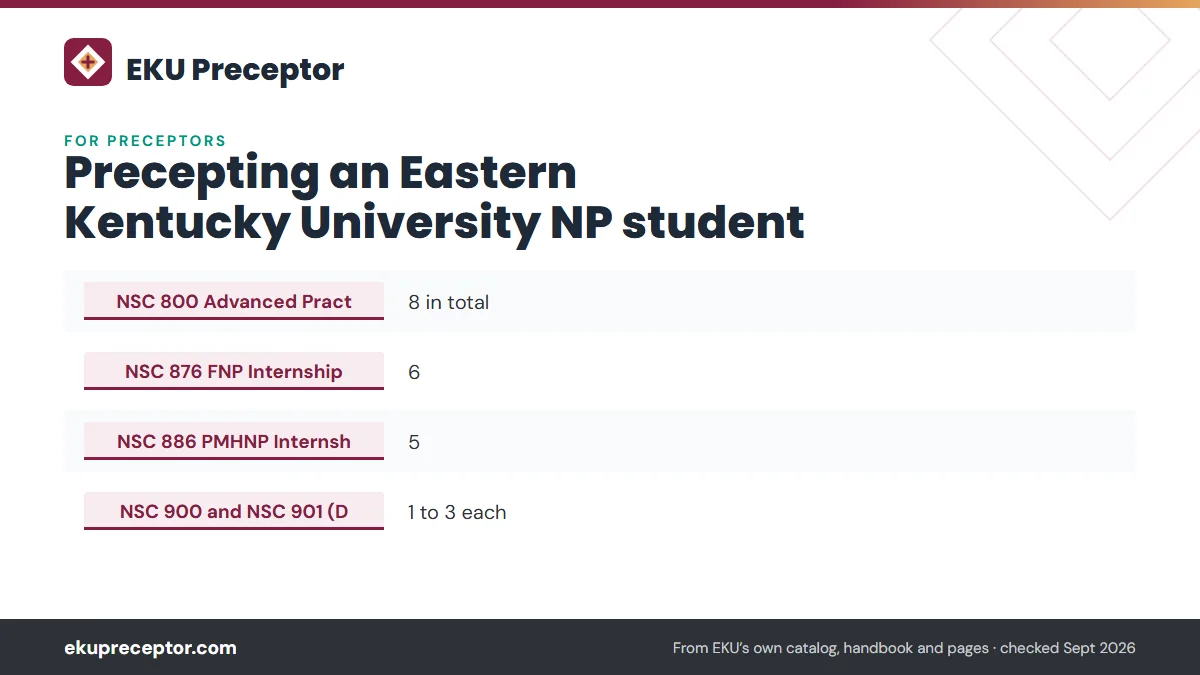
NSC 800 Advanced Practice Role | 8 in total | The core clinical course, spread across FNP I to III (NSC 870, NSC 872, NSC 874) or PMHNP I to III (NSC 880, NSC 882, NSC 884) |
NSC 876 FNP Internship | 6 | A concentrated rural primary care practicum that closes the FNP track |
NSC 886 PMHNP Internship | 5 | The last psychiatric-mental health clinical course in the PMHNP track |
NSC 900 and NSC 901 (DNP) | 1 to 3 each | Organizational Leadership: DNP Experience hours at a practice site, tied to an improvement project |
EKU's archived curriculum plans ran these clinical courses over 16 weeks, longer than the 7-week sessions used for core classes, so a placement usually spans most of a semester. NSC 800 has its own guide.
Who arrives at your practice
An EKU NP student is already a working registered nurse. Admission asks for a BSN, at least one year of RN experience and an unencumbered RN license, and the student keeps that license clear in every state where they hold one, with Nursys e-Notify monitoring from admission. Before the first clinical course they complete advanced pharmacology, advanced health assessment and advanced pathophysiology (NSC 830, NSC 832, NSC 834) with at least a B.
EKU's 2021-22 MSN handbook added one more gate: students had to show they had mastered advanced health assessment and diagnostic reasoning during the term just before NSC 800. EKU also holds students to a B or better in every required course and a satisfactory grade in each practicum, so the student who walks in has every reason to arrive prepared.
If you practice in Kentucky
Kentucky's APRN regulation, 201 KAR 20:062, lets a physician, a physician assistant or an advanced practice registered nurse serve as an NP student's preceptor. For practices inside the state, the Board of Nursing adds a licensing point for online graduate APRN programs: nursing faculty and preceptors working with those students in Kentucky should carry Kentucky RN and APRN licenses, active and unencumbered.
The same regulation makes Kentucky programs such as EKU responsible for securing their students' preceptors, while letting each student have input. That input is often how a preceptor like you enters the picture: a student proposes a practice near home, and EKU reviews and approves it. More on the regulation is on the Kentucky rule page; practices outside Kentucky follow their own state board, summarized in the state guides.
What the student takes care of
Compliance belongs to the student and EKU, and your site's own list comes on top. Under EKU's most recent public MSN handbook, the student keeps these current each semester of a clinical course:
- Professional liability insurance bought through EKU, which applies to clinical work within scheduled classes and runs from August 15 through August 14 each year
- A clear, unencumbered RN license in each state that has licensed the student
- The clinical contract and preceptor information form, the EKU document your practice appears on
- A Clinical Waiver form, with a Telehealth Checklist added for FNP students during
NSC 800andNSC 876 - Whatever your site requires, such as background checks, drug screens, immunization records, or OSHA, HIPAA and CPR certificates
If a student has to miss a scheduled day, EKU's handbook expects notice to you and to the clinical faculty at least an hour ahead. The coverage details are on professional liability insurance.
Your role, and the faculty behind it
In EKU's MSN handbook the preceptor goes by clinical instructor (preceptor), and clinical faculty oversee each clinical component alongside you. The evaluation forms EKU uses are not public; the student's faculty share them for the course, and the clinical evaluations page explains how EKU grades clinical work as satisfactory or unsatisfactory.
You also hold real weight on safety. The handbook defines unsafe practice as any circumstance that could potentially harm the client, and a student removed from a clinical site for unsafe or unprofessional conduct receives an unsatisfactory grade. With DNP students the relationship is different: the DNP Preceptor is a stakeholder in an improvement project, which EKU says can be completed in the student's own organization or community.
What the placement desk does for you
We work with EKU students and with the clinicians who teach them, and we keep hosting a student as light as possible on your side:
- A student whose course matches your practice: family primary care, psychiatric-mental health care or a DNP project site
- Start dates and weekly clinical days agreed with you before anything goes to EKU
- Your license and practice details gathered once and organized for EKU's preceptor information form
- Early contact with your site about EKU's clinical contract and your own onboarding steps
- One point of contact through the course, with a backup plan if your schedule changes
To offer your practice, use the form and pick I'm a preceptor (not a student) as the program. Tell us your specialty, your city and the days you could host, and your placement advisor follows up. How it works shows the student side of the same process.
Questions EKU students ask
Who can precept an EKU nurse practitioner student?
Kentucky's APRN rule names three kinds of clinician: APRNs, physicians and physician assistants. Beyond that, fit decides it: family practice for the FNP courses, psychiatric-mental health practice for the PMHNP courses. EKU reviews each preceptor through the student's paperwork, and the preceptor requirements guide covers licensing and the checks in detail.
How many hours will an EKU student spend at my practice?
That depends on the course and the plan the student and faculty set. EKU's FNP track adds up to 750 direct patient care hours between NSC 800 and the internship, the final 300 of them for synthesis, and EKU's archived plans spread each clinical course over about 16 weeks. PMHNP totals are not published, so the faculty confirm them.
Is the EKU student insured while at my site?
Yes, for course work. EKU requires professional liability insurance bought through EKU for clinical practicum courses. The archived handbook limits it to clinical experiences inside scheduled classes, with coverage ending at withdrawal or graduation. If your site keeps insurance certificates on file, ask the student for a copy at onboarding.
Does EKU need a contract with my practice?
A clinical contract is one of the documents EKU's MSN handbook has students keep current before clinicals, so expect paperwork between your practice and EKU. How EKU drafts and signs these agreements is not public. Your placement advisor raises it with you early so it is settled before the term; see agency agreements.
Can I precept an EKU DNP student?
Yes, when your practice fits the student's project. EKU's DNP is post-master's with an Organizational Leadership focus, and students file a site approval request for each clinical course, starting hours only after EKU's Clinical Placement Coordinator approves them. The DNP handbook describes the DNP Preceptor as a stakeholder in the student's project.
Related pages
Last checked 2026-09-25
We check these pages against EKU's own catalog, program pages and handbooks, and Kentucky's regulations. The current MSN Student Handbook, your course and your faculty have the final word.
EKU secures your preceptor. Your input decides how well it fits your life.
Tell us your EKU program, where you live and when your next clinical course starts. We find preceptors in your community who fit the course and prepare everything EKU reviews, so the option you put forward is ready to approve.
- Preceptors matched to the course: family primary care for
NSC 800andNSC 876, psychiatric care forNSC 886 - Preceptor, license and site details organized for EKU's preceptor information form
- In your own community, wherever EKU enrolls students and you hold your RN license
Start your placement plan
Program, city and start date is all we need to begin.