Kentucky's preceptor rule: EKU secures your preceptor, and you may have input
Under 201 KAR 20:062, a regulation of the Kentucky Board of Nursing, every Kentucky APRN program must secure its students' preceptors and may not require a student to find one. The same sentence gives you a voice in the process. This page sets out the rule word for word, who it covers, how EKU's own documents reflect it, and what input looks like in practice.
Put your input to work
Tell us your EKU program, where you live and when your next clinical course starts. We find a preceptor who fits, and you offer that option to EKU.
The rule, word for word
Section 5 of 201 KAR 20:062 sets the preceptor standards for APRN programs. Its first subsection says a program must meet those standards in addition to the standards of its national nursing accrediting body. The second subsection is the one that shapes your clinical courses:
"The APRN program shall secure all necessary preceptors to students enrolled in the program. A student shall not be required to obtain his or her own preceptor, but may have input into the process." (201 KAR 20:062, Section 5(2))
Read it as three commitments. The program secures the preceptors. No student can be required to obtain one. And students may shape the process with input of their own. Section 1(6) limits the word preceptor to APRNs, physicians and physician assistants who meet the Section 5 standards; what else EKU looks for is covered under preceptor requirements.
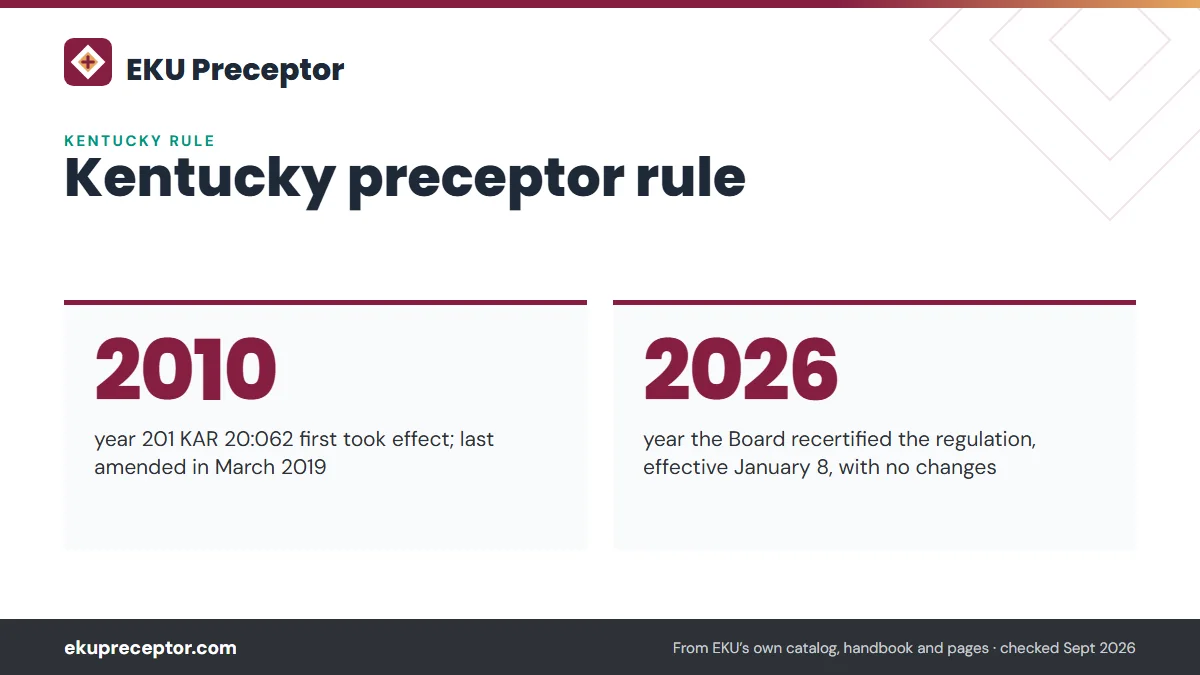
The regulation took effect in December 2010 and was amended in 2011, 2014, 2015 and March 2019. The Board recertified it without changes effective January 8, 2026, so it is in force today.
Who the rule covers
The Kentucky Board of Nursing says 201 KAR 20:062 pertains to Kentucky-based MSN and DNP APRN programs. EKU is based in Richmond, and the Board's approved-program list shows both EKU's MSN and its DNP as Approved. EKU's catalog lists the same Board approval.
The rule speaks most directly to EKU's FNP and PMHNP tracks, which prepare nurses for APRN licensure, and to the post-MSN FNP and PMHNP certificates, which use the same clinical courses and follow every MSN policy. EKU's DNP is a post-master's degree in Organizational Leadership rather than an APRN track, and its practice sites go through the DNP handbook's own approval form, so ask the program how the rule bears on your DNP hours.
EKU's on-campus BSN and associate degree programs are prelicensure programs. They fall under a separate regulation, 201 KAR 20:310, which has preceptor terms of its own.
What else the regulation expects of programs
Section 5(2) is not a stray line. Elsewhere, 201 KAR 20:062 treats preceptor supply as a core measure of an APRN program. A proposal for a new program must include "a five (5) year plan for securing clinical sites and preceptors sufficient to accommodate the number of students" (Section 3(8)(b)7).
Section 6(4) lists factors that may lead the Board to visit a program and that can put its approval status at risk. One of them, Section 6(4)(d), reads: "Failure to provide sufficient clinical learning opportunities including securing preceptors for students to achieve stated outcomes." Securing preceptors is part of how Kentucky judges whether an APRN program is doing its job.
The regulation sets no minimum clinical hour count and no preceptor-to-student ratio for APRN programs. Hours follow the national accreditor, which for EKU is CCNE, and EKU's own figures are on the clinical hours page.
How EKU's documents reflect the rule
EKU's own documents show the rule's two halves at work. The program side appears in the approval steps its handbooks describe, with faculty and the Clinical Placement Coordinator reviewing sites; the input side appears in the preceptor information MSN students keep current and the site approval requests DNP students submit.
EKU's student handbooks have put the same idea in practical terms. The 2009-10 MSN handbook said nurse practitioner clinical experiences "will be arranged throughout the region according to agency and preceptor availability and faculty coverage." The 2020-21 and 2021-22 handbooks, the latest that can still be read, drop that sentence and instead list a "Clinical contract and preceptor information form" that students keep current. Neither edition asks students to find their own preceptor; the newer one gives student input a formal place.
EKU does not publish a current student-facing statement on how it matches NP students with preceptors. That belongs to the MSN Student Handbook your program provides, and your faculty can explain how it works for your course.
What "may have input" means in practice
The regulation does not define input, so EKU's documents are the best guide to what it looks like. MSN and post-MSN students maintain a preceptor information form through every clinical course (2021-22 handbook, archived). DNP students request approval for each practice site on a dedicated form. And EKU Online's 2021 profile of an FNP graduate describes her doing clinicals at her own workplace.
Taken together, input can mean proposing a named preceptor, a practice close to home, a setting in your specialty, clinical days that fit your job, or a unit at your own employer. It can also mean offering nothing: input is a right, not a duty, and EKU's obligation stays the same either way. Whatever you offer, EKU reviews and approves it. Our guide to using your input covers what makes an option strong, and your input vs waiting compares the two routes.
The rule gets misread in both directions. Its first sentence means you cannot be made to find a preceptor. Its second means you are not shut out of the choice either.
If you live outside Kentucky
EKU's NP programs run online and accept students from most states, and the text of Section 5(2) covers "students enrolled in the program" without any geographic limit. Beyond that text, neither EKU nor the Board publishes how the rule plays out for an online student whose clinicals are in Ohio, Texas or Alaska. Our research found nothing more specific, so ask your faculty how it works for your state rather than relying on anyone's assumption.
Some things are published. EKU's graduate catalog makes students report where any supervised field placement outside Kentucky will happen. EKU's state authorization page lists states where it is not accepting online NP students, including Mississippi, where EKU says it is not authorized to enroll students because of clinical placement restrictions. A few states come with EKU conditions attached: EKU notes that Missouri permits only short-term site contracts, and that Alabama and North Dakota require the program to notify the state before placing students in clinicals. Check your state on the state authorization page.
Distance is also where input earns its keep. You know the practices in your own town, and the rule invites you to share that knowledge.
How we work within the rule
Everything we do sits on the input side of Section 5(2). Your placement advisor locates a preceptor and site near you that match your EKU course, confirms the specialty, the license and the site's readiness to host you, and prepares the details EKU's preceptor information form calls for. You put that option forward; EKU secures and approves the placement.
We begin a term or more before NSC 800, hold a second option in reserve, and remain available through the internship in case a preceptor has to withdraw. EKU students choose us because the option they bring is specific, complete and built around EKU's own process. Our help leaves the duty exactly where Kentucky put it; what it changes is how ready your option is. Tell us your program and your first clinical term in the form below.
Questions EKU students ask
Where can I read 201 KAR 20:062 myself?
The Kentucky Legislative Research Commission publishes the official text of Kentucky Administrative Regulations on its website, under Title 201, Chapter 20, regulation 062. Cornell's Legal Information Institute carries a matching copy. Both show the history line ending with the January 2026 certification, and both links are in the sources for this page.
Can EKU make me find my own preceptor?
Not under Kentucky law. Section 5(2) places the duty to secure preceptors on the program and says no student shall be required to obtain one. You can still choose to propose a preceptor, because the same sentence protects your input, and EKU reviews and approves whatever you propose.
Does the rule mean EKU picks my preceptor without asking me?
No. The regulation's second sentence gives students room for input, and EKU's handbooks show that input at work through the preceptor information form. EKU makes the final decision on any preceptor and site, but you can tell your faculty where you live, the setting you want and the days you can train, or propose a specific preceptor.
Who enforces Kentucky's preceptor rule?
The Kentucky Board of Nursing, which approves Kentucky APRN programs. Under Section 6 of the regulation, a failure to secure preceptors is one of the factors that may prompt a Board site visit and can jeopardize a program's approval status. EKU's MSN and DNP currently appear on the Board's list as Approved.
Does the same rule apply to EKU's BSN students?
Not this one. EKU's on-campus BSN and associate programs are prelicensure programs under 201 KAR 20:310. That regulation lets a preceptor be used only after program faculty have taught the student in all basic areas, requires the preceptor's RN license to be valid where the clinical site is, bars preceptors from replacing clinical instructors and caps the ratio at two students per preceptor.
Related pages
Last checked 2026-09-25
We check these pages against EKU's own catalog, program pages and handbooks, and Kentucky's regulations. The current MSN Student Handbook, your course and your faculty have the final word.
EKU secures your preceptor. Your input decides how well it fits your life.
Tell us your EKU program, where you live and when your next clinical course starts. We find preceptors in your community who fit the course and prepare everything EKU reviews, so the option you put forward is ready to approve.
- Preceptors matched to the course: family primary care for
NSC 800andNSC 876, psychiatric care forNSC 886 - Preceptor, license and site details organized for EKU's preceptor information form
- In your own community, wherever EKU enrolls students and you hold your RN license
Start your placement plan
Program, city and start date is all we need to begin.