EKU's RN to BSN clinical: NSC 442C hours, setting and approval
The online RN to BSN at EKU has a single clinical course, NSC 442C Complex Health Systems Clinical, taken with the NSC 442 theory course. EKU's most recent available RN to BSN handbook (2023-24, archived) set it at 60 clock hours over 8 weeks, and EKU says the clinical project can be completed at your current employer. Here is what the course looks like and what to line up the semester before it.
Line up your NSC 442C agency
Tell us the term your clinical falls in and where you live. Your placement advisor will find an agency and mentor that fit the course.
NSC 442C at a glance
NSC 442C is the only course in EKU's 25-credit RN to BSN plan that carries clinical hours. The other eight, from NSC 381 Perspectives in Professional Nursing I through NSC 486 RN Public Health Nursing, are theory courses. The full plan is in the RN to BSN program guide.
| Item | What EKU's sources say |
|---|---|
| Course | NSC 442C Complex Health Systems Clinical, paired with NSC 442 Complex Health Systems |
| Credits | 2.5 in the 2026-27 catalog; 2 when the archived 2023-24 handbook was written |
| Clock hours | 60 over 8 weeks in the archived handbook; no current figure published |
| Format | A clinical project; EKU says it can be completed at your current place of employment |
| Who approves your mentor | The primary course leader, per the archived handbook |
| Campus visits | None required anywhere in the RN to BSN |
Hours and timing: archived figures against today's catalog
The 60-hour figure comes from the 2023-24 RN to BSN Student Handbook, which EKU no longer posts. At that point the course carried 2 credits and ran over 8 weeks. Two things have moved since: the 2026-27 catalog lists NSC 442C at 2.5 credits, and EKU now describes its online courses as running in 7-week terms.
That makes the old numbers a guide rather than a rule. If 60 hours still applied across 8 weeks, it would work out to about 7.5 hours a week by our arithmetic; squeezed into a 7-week session it would be nearer 8.6. A credit increase could also bring more hours. Ask your course leader for the current total before you ask a mentor to set aside time, and map the course against your calendar with the 7-week term guide.
Don't book your mentor around 60 hours without checking. That figure comes from an archived handbook written when the course carried fewer credits than it does now.
What the setting and your contact look like
EKU frames the RN to BSN clinical as project work. Its program page offers the option of carrying out the clinical project at the place you already work, and an EKU news story on nursing pathways calls it a capstone clinical project. Under the archived handbook the host must be a healthcare agency with an affiliation agreement signed with EKU.
Your contact at the agency is a preceptor or mentor, and the archived handbook says every one must be approved by the primary course leader. The same handbook says faculty are available to guide students and to help them identify and secure potential clinical sites. What the project must cover, and what your mentor signs, comes from the course itself, so read the NSC 442C syllabus in Canvas as soon as it opens.
Because the course centers on complex health systems, look for a mentor who sees how a unit, department or organization works: a nurse manager, a quality or education lead, or a case management leader will usually give a project more to work with than a colleague on your own shift.
Doing NSC 442C where you already work
EKU says outright that the RN to BSN clinical project can be done at your current employer. The archived handbook adds the conditions: the workplace has to be a healthcare agency, and an affiliation agreement is required even when the agency is the student's own employer.
Your own workplace has real advantages. You know the people, the systems and the problems worth a project. It also raises questions to settle well before the course:
- Does your employer already have an agreement with EKU, or does one need to start now? The agency agreements guide explains why they take time.
- Which leader will act as your mentor, and will the primary course leader approve them?
- Do your clinical hours need to be separate from your paid shifts? The archived handbook doesn't say, so ask your course leader.
- Will your manager back a project on the unit, and is there a problem there that fits a complex health systems course?
The workplace clinicals guide looks at the same question for EKU's graduate students.
The timeline to plan backward from
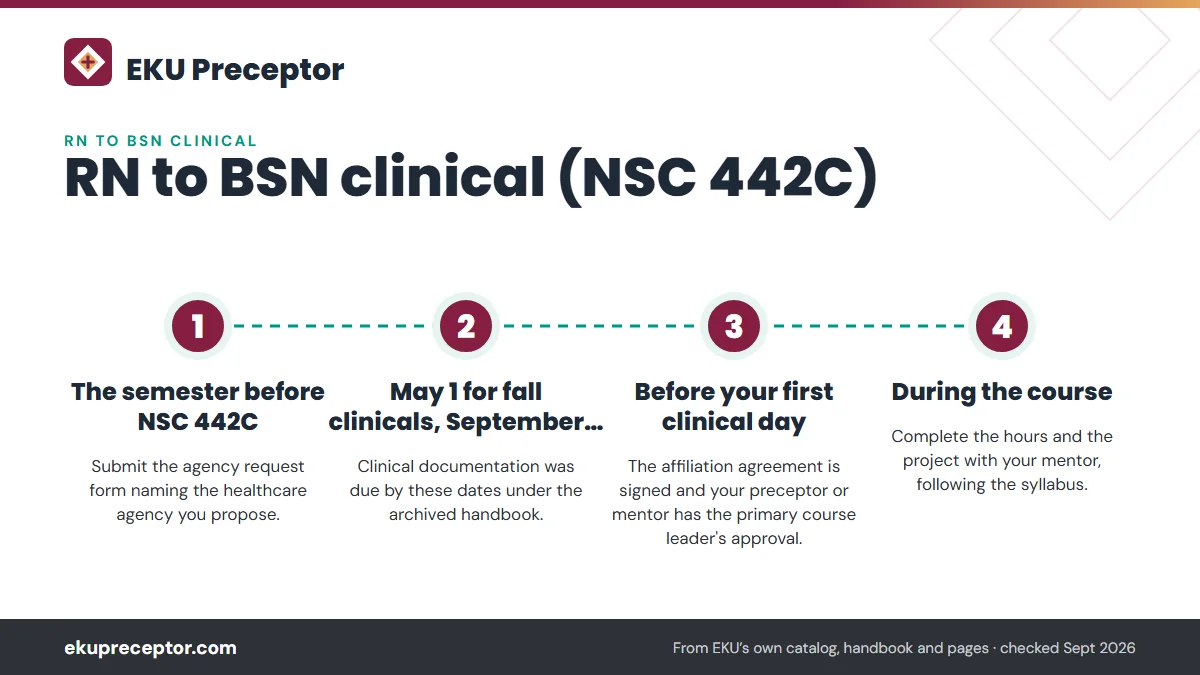
EKU's archived 2023-24 handbook set its dates well ahead of the course. Confirm them for your own term, since the handbook is no longer posted.
- The semester before
NSC 442CSubmit the agency request form naming the healthcare agency you propose. - May 1 for fall clinicals, September 1 for springClinical documentation was due by these dates under the archived handbook.
- Before your first clinical dayThe affiliation agreement is signed and your preceptor or mentor has the primary course leader's approval.
- During the courseComplete the hours and the project with your mentor, following the syllabus.
Since the request form goes in a full semester early, it pays to settle on an agency before that semester begins. If your employer needs a new agreement, start that conversation earlier still.
How we help with NSC 442C
If your employer can't host the project, or you would rather do it somewhere new, your placement advisor finds a healthcare agency near home and a mentor whose role suits a complex health systems project. EKU's archived handbook invites students to explore partnerships within their local community, and that is exactly the search we run for you.
If your employer is willing but has no agreement with EKU yet, we help you pull together the agency contacts and details the agreement process asks for, so it can start a semester or more before the course.
We prepare the agency details for your request form, flag what the affiliation agreement will need, and keep the timeline tied to EKU's dates so the agency is settled before the course opens. If the agency pulls back, we start on a replacement straight away. Tell us your clinical term with the form below.
Questions EKU students ask
How many hours is EKU's NSC 442C clinical?
EKU's archived 2023-24 RN to BSN handbook set NSC 442C at 60 clock hours over 8 weeks, when the course carried 2 credits. The 2026-27 catalog now lists it at 2.5 credits, and EKU hasn't published a current hour figure. Ask your course leader for the total that applies to your term before you schedule your mentor.
Does EKU find my RN to BSN clinical site?
EKU's archived handbook describes a shared process: students may explore partnerships in their local community, faculty are available to help identify and secure sites, and the primary course leader approves every preceptor or mentor. Kentucky's preceptor rule is written for APRN programs, not the RN to BSN, so the handbook's process is the guide here.
Do I have to go to campus for the RN to BSN clinical?
No. EKU's RN to BSN page says there are no required campus visits, no cohorts and no testing centers, and the clinical project takes place at a healthcare agency in your own area, often your employer. The agency still needs an affiliation agreement with EKU, and your mentor needs approval, before you start.
Can I do NSC 442C in another state?
Your state first decides whether EKU can enroll you in the RN to BSN at all. EKU's licensure table and state notes rule out Colorado, Louisiana, Massachusetts, Minnesota, New York, Oregon, Tennessee and Washington for this program. Elsewhere, your clinical agency is normally local to you; the state authorization guide lists the conditions some states add.
What is the difference between NSC 442 and NSC 442C?
NSC 442 Complex Health Systems is the 2.5-credit theory course, and NSC 442C Complex Health Systems Clinical is its 2.5-credit clinical partner, taken as co-requisites. Together they make up 5 of the 25 credits in EKU's RN to BSN plan, and only the C course carries clinical hours.
Related pages
Last checked 2026-09-25
We check these pages against EKU's own catalog, program pages and handbooks, and Kentucky's regulations. The current MSN Student Handbook, your course and your faculty have the final word.
EKU secures your preceptor. Your input decides how well it fits your life.
Tell us your EKU program, where you live and when your next clinical course starts. We find preceptors in your community who fit the course and prepare everything EKU reviews, so the option you put forward is ready to approve.
- Preceptors matched to the course: family primary care for
NSC 800andNSC 876, psychiatric care forNSC 886 - Preceptor, license and site details organized for EKU's preceptor information form
- In your own community, wherever EKU enrolls students and you hold your RN license
Start your placement plan
Program, city and start date is all we need to begin.