EKU's online RN to BSN: credits, pace, the clinical and state limits
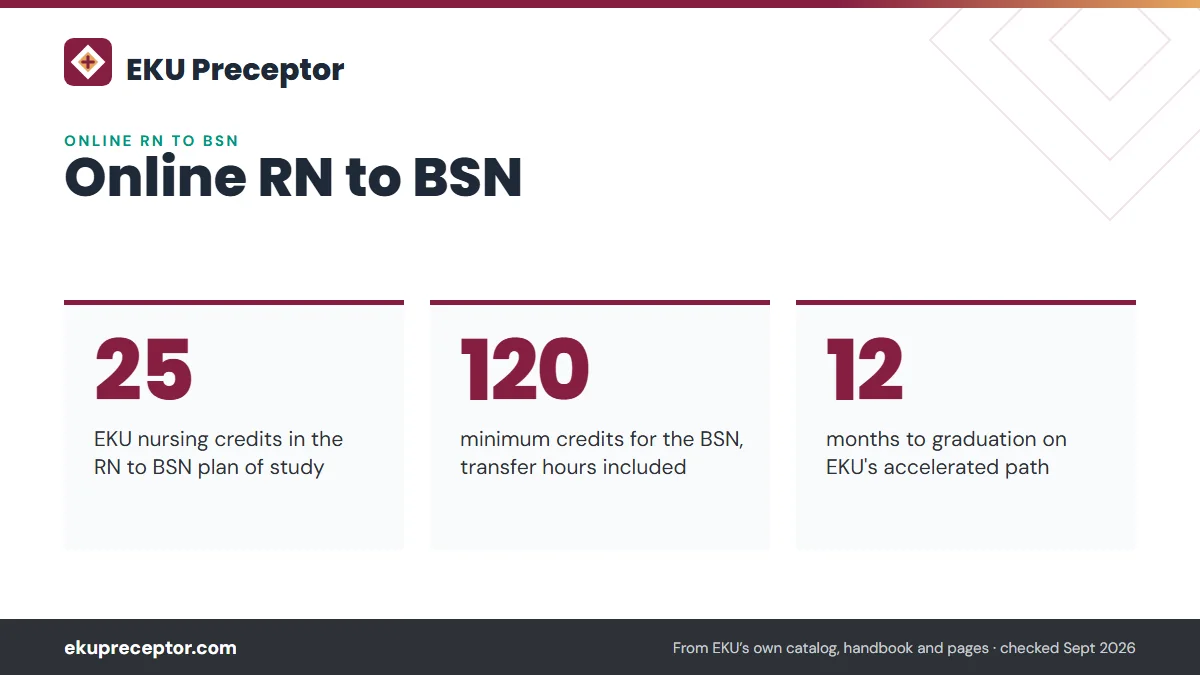
EKU's RN to BSN is an online completion program for associate-degree RNs: 25 credits of EKU nursing courses inside a 120-credit bachelor's degree, taught in 7-week terms with no campus visits. It has one clinical course, NSC 442C, and an accelerated path built to finish in 12 months. Here is how the credits add up, what the plan contains and which states EKU enrolls from.
Get help with your RN to BSN clinical
Tell us your start term and where you work. Your placement advisor will plan the NSC 442C agency and mentor with you.
The program at a glance
| Feature | EKU RN to BSN |
|---|---|
| Degree | Bachelor of Science in Nursing, RN to BSN pathway |
| Format | Online; no required campus visits, no cohorts, no testing centers |
| Terms | 7-week terms, with fall, spring and summer starts |
| EKU nursing credits | At least 25, within a minimum of 120 total |
| Pace | Accelerated path about 12 months; traditional path about 18 months |
| Clinical | One course: NSC 442C Complex Health Systems Clinical |
| Accreditation | CCNE (baccalaureate) through December 31, 2028 |
EKU designed the program around working nurses. Its page promotes clinical projects that can be completed at your current place of employment and a schedule built on one course at a time. Application deadlines are July 1 for a fall start with classes in August, November 1 for spring (January) and March 15 for summer (May).
How 25 EKU credits become a 120-credit BSN
The catalog requires a minimum of 25 nursing credits taken at EKU and a minimum of 120 credit hours in total, transfer hours included. Three things close the gap between the two numbers:
- Credit for prior learning. On admission, with a current, valid, unencumbered RN license from an approved state, you receive 39 credits standing in for EKU's prelicensure courses, including
NSC 330Clinical Drug Therapy,NSC 350Pathophysiology and the adult, mental health and family health nursing courses with their clinicals. - General education waiver. Associate-degree RNs who meet EKU's general education certification protocol have their general education requirements waived.
- Transfer credit. Your associate degree and other college work supply the rest, and any transferred nursing or support course needs a minimum grade of 2.5 (C).
Your own total depends on the transcripts you bring, so ask for a credit evaluation before you choose a pace. Once you're admitted, Degree Works shows how each credit is being counted toward the 120.
The nine courses in the plan
| Course | Title | Credits |
|---|---|---|
NSC 381 | Perspectives in Professional Nursing I | 3 |
NSC 383 | Perspectives in Professional Nursing II | 3 |
NSC 385 | Perspectives in Professional Nursing III | 4 |
NSC 445 | RN Professional Role Transitions | 2 |
NSC 390 | Research for EBNP | 2 |
NSC 440 | RN Leadership and Management | 3 |
NSC 486 | RN Public Health Nursing | 3 |
NSC 442 | Complex Health Systems | 2.5 |
NSC 442C | Complex Health Systems Clinical | 2.5 |
| Total | 25 |
Eight of the nine are theory courses taken online within EKU's 7-week terms. Only NSC 442C carries clinical hours, and it is taken together with its theory partner, NSC 442. Leadership, public health and research all appear in the plan, which gives you material to draw on when the clinical project comes around.
Accelerated or traditional: picking a pace
EKU offers two speeds. The accelerated path aims for graduation in 12 months by taking two courses most terms, and it requires general education certification and a qualifying statistics course before you start. The traditional path takes one course every 7 weeks, adding a second now and then, and EKU says students on it earn the BSN in about 18 months.
The right pace depends on your shifts more than your ambition. Two courses in one 7-week session means two sets of deadlines running at once, and the term that holds NSC 442 and NSC 442C also brings clinical hours at an agency. It helps to place that clinical term where your work schedule is lightest and plan the rest of the program around it. The 7-week term guide shows how sessions fall across the year.
Admission requirements
EKU keeps the list short, with one wording difference between its sources:
- An associate degree in nursing: the program page asks for a program accredited by ACEN or NLN CNEA, while the catalog says a regionally accredited school
- An RN license from an approved state, without restrictions
- A minimum grade of 2.5 (C) in any nursing or support course you transfer
- A Nursys QuickConfirm license report submitted with your application
If your associate program's accreditation is unusual, ask EKU which of the two standards it applies before you apply. The Nursys report is part of the application itself, and the same RN license is what earns the 39 credits for prior learning once you are admitted.
The one clinical course: NSC 442C
NSC 442C Complex Health Systems Clinical is where the program's clinical hours sit. In the 2023-24 handbook, since archived, the course was worth 2 credits and asked for 60 clock hours across 8 weeks; today's catalog gives 2.5 credits and no hour figure. EKU presents the work as a clinical project that you can complete at your current employer.
The archived handbook also laid out the process around it. Students could explore partnerships in their local community with faculty guidance, the agency needed an affiliation agreement even when it was the student's employer, the primary course leader approved every preceptor or mentor, and the agency request form was due the semester before the course. The NSC 442C guide covers the hours, setting and deadlines in detail, and the agency agreements guide explains why agreements need lead time.
States EKU enrolls RN to BSN students from
EKU publishes a separate licensure table for the RN to BSN, and it doesn't match the MSN list. For this program, EKU does not enroll students from eight states: Colorado, Louisiana, Massachusetts, Minnesota, New York, Oregon, Tennessee and Washington. The two territories on the table, Puerto Rico and the U.S. Virgin Islands, sit under Unable to Determine.
New York is a conflict on EKU's own page. The RN to BSN table lists New York as Meets Requirements, yet the written New York entry says EKU is turning away online RN to BSN applicants from the state. The note is the safer reading, so confirm with EKU before applying from New York.
Four states carry conditions. Alabama and North Dakota require EKU to give notice and pay the state before it places clinical students, in Maryland any unpaid or low-paying placement must be approved before admission, and Missouri allows only short-term site contracts. Moving to another state once admitted can cost you your place, so talk to your advisor before any move. The state authorization guide lists every state.
How we help EKU RN to BSN students
Your placement advisor's work centers on NSC 442C. If your employer can host the project, we help you confirm the agreement route and a suitable mentor early. If it can't, or you would rather work somewhere new, we find a nearby healthcare agency with a mentor suited to a complex health systems project, then prepare the details your agency request form needs.
If this is the first clinical you have helped arrange, we walk you through each step EKU's process asks of you, from the agency request form to the mentor approval, so nothing about the course catches you short.
Every step is timed against EKU's calendar, so your agency is in place a semester ahead, and we stay on call if the agency steps back. Use the form below to tell us which term your clinical falls in.
Questions EKU students ask
Is EKU's RN to BSN fully online?
Yes. EKU says the RN to BSN has no required campus visits, no cohorts to join and no testing centers to visit, and courses run in 7-week terms. The single clinical course, NSC 442C, takes place at a healthcare agency close to where you live, which can be your current employer once an affiliation agreement is in place.
How long does EKU's RN to BSN take?
EKU gives two answers. The accelerated path is designed for graduation in 12 months by taking two courses most terms, and it requires general education certification and a qualifying statistics course. The traditional path, one course every 7 weeks with an occasional second, takes about 18 months according to EKU.
How many credits does EKU give for my associate degree and RN license?
Three things count before you take an EKU course: 39 prior-learning credits granted on admission with a valid, unencumbered RN license, a general education waiver for RNs who meet EKU's certification protocol, and transfer credit for other college work, with at least a 2.5 (C) in any transferred nursing or support course. The 25 EKU nursing credits then bring you to the 120-credit minimum.
Is EKU's RN to BSN accredited?
Yes. The RN to BSN is part of EKU's baccalaureate program, which CCNE accredits through December 31, 2028, with CCNE's next site visit expected in spring 2028. EKU's program pages carry the same CCNE statement for its master's, DNP and post-graduate certificate programs. See the accreditation guide.
When can I start EKU's RN to BSN?
Three times a year. Apply by July 1 to begin in August, by November 1 to begin in January, or by March 15 to begin in May. Because courses run in 7-week terms, your first term decides when NSC 442C falls, so map the clinical course against your work calendar before you choose.
Related pages
Last checked 2026-09-25
We check these pages against EKU's own catalog, program pages and handbooks, and Kentucky's regulations. The current MSN Student Handbook, your course and your faculty have the final word.
EKU secures your preceptor. Your input decides how well it fits your life.
Tell us your EKU program, where you live and when your next clinical course starts. We find preceptors in your community who fit the course and prepare everything EKU reviews, so the option you put forward is ready to approve.
- Preceptors matched to the course: family primary care for
NSC 800andNSC 876, psychiatric care forNSC 886 - Preceptor, license and site details organized for EKU's preceptor information form
- In your own community, wherever EKU enrolls students and you hold your RN license
Start your placement plan
Program, city and start date is all we need to begin.