EKU DNP clinical hours: the 1,000-hour rule and the hours you complete at EKU
EKU's post-master's DNP asks every student to document at least 1,000 clinical hours completed after the BSN, and EKU decides at admission how many of those you still owe. From there the hours run through a site approval request for each clinical course, a log of DNP Experience Hours and the project courses. This guide explains each piece from the current catalog and EKU's most recent available DNP handbook.
Get your DNP site ready
Tell us your start term and your proposed project. Your placement advisor will plan the organization and approval timing with you.
The rule in EKU's words
The 2026-27 graduate catalog puts it this way: "Students must have documentation of a minimum of 1,000 total clinical hours completed beyond the BSN. Hours required to be completed at EKU will be assessed upon admission to the DNP Program and a plan of study developed accordingly."
Two things follow from that sentence. First, the 1,000 is a running total counted from your BSN, so clinical time from your master's program can go toward it if you can document it. Second, the share you complete at EKU is set for you individually, which means two students starting in the same term can owe quite different amounts. The catalog evaluates required credits for each student too, so the DNP's credit total is a range; the DNP program guide explains it along with the courses.
How EKU works out the hours you owe
The last DNP handbook EKU made public (revised in June 2020, archived) describes a gap analysis carried out when you are admitted. It says credit is awarded, when possible, for hours completed during the student's MSN program, and that a minimum of 200 hours must be completed at EKU.
Read the 200-hour floor as the most recent published rule, not a settled one. The handbook predates EKU's current course numbers, and the catalog now says only that hours owed at EKU are assessed at admission. Your plan of study is the document that records your figure, so check it there.
One group should raise the question early. EKU's admission rules accept a master's outside nursing, a public health, health administration or business degree for example, as long as the applicant also holds a BSN. The handbook's credit language speaks of hours from an MSN program, so if your master's had no clinical component, ask how the gap analysis will treat it before you plan your first term.
Bring evidence of your master's clinical hours to admission. EKU's rule turns on documentation, and a clear record from your MSN program is what lets the gap analysis credit that time.
Where DNP hours sit in the courses
The catalog lists credits, not hours, for each DNP course. EKU's archived documents fill in part of the picture:
| Course | Title | Credits | What archived documents say |
|---|---|---|---|
NSC 900 | Organizational Leadership: DNP Experience I | 1–3 | Fall 2023 flow plans: 8 weeks of seminar, up to 16 weeks to finish the required experience hours |
NSC 901 | Organizational Leadership: DNP Experience II | 1–3 | Fall 2023 flow plans: up to 12 weeks |
NSC 990 | DNP Project Development | 3 | No hour detail published |
NSC 992 | DNP Project Implementation and Data Collection | 3 | No hour detail published |
NSC 994 | DNP Project Analysis & Dissemination | 3 | Carried experience hours in the 2020 handbook; the project is completed and presented here |
The two experience courses carry variable credit, and the catalog doesn't tie a credit to a set number of hours. Ask your faculty which courses in your own plan carry experience hours and how many each term, because that determines how many days a week your organization needs to host you.
The Request for DNP Experience Site Approval Form
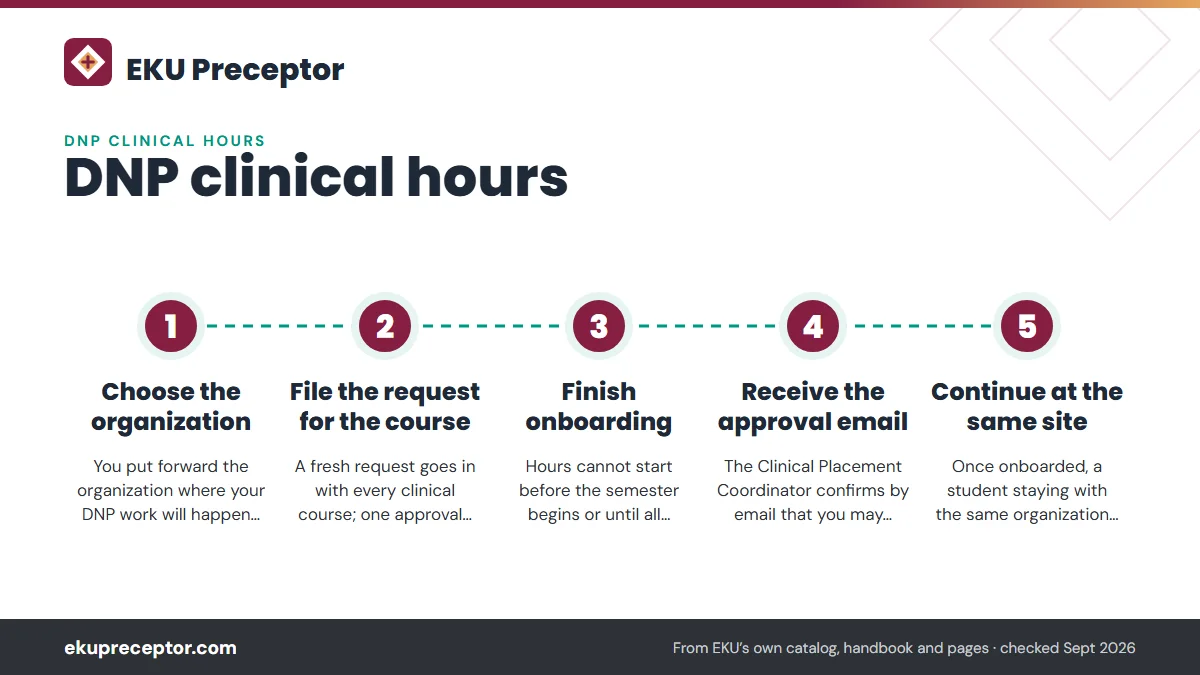
Under EKU's archived DNP handbook, no hour counts until the site is approved. The paperwork is the Request for DNP Experience Site Approval Form, filed course by course, and the go-ahead arrives as an email from the School of Nursing Clinical Placement Coordinator. The sequence ran like this:
- Choose the organizationYou put forward the organization where your DNP work will happen, which EKU's program page says can be your own workplace or your wider community.
- File the request for the courseA fresh request goes in with every clinical course; one approval doesn't carry the whole program.
- Finish onboardingHours cannot start before the semester begins or until all onboarding paperwork is complete, including anything the organization itself requires.
- Receive the approval emailThe Clinical Placement Coordinator confirms by email that you may begin DNP Experience Hours.
- Continue at the same siteOnce onboarded, a student staying with the same organization could mark later requests as continuing.
The Clinical Placement Coordinator guide explains how that role fits across EKU's programs.
Logging hours and the people involved
EKU's archived handbook calls the time DNP Experience Hours. Each entry in your DNP Experience Log records when the activity happened, how long it took, what you did and how it connects to the DNP Essentials. Entries written up weeks later tend to be thin, so tie each block of time to your project and to the Essentials as you go.
Your project also has a team. EKU's DNP Committee gives each student a faculty chair holding a doctorate plus a second team member, and the handbook lists your DNP Preceptor and people from the organization among the project's stakeholders. EKU's program page promises individualized mentorship for the project. EKU hasn't published qualifications for a DNP Preceptor, so settle expectations with your chair before you ask someone to take the role.
Clearance before your first hour
The same archived handbook lists what DNP students keep in place for clinical work. Confirm the current list with your faculty, since EKU no longer posts it.
- An RN license that is current and carries no board restrictions
- Professional liability insurance purchased through EKU
- The organization's own requirements; EKU's catalog notes that sites may ask for background checks, drug screens and immunization records at the student's expense
- Your EKU Photo ID, worn whenever you are on site
If your organization is outside Kentucky, EKU's catalog asks you to notify the University of the physical location of supervised field placement activities there, and a few states attach conditions to placements; the state authorization guide lists them. The liability insurance guide covers the policy EKU requires.
How we help DNP students secure an approved site
For some EKU DNP students the organization is their own employer, and the work is getting it approved and onboarded in time. For others the project needs an organization where they have no foothold yet. Either way, your placement advisor starts from your proposed improvement project and your plan of study, and the workplace clinicals guide covers the employer route in more depth.
We find the organization and the DNP Preceptor that suit the project, gather the site details your approval request needs, and line up the onboarding items the organization expects, so the request is complete when it reaches the Clinical Placement Coordinator. If an organization changes direction mid-project, we find the next one quickly. Tell us your start term through the form below.
Questions EKU students ask
Do my MSN clinical hours count toward EKU's 1,000-hour DNP requirement?
They can. The catalog counts clinical hours completed beyond the BSN, and EKU's archived DNP handbook says credit is awarded, when possible, for hours from the student's MSN program. EKU makes that assessment at admission. Gather whatever record of your master's clinical hours your MSN program can provide before you apply, so the gap analysis has something to credit.
Is there still a 200-hour minimum at EKU for the DNP?
EKU's DNP handbook revised in June 2020 said a minimum of 200 hours must be completed at EKU. That handbook is archived and uses older course numbers, and the current catalog doesn't repeat the figure. Ask your faculty, or check your plan of study, which records the hours EKU set for you at admission.
Can I complete EKU DNP hours at my own job?
EKU's DNP page invites projects in your own organization, so your employer is a natural candidate. The archived handbook still requires a site approval request for each clinical course and the Clinical Placement Coordinator's approval before hours begin, and the organization's own onboarding comes first.
Can I start logging DNP hours before the semester begins?
Not under EKU's archived DNP handbook. It says students cannot start DNP Experience Hours before the semester starts or until all onboarding paperwork is complete, and the Clinical Placement Coordinator's approval email is the signal to begin. Time logged earlier risks not counting, so have the site approved and onboarding finished first.
Who can be my DNP Preceptor at EKU?
EKU's archived handbook treats the DNP Preceptor as a stakeholder in your project, alongside organizational representatives and your faculty chair. EKU hasn't published qualification rules for the role. Look for someone inside the organization who can support the project and speak to your hours, and confirm your chair's expectations before asking them to commit.
Related pages
Last checked 2026-09-25
We check these pages against EKU's own catalog, program pages and handbooks, and Kentucky's regulations. The current MSN Student Handbook, your course and your faculty have the final word.
EKU secures your preceptor. Your input decides how well it fits your life.
Tell us your EKU program, where you live and when your next clinical course starts. We find preceptors in your community who fit the course and prepare everything EKU reviews, so the option you put forward is ready to approve.
- Preceptors matched to the course: family primary care for
NSC 800andNSC 876, psychiatric care forNSC 886 - Preceptor, license and site details organized for EKU's preceptor information form
- In your own community, wherever EKU enrolls students and you hold your RN license
Start your placement plan
Program, city and start date is all we need to begin.