Clinical agency agreements for EKU nursing students
A clinical site needs its paperwork with EKU in place before you see a single patient there, and EKU's MSN handbook lists a clinical contract among the documents students keep current each semester. EKU does not describe publicly how those agreements are drafted, signed or timed, but the published rules of Kentucky's large health systems show why the contract can set the pace of a whole placement.
Get your placement plan
Tell us your EKU program and where you live. A placement advisor replies with preceptor and site options in your community that fit your EKU course.
Where the clinical contract appears in EKU's documents
EKU's 2021-22 MSN Student Handbook, its most recent public edition, which now exists online only as an archived snapshot, names the document outright: a clinical contract and preceptor information form, one of the items MSN and post-MSN students present each semester of enrollment before clinical practice in NSC 800, NSC 876 or NSC 886. The same list adds any documentation or requirements specific to the clinical site. The form itself has its own guide, the preceptor information form; this page is about the agreement behind it.
Other EKU programs follow the same principle. The archived 2023-24 RN to BSN handbook required a signed affiliation agreement even at a student's own place of employment and wanted the agency request the semester before NSC 442C. EKU's BSN catalog ties its clinical requirements to clinical agency contractual agreements and Joint Commission rules, and the June 2020 DNP handbook bars experience hours until onboarding paperwork is done. EKU's FNP page still names a 2020-2021 MSN handbook without linking it, so confirm the current wording with your faculty.
What sites can ask of you
EKU's graduate catalog and its state authorization page carry the same warning: organizations that host clinical students may set their own screening, and those checks are at the student's expense. A site may also refuse a placement to a student with a criminal record or a failed drug test. Depending on the site, expect some or all of these:
- A criminal background check and a drug screen
- Federal fingerprinting
- An OIG (Office of Inspector General) search and a sex offender registry search
- Immunization records
- OSHA, HIPAA and CPR certificates
- The site's own orientation or electronic onboarding system
EKU's own items come on top: liability insurance bought through EKU, an unencumbered RN license and, for DNP students under their handbook, an EKU photo ID on display at every clinical site. The clinical compliance requirements guide turns these into one checklist, and liability insurance explains EKU's coverage year.
Why agreements take time
An agreement is a contract between two organizations, so it moves at the pace of the slower one. EKU publishes no timeline, no named signer and no rule on whether a student may open the conversation with a site. What is public is the order of events: the contract and the site's documents must be current before your first clinical day, and an agreement still unsigned when the term opens takes clinical days away from you.
Two EKU facts raise the stakes. Clinical courses in EKU's archived plans lasted about 16 weeks, so a late start eats into a long block of expected hours, and the FNP track asks for 750 direct patient care hours by graduation. Some states also shape the contract itself: Missouri does not allow multi-year agreements between placement sites and EKU, so a site there signs a short-term one.
In EKU's directory, the College of Health Sciences title nearest to this contract work is Coordinator, Clinical Agreement & Compliance. How that title relates to the handbooks is covered on the Clinical Placement Coordinator page.
What Kentucky health systems publish about NP students
Several Kentucky systems post rules for advanced practice students from outside schools. Each describes how the system treats students from any program. None mentions EKU, and whether EKU holds an agreement with any of them is not public.
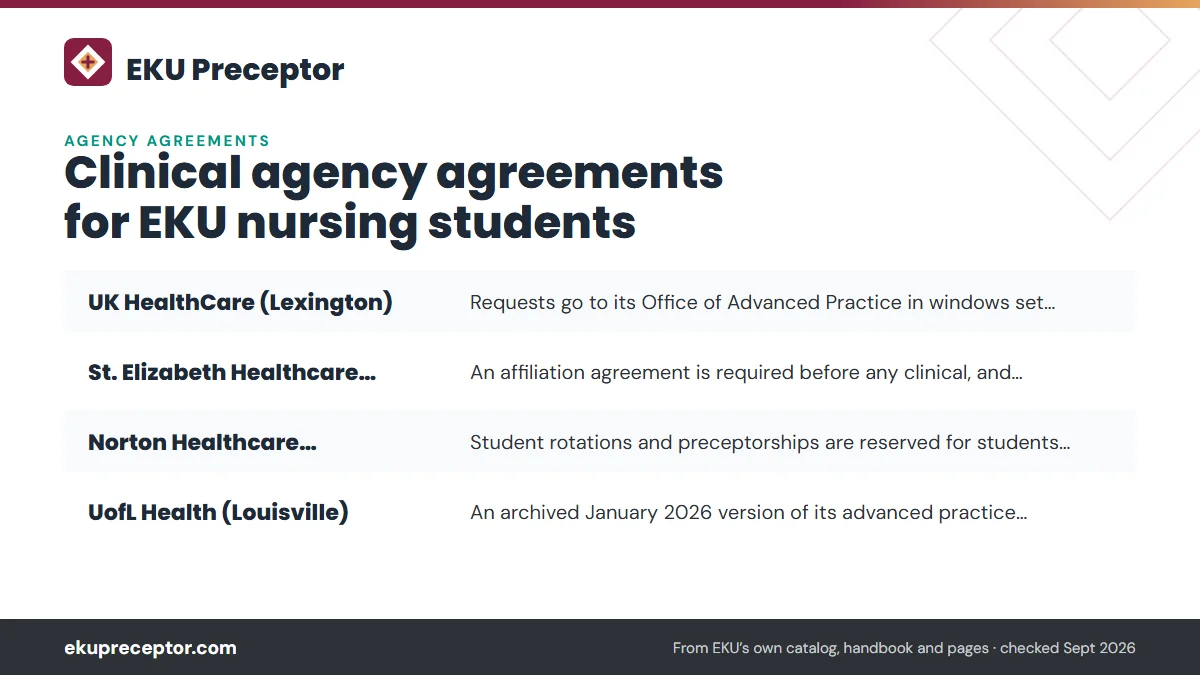
| System | What its pages say |
|---|---|
| UK HealthCare (Lexington) | Requests go to its Office of Advanced Practice in windows set by clinical dates; fall clinicals (August 1 to December 15) are requested July 15 to August 15. A student agreement with your school must be on file, UK's own students are placed first, both the Office of Advanced Practice and the Office of Observation and Learning Experience must approve, and a status email arrives about four to six weeks before the start. |
| St. Elizabeth Healthcare (Northern Kentucky) | An affiliation agreement is required before any clinical, and St. Elizabeth Physicians needs its own separate contract. Its graduate medical education office onboards rotation students through Clinician Nexus at least 14 days before the rotation starts. |
| Norton Healthcare (Louisville) | Student rotations and preceptorships are reserved for students near the end of their program, and the preceptor is approved by the school's own criteria. |
| UofL Health (Louisville) | An archived January 2026 version of its advanced practice preceptor request form asked for requests at least eight weeks ahead so a school contract could be confirmed. The live form page returned an error in September 2026. |
The pattern repeats across all four: contract first, then a request window, then onboarding. That is why the site side of a placement needs as much lead time as the preceptor.
Sites outside Kentucky
Online EKU students train where they live, and the site's state can add steps. EKU's graduate catalog has every student tell EKU where supervised field placements will physically take place whenever they fall outside Kentucky. EKU's state authorization page then adds notes for particular states that bear directly on sites and contracts:
- Alabama and North Dakota: before nursing students start clinicals there, EKU files a notice with the state along with a fee; Alabama's is due by January 1 of each year EKU plans clinicals.
- Missouri: site contracts with EKU must be short-term rather than multi-year, and the EKU program approves each site.
- Maryland: unpaid or low-paying placements of any kind must be approved before admission.
- Colorado: EKU is not authorized to conduct clinical practicum there, and New York field placements need that state board's specific approval.
Enrollment limits, the licensure table and the full text of each note are on state authorization. If your site sits in one of these states, raise the note with your faculty before the site signs anything.
How we prepare the site side
Your placement advisor gives the site the same attention as the preceptor. Before you put an option forward, we confirm the site will sign a clinical contract with EKU, collect its onboarding list, and set both against your term. Fall 2026 classes start August 24 and spring 2027 classes start January 25, and a contract still in review on those dates can hold back a clinical block that begins with them.
We also check the site's state against EKU's notes, flag anything that needs action from EKU first, such as a short-term Missouri contract, and organize the site details for your preceptor information form. EKU signs and approves; we make sure it has everything it needs to do that quickly. Start your placement plan with your program, city and start term.
Questions EKU students ask
Does EKU have a clinical agreement with my hospital?
EKU does not publish a list of its clinical agency agreements. Ask your faculty whether a contract is already on file for the site you have in mind, since a system such as UK HealthCare approves no placement until one is. Your placement advisor also asks the site directly whether it will sign with EKU before you put it forward.
Can I do clinical hours while the contract is still being signed?
Plan on no. EKU's most recent public MSN handbook requires the clinical contract and site documents to be current before clinical practice each semester, and the DNP handbook holds hours until onboarding paperwork is complete. Build the contract into your timeline early enough that it is signed before your course starts.
If I do clinicals at my job, does my employer still need a contract with EKU?
For the RN to BSN, EKU's archived 2023-24 handbook said yes, even at the student's own employer. The MSN rule for workplace clinicals is not public, so expect the site to need its paperwork with EKU and confirm with your faculty. Clinicals where you work covers the other questions that option raises.
Who signs clinical agreements for EKU?
EKU does not name the signer. The closest title in its directory is the College of Health Sciences' Coordinator, Clinical Agreement & Compliance, and the DNP handbook names a Clinical Placement Coordinator who approves sites. Your faculty can tell you who handles a new site's contract for your course.
Why does Missouri limit EKU to short-term site contracts?
EKU's state authorization page records it as a Missouri rule: the state will not permit a placement site and EKU to sign a multi-year contract, though a short-term one is fine, and each site needs the EKU program's approval. The practical effect is that a Missouri site signs for your placement rather than for years at a time, so start that paperwork early.
Related pages
Last checked 2026-09-25
We check these pages against EKU's own catalog, program pages and handbooks, and Kentucky's regulations. The current MSN Student Handbook, your course and your faculty have the final word.
EKU secures your preceptor. Your input decides how well it fits your life.
Tell us your EKU program, where you live and when your next clinical course starts. We find preceptors in your community who fit the course and prepare everything EKU reviews, so the option you put forward is ready to approve.
- Preceptors matched to the course: family primary care for
NSC 800andNSC 876, psychiatric care forNSC 886 - Preceptor, license and site details organized for EKU's preceptor information form
- In your own community, wherever EKU enrolls students and you hold your RN license
Start your placement plan
Program, city and start date is all we need to begin.