EKU's rural health focus and the clinical sites it points to
EKU's 2026-27 catalog names its NP concentrations plainly, Family Nurse Practitioner and Psychiatric Mental Health NP, yet rural wording runs all through the program: Rural Health Family Nurse Practitioner on EKU Online pages, “MSN – Rural PMHNP” on the PMHNP landing page, a rural primary care internship and a library guide built for rural FNP research. Here is where that emphasis comes from and what it means for choosing clinical sites and preceptors.
Get your placement plan
Tell us your EKU program and where you live. A placement advisor replies with preceptor and site options in your community that fit your EKU course.
Where EKU still says rural
The catalog dropped “Rural” from the concentration names, but the idea never left the program. You will meet it in several places:
- EKU Online landing pages market the MSN FNP as the Rural Health Family Nurse Practitioner program.
- The PMHNP landing page uses the title “MSN – Rural PMHNP”.
- EKU student stories refer to “EKU's Rural FNP program”.
- The internship. EKU's catalog frames the
NSC 876FNP Internship around rural primary care; theNSC 876page covers what that asks of you. - Old addresses. EKU's former FNP page address, which carried the words rural health, now redirects to the current FNP page, and the PMHNP page's catalog link still uses an older rural-named address.
- A dormant course.
NSC 883Rural PMHNP Child Adolescent (3 credits) remains in the course list. Only nurses already certified as adult PMHNPs may take it, and no current program requires it.
None of this changes your degree. The MSN FNP and the Rural Health FNP are the same 47-credit concentration, and the PMHNP is one 49-credit concentration whatever the landing page calls it. What the rural thread does change is the kind of clinical setting EKU has in mind, above all for the FNP internship.
EKU's home region in numbers
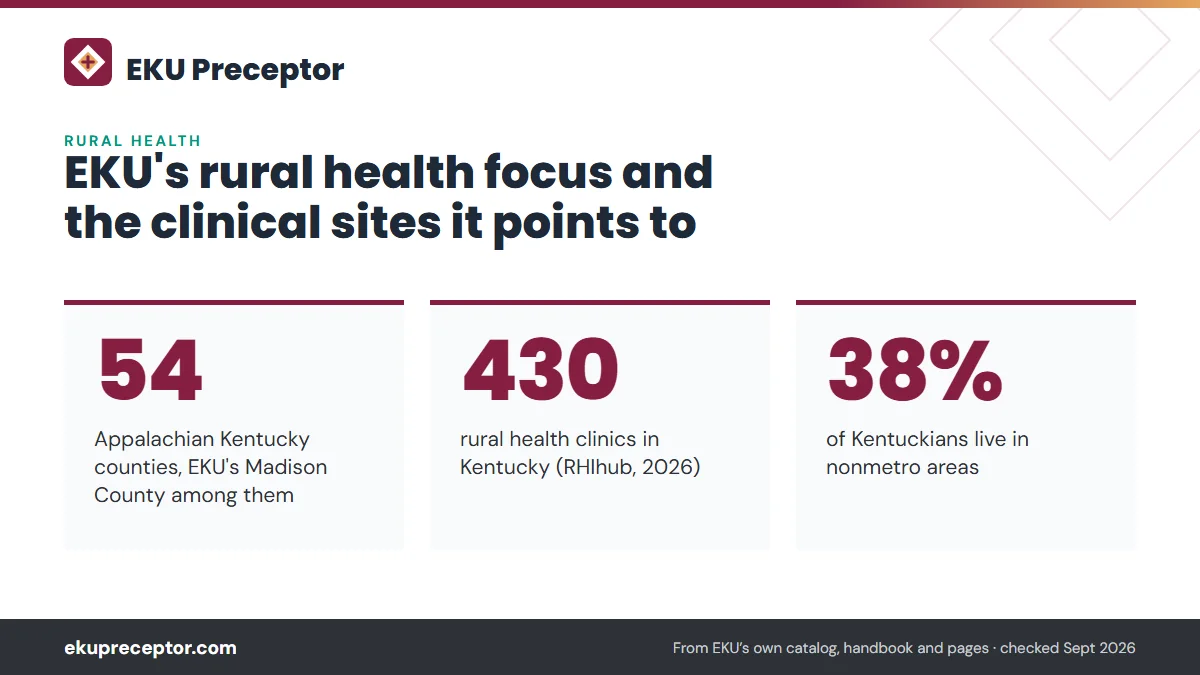
EKU sits in Richmond, in Madison County, one of the 54 counties the Appalachian Regional Commission counts as Appalachian Kentucky. The rural focus reflects the communities around the campus and across the region.
| Measure | Figure | Source |
|---|---|---|
| Madison County economic status, FY 2027 | Transitional, with 6 distressed census tracts (2 in FY 2026) | Appalachian Regional Commission |
| Appalachian Kentucky counties, FY 2027 | 41 Distressed, 10 At-Risk, 3 Transitional | Appalachian Regional Commission |
| Neighboring counties | Estill, Jackson and Rockcastle Distressed; Clark and Garrard Transitional (FY 2026 and 2027) | Appalachian Regional Commission |
| Madison County shortage designations | Low-income population HPSA in primary care (score 17) and mental health (score 18), both marked rural | HRSA data, 2026 |
| Kentucky shortage areas | 256 primary care and 221 mental health HPSAs in designated status | HRSA data, 2026 |
| Kentuckians in nonmetro areas | 1,723,273 people, 38.0% of the state | RHIhub, from Census ACS 2024 5-year |
For an FNP or PMHNP student, the shortage figures matter most. They describe exactly the communities where primary care and mental health providers are stretched, which is also where EKU's rural emphasis points its students.
Rural settings that suit EKU clinicals
Kentucky alone has 430 rural health clinics, 423 federally qualified health center sites, 29 critical access hospitals and 2 rural emergency hospitals, according to the Rural Health Information Hub's 2026 figures. Similar settings exist in most states EKU enrolls from, so online students outside Kentucky can look for the same types near home.
- Rural health clinics suit FNP students in
NSC 800and the internship: small primary care practices seeing patients of every age. - Federally qualified health center sites suit FNP students, and those with behavioral health services can suit PMHNP students too.
- Critical access hospital clinics can offer broad outpatient primary care alongside a small rural hospital.
- Community mental health and outpatient psychiatry in rural counties suit PMHNP students through
NSC 800and theNSC 886internship. - Small-town family practices, often run by one or two providers, suit FNP students who want continuity with one preceptor.
EKU publishes no definition of rural for its clinical courses. Before you settle on a site for the internship, ask your faculty whether it fits the course's rural primary care description.
What rural precepting is really like
Rural sites can offer unusually broad NP training. You see a wide mix of patients, acute and chronic, young and old, often with mental health needs woven into primary care visits, and you work closely with one preceptor. The same features bring practical limits worth planning for.
One preceptor, one schedule. In a clinic with one or two providers, your preceptor's day off or vacation is your day off too. Build a buffer into your weeks, because under EKU's archived handbook, missing a third clinical day could put the course at risk.
Distance. A strong rural site may be a long drive each way, and a concentrated internship repeats that drive twice a week for a full semester.
Paperwork lead time. Small practices may have little experience with school agreements, so the clinical contract, site documents and EKU's review can take longer than at a large system. Agency agreements explains the steps.
Who can precept. Kentucky's definition of a preceptor reaches beyond NPs to physicians and physician assistants, which widens the field in places with few NPs. EKU's own specialty rules are not public; preceptor requirements covers what is known.
The Rural Health FNP research guide
EKU Libraries keeps a guide called the Rural Health Family Nurse Practitioner Research Guide, last updated May 4, 2026. Its tabs cover UpToDate and articles, searching, getting help, health data and APA 7th edition, and its database list runs from CINAHL Ultimate and MEDLINE to Web of Science, APA PsycINFO, the Cochrane Library and UpToDate.
The health data tab is worth a look before your clinicals: understanding the population your rural site serves makes you a sharper student and gives you something concrete to discuss with a prospective preceptor. There is no separate PMHNP or DNP guide; PMHNP students can use the School of Nursing's broader Nursing Research Guide, which also carries a tab for NSC 890 PICOT searches. EKU's online student tools lists the other systems you will use.
How we find rural preceptors for EKU students
Under Kentucky's regulation for APRN programs, EKU secures preceptors and students may have input into the process; the Kentucky rule page gives the full text. Rural students often have the clearest input of all: they know which clinic in the next county sees every kind of patient and which practice their neighbors rely on.
We build on that. Your placement advisor searches rural health clinics, health center sites and small-town practices near you, finds a preceptor whose schedule fits your course and your job, and readies the paperwork EKU reviews. We stay on call all term, and if a preceptor has to withdraw, we source another. EKU reviews and approves every option; ours reach it complete, with the rural primary care or psychiatric fit already worked out. Tell us where you live through the request form.
Questions EKU students ask
Do I have to live in a rural area to join EKU's FNP program?
No such requirement appears in EKU's admission criteria, which cover a BSN, an unencumbered RN license, a 3.0 GPA, a statistics course, a year of RN experience, references and a professional statement. Where you live matters for state authorization, not rurality. The rural emphasis shows up mainly in the FNP internship, so an urban student should ask early how to meet it.
Is EKU's Rural Health FNP a different degree from its FNP?
No. Rural Health FNP is the name EKU Online still uses in marketing for the MSN Family Nurse Practitioner concentration, the same 47-credit program in the 2026-27 catalog. EKU's older rural-named FNP page address now redirects to the current FNP page. See the MSN FNP page for the full program.
Does a federally qualified health center count as a rural site?
It depends on the site. Health center sites operate in both cities and small towns, and many are rural. EKU does not publish its own definition of rural for the FNP internship, so ask your faculty whether a particular health center location fits before you commit to it.
Does EKU offer a rural PMHNP program?
EKU's PMHNP landing page uses the title “MSN – Rural PMHNP”, and the catalog lists the program as the Psychiatric Mental Health NP concentration, 49 credits, with NSC 886 PMHNP Internship at the end. A rural child and adolescent course, NSC 883, is still in the course list but is not part of any current program.
Can a physician assistant precept me at a rural clinic?
Kentucky's APRN program regulation includes physician assistants in its definition of a preceptor, along with APRNs and physicians. EKU's own rules on which professional can precept which course are not public, so raise a PA preceptor with your faculty before the term, especially for PMHNP courses.
Related pages
Last checked 2026-09-25
We check these pages against EKU's own catalog, program pages and handbooks, and Kentucky's regulations. The current MSN Student Handbook, your course and your faculty have the final word.
EKU secures your preceptor. Your input decides how well it fits your life.
Tell us your EKU program, where you live and when your next clinical course starts. We find preceptors in your community who fit the course and prepare everything EKU reviews, so the option you put forward is ready to approve.
- Preceptors matched to the course: family primary care for
NSC 800andNSC 876, psychiatric care forNSC 886 - Preceptor, license and site details organized for EKU's preceptor information form
- In your own community, wherever EKU enrolls students and you hold your RN license
Start your placement plan
Program, city and start date is all we need to begin.