Doing your EKU clinicals where you work
EKU has no published rule on MSN clinicals at your own employer, in either direction. What it has published is a 2021 EKU Online story in which an FNP graduate credits EKU with letting her train at her own job, plus workplace language for its RN to BSN and DNP programs. Below: what that adds up to, what makes an employer site workable, and the questions to settle with faculty first.
Check your workplace option
Tell us your EKU program, your employer's setting and your next clinical term. We help you shape a workplace proposal or find a site nearby.
What EKU has said
The clearest statement comes from EKU, though not from a policy. In a September 2021 EKU Online blog post, a Rural FNP graduate from Alaska said she chose EKU partly because it "would allow me to perform clinicals where I worked." It is one graduate's account, in a story EKU published about its program, and it is five years old. It still shows that EKU has allowed workplace clinicals for at least one FNP student.
EKU says more about workplaces for its other online programs. The RN to BSN page tells students their clinical projects can be done at their current employer, and the DNP page says the doctoral project can take place in the student's own organization or community.
For the MSN and post-MSN tracks, no current EKU page, catalog entry or archived handbook sets a rule on employer sites: nothing on whether a different unit is needed, whether a different supervisor is needed, or whether hours during paid shifts can count. Under Kentucky's rule, EKU secures preceptors while you keep a voice in the choice, and proposing your employer is one way to use that input. The details come from your faculty, course by course.
One graduate's story is not a policy. Treat the 2021 quote as evidence that EKU has allowed workplace clinicals, then get your own course's answer from your faculty before you build a plan on it.
What EKU's RN to BSN rules suggest
The only EKU document that spells out workplace placements is the archived RN to BSN Student Handbook for 2023-24, and it belongs to a different program, so read it as a pointer rather than an NP rule. It let students use their place of employment when it was a healthcare agency and an affiliation agreement was signed, and it said EKU requires that agreement "even if it is the student's place of employment". All preceptors and mentors needed approval from the primary course leader.
The lesson carries over: being on staff does not replace the paperwork. Expect your employer to need the same kind of agreement a stranger's clinic would, and expect your preceptor to go through EKU's review like any other. The MSN form is, after all, a clinical contract as well as a record of preceptor information. Our guide to clinical agency agreements covers what EKU publishes about contracts.
What makes a workplace site work
These are the features that make a workplace site workable in practice. None is a published EKU rule for NP students; each is a question a careful reviewer is likely to raise.
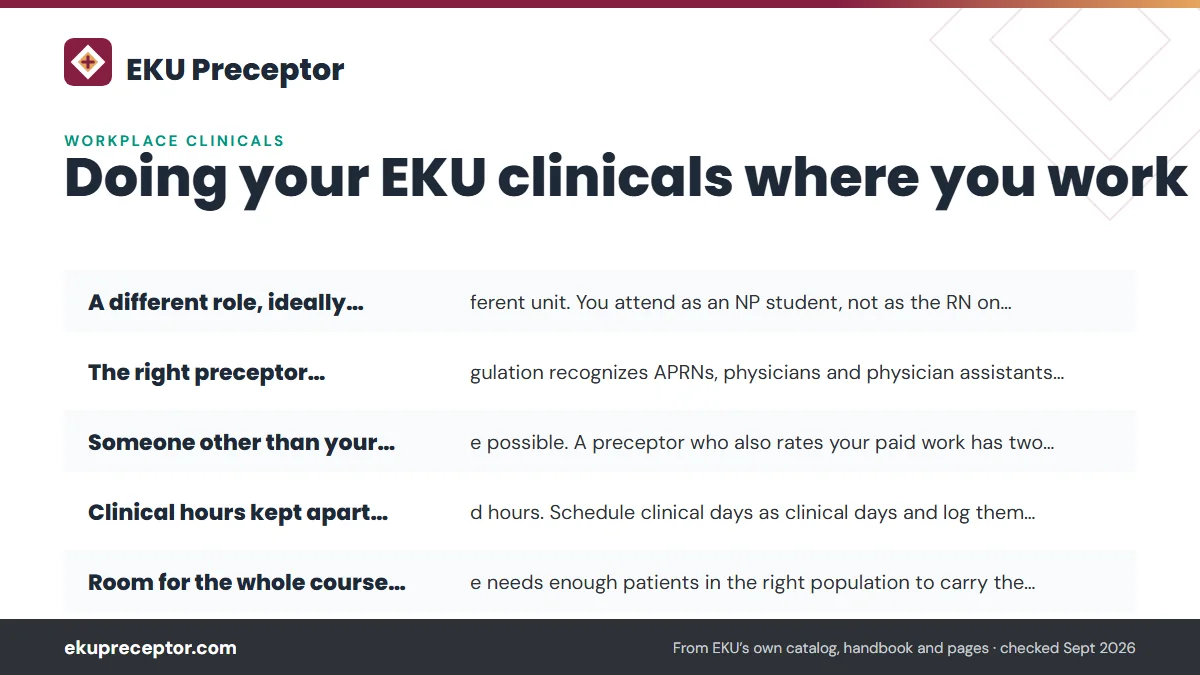
- A different role, ideally in a different unit. You attend as an NP student, not as the RN on shift. A clinic or unit where you do not normally work keeps colleagues, patients and your own habits from pulling you back into the staff role.
- The right preceptor. Kentucky's regulation recognizes APRNs, physicians and physician assistants as preceptors. For FNP courses that means someone practicing family primary care; for PMHNP courses, psychiatric-mental health care. An RN manager, however senior, falls outside that definition. See preceptor requirements.
- Someone other than your boss, where possible. A preceptor who also rates your paid work has two roles to keep apart, and your faculty can tell you whether EKU wants them separated for your course.
- Clinical hours kept apart from paid hours. Schedule clinical days as clinical days and log them separately, as the next section explains.
- Room for the whole course. The site needs enough patients in the right population to carry the full clinical load. For
NSC 876, the rural primary care internship, ask whether your workplace qualifies. - Clearance as a student. Expect student onboarding to run apart from your employee file, and a site may ask for its own screening even for staff.
Why paid hours and clinical hours stay apart
The reasons are practical as much as formal. Under the 2021-22 handbook, the professional liability insurance students must buy through EKU applied only to clinical experiences within scheduled classes. A paid shift is not a scheduled class, so time you spend on the payroll sits outside that coverage. The liability insurance guide explains the coverage year.
The hours are also measured on their own terms. EKU's MSN FNP counts 750 hours of direct patient care, with the final 300 set aside for synthesis, and every one of them belongs to a clinical course under a preceptor's supervision. Hours that were plainly student time, spent on NP-level work with a qualified preceptor, are the easiest to stand behind. EKU has not said whether paid time can ever count.
Attendance rules assume a clinical schedule too. The same handbook wanted the preceptor and clinical faculty told at least an hour ahead of any missed clinical, and more than two missed clinical experiences could mean failure. A clinical day swallowed by a staffing call is still a missed clinical day.
What to confirm with your faculty
Take these questions to your clinical faculty or program coordinator before asking your employer for anything. With EKU's answers in hand, your request to your manager can be specific.
- Can my employer serve as a site for this course, and for the internship as well as
NSC 800? - Does EKU want a different unit, clinic or department from the one where I am employed?
- May my preceptor be someone who supervises or evaluates my paid work?
- Can any time worked during a paid shift count, and how must clinical hours be logged?
- Is there an existing agreement between my employer and EKU, and if not, who starts one?
- For
NSC 876, does my workplace meet the rural primary care focus of the internship? - Does my employer's own student policy let staff train there as students?
How we help with a workplace placement
If your workplace fits, your placement advisor helps you turn it into a clean proposal: finding an NP or physician in the right specialty in a unit where you do not work, confirming their license, and preparing the preceptor and site details for EKU's form along with what your employer's agreement needs.
If it does not fit, because no one there practices in your specialty, your employer does not host students, or EKU asks for a separate site, we find a preceptor near your home or your job instead, on days that work around your shifts. Either way, we remain on call through the course with a fallback ready, and the placement itself is EKU's to approve. Start with the form below.
Questions EKU students ask
Can my manager be my preceptor at EKU?
Only if your manager is an APRN, physician or physician assistant in the right specialty, since Kentucky's regulation defines a preceptor that way. Even then, EKU has not published whether someone who supervises your paid work may also precept you. Ask your faculty before proposing a supervisor, and consider a colleague in another clinic or unit.
Can hours from my regular job count as clinical hours?
EKU has not published a rule that allows it. Clinical hours belong to your clinical courses and your preceptor's supervision, and the student liability policy bought through EKU was tied to scheduled clinical coursework in the 2021-22 handbook. Plan clinical days as separate student time, log them that way, and raise anything borderline with your faculty.
Will my employer need a clinical agreement with EKU?
Plan for yes. EKU's MSN form combines a clinical contract with preceptor information, and EKU's RN to BSN handbook required an affiliation agreement even at a student's own workplace. Whether your employer already has one with EKU is a question for your faculty, and the answer tells you how much lead time to allow.
Can I do the FNP internship at my workplace?
Possibly, if your workplace is the right kind of practice. EKU describes NSC 876 as a concentrated rural primary care practicum, and the final 300 of the 750 FNP hours are meant for synthesis of everything before them. A rural primary care clinic with an NP or physician preceptor is the natural fit. Confirm with your faculty before planning around it.
What if my employer does not take NP students?
Then look beyond it. Your placement advisor finds a preceptor near your home or your job, in the right specialty and on days that fit your shifts, and prepares the details for EKU's review. A nearby practice can also be easier to schedule, since clinical days there never compete with your employer's staffing needs.
Related pages
Last checked 2026-09-25
We check these pages against EKU's own catalog, program pages and handbooks, and Kentucky's regulations. The current MSN Student Handbook, your course and your faculty have the final word.
EKU secures your preceptor. Your input decides how well it fits your life.
Tell us your EKU program, where you live and when your next clinical course starts. We find preceptors in your community who fit the course and prepare everything EKU reviews, so the option you put forward is ready to approve.
- Preceptors matched to the course: family primary care for
NSC 800andNSC 876, psychiatric care forNSC 886 - Preceptor, license and site details organized for EKU's preceptor information form
- In your own community, wherever EKU enrolls students and you hold your RN license
Start your placement plan
Program, city and start date is all we need to begin.