How EKU evaluates your clinical performance
EKU's clinical courses turn on a Satisfactory or Unsatisfactory, and an Unsatisfactory carries the same weight as a grade below B. Your preceptor sees your daily work and your faculty run the course, but EKU has not published its evaluation forms, its site-visit practice or how preceptor ratings feed the grade. Here is what is public, what to ask in week one, and how to keep a preceptor relationship strong from first day to last.
Start with a preceptor who wants to teach
Tell us your program and your next clinical course. Your placement advisor looks for a preceptor whose practice, schedule and teaching style fit it.
Satisfactory or Unsatisfactory: what the clinical grade decides
EKU's graduate grading scale carries Satisfactory (S) and Unsatisfactory (U) marks alongside letter grades, and the archived 2021-22 MSN Student Handbook makes a Satisfactory mandatory in each practicum and internship. NP students do their clinical work in NSC 800 Advanced Practice Role, then in the FNP internship (NSC 876) or the PMHNP internship (NSC 886); confirm with your faculty how each enrollment is graded.
The stakes match a didactic course. Under that handbook an Unsatisfactory ends your place in the MSN program at once, and readmission is the only road back (grades and progression). A clinical grade carries no letter, but it is never a formality.
Post-MSN certificate students are in the same position, since EKU's catalog applies all MSN policies to them, while DNP students work under their own experience-hour rules (see the last question below). Whatever your program, learn how your clinical work is judged before the first clinical day, not after the first feedback.
Who evaluates you: preceptor and faculty
Two people see your clinical work from different distances. Your preceptor works beside you and sees how you assess, reason and present, day after day; the attendance rule in EKU's handbook refers to "the clinical instructor (preceptor)" and leaves some attendance calls to that instructor's discretion. Your clinical faculty run the course, set its requirements and are the people to hear from you the moment something goes wrong.
Kentucky's rules frame the preceptor's place. The APRN program regulation, 201 KAR 20:062, limits NP preceptors to APRNs, physicians and physician assistants, and places the duty of securing them on the program. For BSN students, the prelicensure rule 201 KAR 20:310 is blunter: "A preceptor shall not be used to replace clinical instructors." Either way, the course and its grade belong to EKU, with the preceptor's view as a central input.
What EKU has not published about evaluations
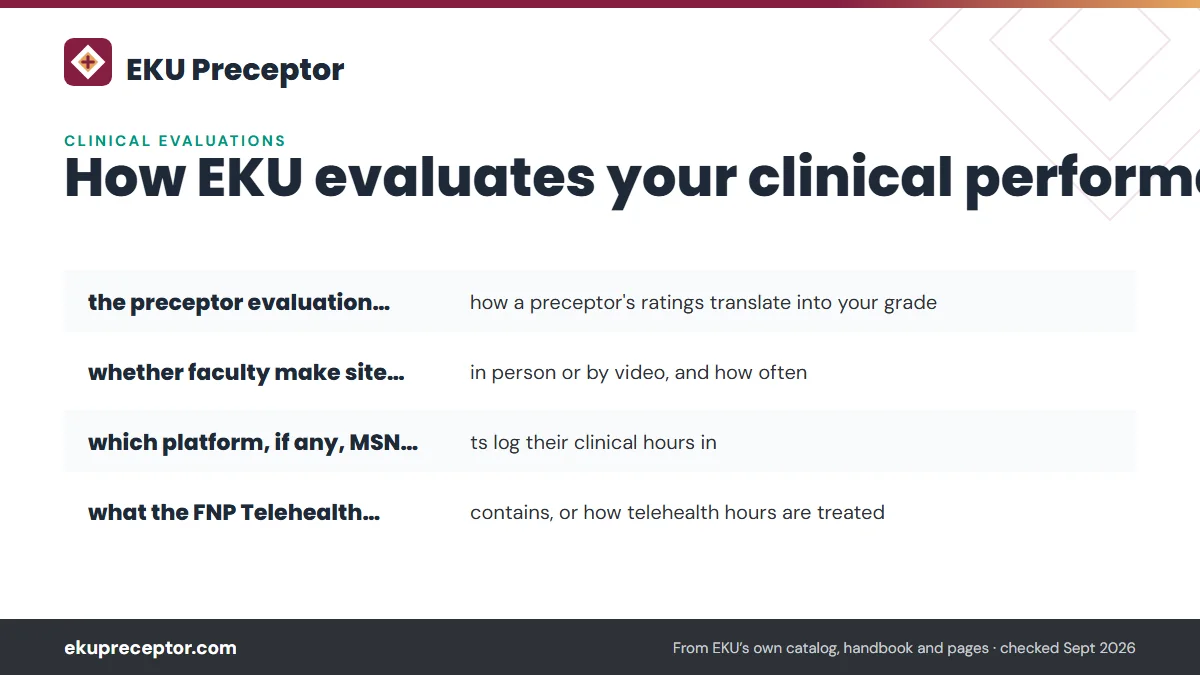
Several parts of the process live only in course materials. No public EKU source, current or archived, shows:
- the preceptor evaluation form, or how a preceptor's ratings translate into your grade
- whether faculty make site visits, in person or by video, and how often
- which platform, if any, MSN students log their clinical hours in
- what the FNP Telehealth Checklist contains, or how telehealth hours are treated
Borrowing answers from other schools will mislead you here. In the first week of each clinical course, ask your faculty four things: which evaluation your preceptor completes and when, whether there is a midpoint check, whether a faculty visit or call is planned, and where your hours are logged. Share the answers with your preceptor so you both work to the same standard, and keep them with your course notes.
Unsafe practice and unprofessional conduct
Two terms in the archived MSN handbook can end a clinical course on the spot. Unsafe practice covers any situation that "could potentially cause harm to the client served." Unprofessional conduct is "conduct that violates the American Nurses Association Code of Ethics for Nurses."
Removal from a clinical area on either ground brings a U for the course and dismissal from the program; the way back is an application to the reinstatement committee. Notice how wide the first definition is: it turns on potential harm, not harm done.
The handbook's social media policy sits right beside these rules: nothing that identifies a patient or a clinical agency goes online, and professional boundaries hold with patients and staff. A casual post about a clinic day is exactly the kind of slip that policy is written to catch.
Learn the site's protocols as carefully as EKU's. Because the unsafe-practice test turns on potential harm, acting outside the site's procedures, or beyond what your preceptor has cleared you to do, can count against you even when nothing goes wrong.
Building a strong relationship with your preceptor
A preceptor who trusts you hands you more patients and more independence, and the evaluation tends to follow. The habits that earn that trust are specific:
- On day one, agree on the schedule, your learning goals and what your EKU course expects, and give your preceptor a copy of the course objectives.
- Give absence notice early and in writing; EKU's floor is an hour ahead, to your preceptor and your faculty both (attendance rules).
- Arrive prepared: read up on the next day's patient mix and present each case in a consistent format.
- Ask for feedback at a set point, such as the end of each week, instead of waiting for the final form.
- Keep your clearance documents current so the site never has to chase you (compliance).
- Close well: thank your preceptor and the site staff, and ask whether they would welcome another EKU student.
How we set you up for a strong evaluation
Evaluations start with the match. Your placement advisor looks for a preceptor whose practice fits the course (primary care for NSC 876, psychiatric-mental health for NSC 886), who has real time to teach, and whose schedule leaves room for your hours. Before the first day we walk the preceptor through the EKU course details you share with us, such as the objectives and the hours you need, so expectations are clear on both sides.
If the relationship falters or a preceptor has to step away, we stay involved and line up a replacement for your input, which EKU approves the same way it approves every placement under Kentucky's rule. Request a preceptor and tell us which course comes next.
Questions EKU students ask
Does my preceptor decide whether I pass an EKU clinical course?
Your preceptor's observations matter a great deal, but EKU has not published how they are weighed. The archived handbook gives the clinical instructor discretion over some attendance decisions, while the course and its grade sit with EKU faculty. Ask at the start of each course how your preceptor's evaluation feeds the Satisfactory you need.
Do EKU faculty visit graduate clinical sites?
EKU has not published whether faculty visit graduate clinical sites, in person or by video, or how often. Ask your faculty in the first week of the course, and pass the answer to your preceptor so a call or visit from EKU is expected rather than a surprise. Keep the site's contact details current in case faculty need them.
What should I do if my preceptor gives me a poor evaluation?
Talk to your faculty quickly, before the course ends, and bring specifics: what the preceptor raised, what you have changed since and the dates. A concern raised midway leaves time to respond, while an Unsatisfactory at the end triggers the progression rule. If the problem is fit rather than performance, say so plainly as well.
Can I switch preceptors partway through an EKU clinical course?
A change goes through EKU, which secures and approves every preceptor, and a new site brings its own paperwork. Your input still counts: you can propose a replacement who fits the course. Raise it with your faculty early, because hours with the new preceptor still have to fit inside the course dates.
How are EKU DNP students evaluated in their experience hours?
EKU's archived DNP handbook describes a DNP Committee that pairs each student with a faculty chair holding a doctorate plus a second team member, and may bring in a DNP Preceptor and people from the organization as stakeholders. Students keep a DNP Experience Log and finish by presenting a DNP project. See DNP clinical hours for the hour rules.
Related pages
Last checked 2026-09-25
We check these pages against EKU's own catalog, program pages and handbooks, and Kentucky's regulations. The current MSN Student Handbook, your course and your faculty have the final word.
EKU secures your preceptor. Your input decides how well it fits your life.
Tell us your EKU program, where you live and when your next clinical course starts. We find preceptors in your community who fit the course and prepare everything EKU reviews, so the option you put forward is ready to approve.
- Preceptors matched to the course: family primary care for
NSC 800andNSC 876, psychiatric care forNSC 886 - Preceptor, license and site details organized for EKU's preceptor information form
- In your own community, wherever EKU enrolls students and you hold your RN license
Start your placement plan
Program, city and start date is all we need to begin.