Who does what at EKU during a clinical course
A clinical course at EKU involves more people than the syllabus lists: course faculty, a clinical instructor at your site, advisors, the Clinical Placement Coordinator, the School of Nursing Chair, and university offices for money, registration and technology. This guide describes each role the way EKU's catalog, handbooks and directory do, along with the questions each one answers best. It uses titles only, never names.
Get your placement plan
Tell us your EKU program and where you live. A placement advisor replies with preceptor and site options in your community that fit your EKU course.
Course faculty and your clinical instructor
Each course has a course leader, whom EKU's handbook also calls the course coordinator, and clinical faculty who oversee the clinical component. They set expectations, grade your work and are the first stop for nearly any question about NSC 800, NSC 876 or NSC 886. Before withdrawing from a course, the MSN handbook tells you to meet the course leader, because dropping one MSN course counts as withdrawing from the whole program and means applying for readmission.
At the site, the MSN handbook's name for your preceptor is the clinical instructor (preceptor). If you must miss a clinical day, the 2021-22 handbook says to give both the preceptor and your clinical faculty at least an hour's notice, and missing more than two clinical experiences can lead to failure at the clinical instructor's discretion. That handbook is archived, so check your syllabus for the current rule; the attendance guide covers the details.
Program coordinators for FNP, PMHNP and DNP
Kentucky's APRN regulation requires two coordinator roles in every Kentucky APRN program: one licensed APRN overseeing the whole program, and a track coordinator for each track who is licensed in that track's role and population. EKU's program pages leave the holders of these posts unnamed, and its DNP handbook also refers to a DNP Coordinator for the doctorate.
Program-level questions belong here: which edition of the MSN Student Handbook applies to you, how a catalog change affects your plan of study, and what to follow where EKU's own sources disagree. Two conflicts are worth raising early. The 2021-22 handbook set a 7-year limit for the master's degree, while the 2026-27 catalog sets 10 years for any master's program above 40 hours, which includes the 47 to 49 hour MSN. The same handbook required 9 credits of NSC 800 for FNP students, where the catalog now lists 8.
The Clinical Placement Coordinator and your advisor
EKU's June 2020 DNP handbook describes the School of Nursing Clinical Placement Coordinator as the person who emails DNP students that they are approved to begin experience hours at a site. The MSN handbook refers to a Clinical Coordinator, who must hear from you at once, together with your advisor, if your license is ever disciplined. The Clinical Placement Coordinator page covers the role and the parts of it EKU has not published.
Advisors are assigned by track. The 2021-22 MSN handbook gives each track an advisor, also called an Assistant Online Coordinator, and EKU's program pages promise personalized academic advising. Your advisor is the person to clear a move out of state with before it happens: EKU's catalog asks you to report your home address and any change of location, and its state page warns that relocating after admission could mean removal from the program.
The School of Nursing Chair and the committees
The School of Nursing, part of the College of Health Sciences, is led by a Chair and an Associate Chair, with a Dean over the college. The unit was a department until 2020, so older handbooks still say Department Chair. In clinical matters the Chair's role is concrete: under the 2021-22 handbook, a student can appeal an absence ruling to the Chair, whose decision is final, and exposure incidents are reported to the Chair as well as the clinical instructor.
Progression decisions belong to the MSN Admission/Progression/Readmission/Reinstatement Committee, whose members the Chair appoints from the Graduate Committee. A student dismissed after a grade below B or an Unsatisfactory in a practicum applies to that committee for readmission 60 days before the term, and the handbook says decisions go out within 10 business days to the student's EKU email. The grades and progression page explains the rules that lead there.
University offices: enrollment, billing, records and technology
Outside the School of Nursing, a handful of university offices handle the practical side of being an online student. Each has a clear lane.
| Office | What it handles | Ask it about |
|---|---|---|
| EKU Graduate, Online & Adult Transfer | Enrollment for online and graduate students, with enrollment counselors, in the Whitlock Building | Applying, start terms and questions before you enroll |
| Big E Central | Financial aid, scholarships, billing, payment plans and registration assistance | Your bill, your aid package and registration problems |
| Office of the Registrar | Student records and registration rules | Late withdrawal petitions and Incomplete Grade Agreements |
| IT ServiceDesk | The first point of contact for all technology service issues | Problems with Canvas (eku.instructure.com), myEKU or myMail |
| EKU Libraries | Research help and databases for online learners, with chat help | The Rural Health Family Nurse Practitioner Research Guide and the nursing research guide |
The liability insurance EKU requires for clinical courses was billed with tuition and fees under the archived handbook, so a question about that charge usually starts at Big E Central. Each system in the table is described in EKU's online student tools.
The appeal chain, step by step
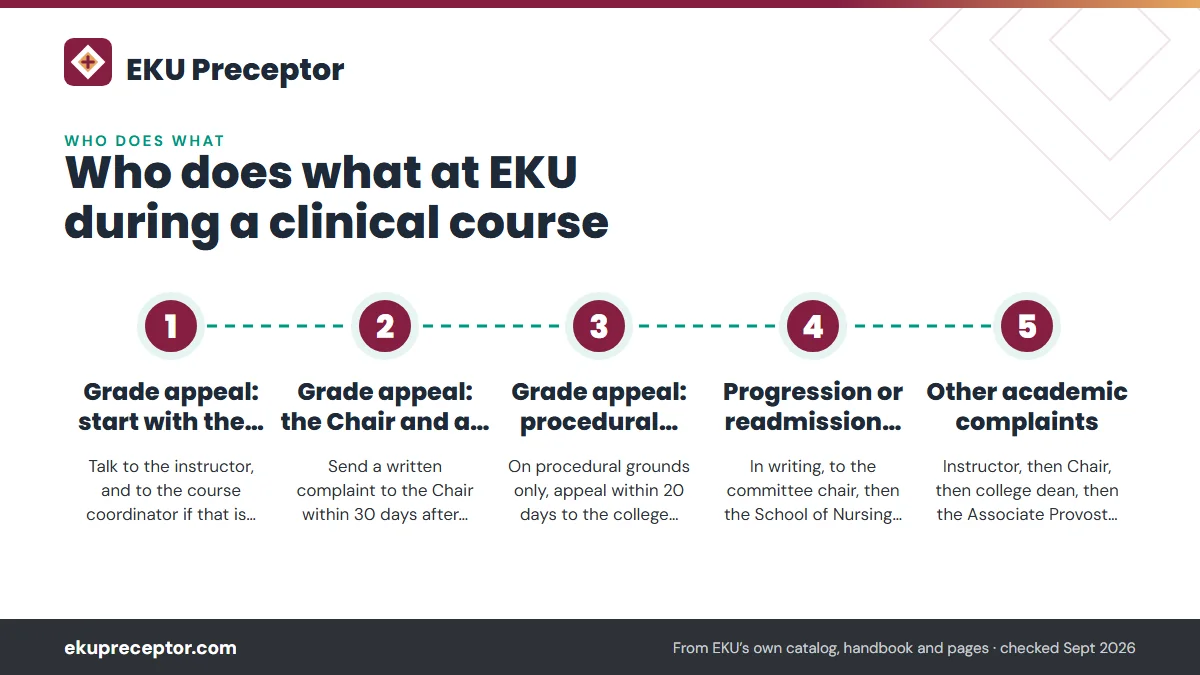
EKU keeps separate chains for grades, for progression decisions and for other academic complaints. Each runs in a set order, and EKU's student handbook says the steps for academic complaints must be taken in sequence, one level at a time.
- Grade appeal: start with the instructorTalk to the instructor, and to the course coordinator if that is a different person.
- Grade appeal: the Chair and a committeeSend a written complaint to the Chair within 30 days after the next semester begins, summer excluded. The Chair mediates, then refers the case to a departmental academic practices committee whose decision is binding.
- Grade appeal: procedural reviewOn procedural grounds only, appeal within 20 days to the college dean and then to the Senior Vice President for Academic Affairs and Provost.
- Progression or readmission appealsIn writing, to the committee chair, then the School of Nursing Chair, then the Dean of the College of Health Sciences, then the Graduate School.
- Other academic complaintsInstructor, then Chair, then college dean, then the Associate Provost for Student Academic Affairs, whose decision is final. EKU's student handbook takes complaints at this level in writing only: a signed letter, or a message sent from your official EKU email address.
Where your placement advisor fits
Your placement advisor works beside this chain rather than within it. Our job is the preceptor and the site: finding a match for your course in your own area, preparing the details EKU reviews, and staying on call to find a replacement should a preceptor drop out mid-term.
When a question belongs to EKU, such as a grade, a policy or an approval, we tell you which role above owns it and help you put it in writing clearly, so you get a usable answer the first time. That keeps EKU's people working on decisions only they can make, and keeps your clinical plan moving. Read how our process works, or send us your program and start term.
Questions EKU students ask
Who do I contact at EKU about a clinical placement problem?
Start with your course faculty, who oversee the clinical component and can tell you who handles sites for your course. DNP students also deal with the Clinical Placement Coordinator, who approves experience sites by email. If the problem is a preceptor stepping away, tell your faculty at once and let your placement advisor start on a replacement the same day.
Does EKU assign success coaches to online nursing students?
No EKU page names success coaches for online graduate nursing students. The roles EKU does describe are your track advisor, whom older handbooks also call an Assistant Online Coordinator, your course faculty and, before you enroll, the enrollment counselors at EKU Graduate, Online & Adult Transfer. The Student Success Center adds tutoring, mentoring and workshops.
Who do I tell if I move to another state during my EKU program?
Your advisor, before you move. EKU's catalog requires you to report your home address and any change of location, and its state authorization page cautions that a move after admission may get you removed from the program, because EKU does not enroll online NP students from every state. The list is on state authorization.
Where do I report a needlestick or exposure during an EKU clinical?
Immediately, to your clinical instructor and the School of Nursing Chair. The appendix to EKU's archived MSN handbook has students follow both the EKU Exposure Control Plan and the clinical agency's own plan. Your site will have its own reporting steps as well, so learn them during orientation and check your syllabus for EKU's current version.
Who is the School of Nursing Chair at EKU?
The Chair leads the School of Nursing within the College of Health Sciences, with an Associate Chair alongside. This site uses titles rather than names because staff change; EKU's catalog nursing page and directory show the current Chair. For clinical students, the Chair's office matters most in absence appeals and in the grade and progression appeal chains.
Related pages
Last checked 2026-09-25
We check these pages against EKU's own catalog, program pages and handbooks, and Kentucky's regulations. The current MSN Student Handbook, your course and your faculty have the final word.
EKU secures your preceptor. Your input decides how well it fits your life.
Tell us your EKU program, where you live and when your next clinical course starts. We find preceptors in your community who fit the course and prepare everything EKU reviews, so the option you put forward is ready to approve.
- Preceptors matched to the course: family primary care for
NSC 800andNSC 876, psychiatric care forNSC 886 - Preceptor, license and site details organized for EKU's preceptor information form
- In your own community, wherever EKU enrolls students and you hold your RN license
Start your placement plan
Program, city and start date is all we need to begin.