EKU clinical compliance: what you clear before a clinical course
Before each EKU clinical course you keep a set of documents current, and every clinical agency can stack its own screening on top. EKU publishes a full immunization and screening list only for its BSN programs; for graduate students it offers a core document list, in an archived handbook, plus a university-wide notice of what agencies may demand. This page sets the two side by side and marks what EKU has not made public.
Get the site's clearance list early
Tell us your program and your next clinical course. Your placement advisor collects the site's onboarding list with the preceptor, so you know what to clear and by when.
The graduate checklist in EKU's most recent MSN handbook
For NSC 800, NSC 876 and NSC 886, the 2021-22 MSN Student Handbook (archived; EKU no longer posts it) names the documents that must be current and shown to EKU every semester you are enrolled, ahead of any clinical practice. Post-MSN certificate students work from the same list, because EKU's catalog applies all MSN policies to them.
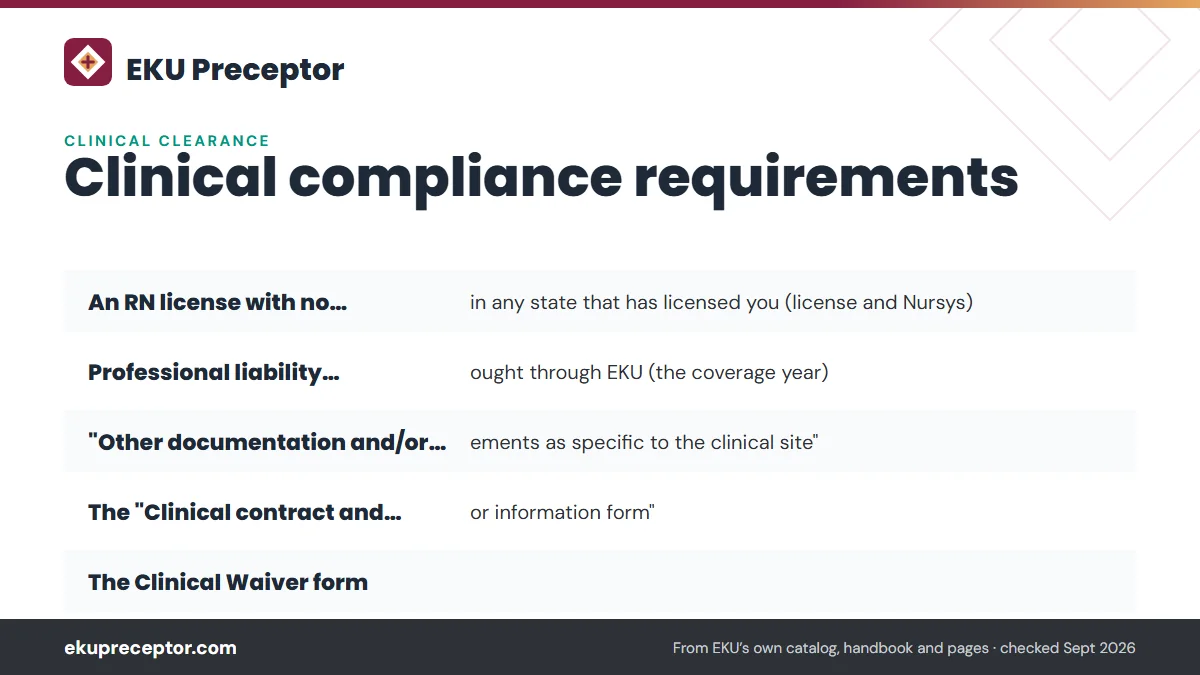
Kept current every semester (MSN Handbook 2021-22)
- An RN license with no encumbrance in any state that has licensed you (license and Nursys)
- Professional liability insurance bought through EKU (the coverage year)
- "Other documentation and/or requirements as specific to the clinical site"
- The "Clinical contract and preceptor information form"
- The Clinical Waiver form
- The Telehealth Checklist, for FNP students taking
NSC 800orNSC 876
Nursys e-Notify is handled once, by consenting at admission, rather than each term. The three forms get their own preceptor information form guide; EKU has not published their contents.
CPR and immunizations: the one list EKU publishes
EKU's only published immunization list sits in the 2026-27 undergraduate catalog for the BSN, which frames its clinical requirements around Joint Commission standards and the contracts EKU holds with clinical agencies. No separate graduate list is public, so read it as a strong preview of what a health care agency may ask of any EKU nursing student, not as your official graduate list.
EKU's BSN clinical clearance items (2026-27 catalog)
- CPR for the Health Care Professional
- Immunity to MMR (measles, mumps and rubella), hepatitis B and varicella
- A negative TB screen and an adult Tdap
- An annual flu vaccine
- A criminal background check and drug screen approved by the College of Health Sciences
- Personal health insurance, liability insurance bought through EKU, and facility-specific items
For graduate students, EKU's university-wide notice names immunization records and CPR certificates among the things an agency may require. Which CPR course and which proof of immunity your placement accepts is a question for your course faculty, since no public graduate document answers it.
Background checks, drug screens and agency extras
The notice appears on EKU's state authorization page and in the graduate catalog. Its list of what a collaborating organization can ask for is long: drug testing, criminal and sex offender registry checks, a search of the Office of Inspector General (OIG) exclusion records, federal fingerprints, immunization records, and certificates in OSHA, HIPAA and CPR. EKU is direct about the bill: "These tests are at the expense of the student."
The same notice cautions that a positive drug test or a criminal history can lead an agency to refuse the placement. If anything in your history could surface on a check, raise it with your faculty before a site is chosen, while there is still room to steer toward an agency whose policy fits.
Individual sites add their own layer. In St. Elizabeth Healthcare's published student guidelines, its Graduate Medical Education office onboards students rotating with credentialed providers through Clinician Nexus, with submissions due at least 14 days before the rotation, and Baptist Health Lexington's 2023 student packet marks Epic "Full Access" as required for students in preceptorships. Items like these are the site-specific requirements the handbook tells you to keep current.
The costly mistake is treating site onboarding as something that starts the week your course opens. Agencies set their own lead times, and a background check or a lab result can take longer than the gap between approval and your first clinical day.
Where the documents live: Complio, CastleBranch and the graduate gap
EKU names two tracking systems, and its pages disagree. The BSN and AAS program pages, updated in September 2026, say "The School of Nursing uses Complio to manage required clinical and compliance documentation." Complio is a product of American DataBank. Yet the AAS page also tells students to complete all CastleBranch requirements, and the School of Nursing's override guide says "Clinical sites check students' CastleBranch accounts before classes start."
A move from CastleBranch to Complio that some pages have not caught up with is the likeliest reading, but EKU has not said so. For online graduate students the record is blank: no EKU source names the system MSN, post-MSN or DNP students use for compliance documents or clinical logs. The single logging tool EKU does name is the DNP Experience Log, and it captures "date, time, nature of the learning activity, and correlation to the DNP Essentials."
So wait for instructions before you open any tracking account. Your course in Canvas, your myMail inbox and your faculty are where the name of your program's system will come from.
DNP students, exposure plans and conduct at the site
The archived DNP handbook (revised June 2020) expects DNP students to hold an RN license carrying no board restrictions, EKU-purchased liability coverage and whatever the site itself requires. It adds one item the MSN list lacks, an EKU Photo ID, to be worn at all clinical sites. DNP Experience Hours cannot begin before the semester opens or before the onboarding paperwork is finished.
Every graduate student also works under two exposure plans at once. The MSN handbook's appendix on exposure and allergy policies has students follow the EKU Exposure Control Plan alongside the clinical agency's plan, and report an exposure "immediately to the clinical instructor and the Department Chair." Learn the site's procedure at orientation, since the agency's plan governs what happens inside its walls.
Add the handbook's social media policy to this checklist as well: keep patient and agency details off every platform, and keep relationships at the site professional.
How we collect a site's clearance list before it matters
Clearance trouble is almost always timing trouble, and timing is where your placement advisor does the most good. When we find a preceptor for your input, we ask the site for its onboarding list in the same conversation: which screens, which proof of immunity, which systems and how many days ahead. You see that list while there is still time to act on it.
We then check your documents against EKU's items and the site's, so the option you put in front of EKU arrives with nothing missing. EKU secures and approves every placement, as Kentucky's rule requires (how the rule works); we make the part you control complete and early. Start a placement request when your next clinical course is two or more terms away.
Questions EKU students ask
Does EKU require a flu shot for graduate clinicals?
EKU publishes an annual flu vaccine requirement only for its BSN students. For graduate placements the deciding voice is the clinical site's own policy, since EKU's notice says agencies may require immunization records. Ask the site or your faculty before flu season starts, and keep proof of the current season's vaccine with your clinical documents.
What CPR certification do EKU nursing students need?
EKU's BSN list names CPR for the Health Care Professional, which is the level to plan around. The graduate documents that survive publicly do not name a CPR course, and EKU's notice lists CPR certificates among what an agency may require. Before you renew, ask your faculty whether your program or site specifies a provider.
Is Complio the same thing as CastleBranch?
No. They are separate compliance-tracking services from different companies; Complio comes from American DataBank. EKU's 2026 BSN and AAS pages name Complio, while the AAS page and the School of Nursing override guide still mention CastleBranch. Use whichever system your faculty or course instructions name for your program.
Do I resubmit compliance documents every term at EKU?
Under the archived MSN handbook, yes: the listed documents are presented each semester of enrollment before clinical practice, not once at admission. Some items rarely change, such as proof of immunity. Others do: a new site brings new site-specific requirements, and your insurance registration follows the August-to-August coverage year.
Do compliance rules change if my clinical site is outside Kentucky?
EKU's list travels with you, and the host state and the site can add to it. EKU requires students to report where supervised field placements outside Kentucky will happen, and some states attach conditions to out-of-state programs. The state authorization guide collects EKU's notes state by state.
Related pages
Last checked 2026-09-25
We check these pages against EKU's own catalog, program pages and handbooks, and Kentucky's regulations. The current MSN Student Handbook, your course and your faculty have the final word.
EKU secures your preceptor. Your input decides how well it fits your life.
Tell us your EKU program, where you live and when your next clinical course starts. We find preceptors in your community who fit the course and prepare everything EKU reviews, so the option you put forward is ready to approve.
- Preceptors matched to the course: family primary care for
NSC 800andNSC 876, psychiatric care forNSC 886 - Preceptor, license and site details organized for EKU's preceptor information form
- In your own community, wherever EKU enrolls students and you hold your RN license
Start your placement plan
Program, city and start date is all we need to begin.