Who can precept an EKU nurse practitioner student
Kentucky law allows three kinds of clinician to precept a nurse practitioner student: a physician, a physician assistant (PA) or an advanced practice registered nurse (APRN). EKU reviews each preceptor through the paperwork it collects before every clinical course, but it posts no public checklist of its own, so the working test is fit: the right specialty for your course, a clean license in the state where the site is, and a site ready for EKU's documents.
Get your placement plan
Tell us your EKU program and where you live. A placement advisor replies with preceptor and site options in your community that fit your EKU course.
What Kentucky's regulation says about preceptors
Regulation 201 KAR 20:062, written by the Kentucky Board of Nursing, governs APRN programs based in Kentucky, and EKU's MSN and DNP sit on the Board's approved list. Under Section 1, a preceptor can be a physician, a PA or an APRN, so long as they meet the standards in Section 5. Those three are Kentucky's entire list of eligible clinicians. The regulation adds no minimum years in practice, no certification type and no student-to-preceptor ratio for APRN programs.
Section 5 does two things. It tells each program to follow its national accrediting body's preceptor standards on top of Kentucky's, and for EKU that body is CCNE (see EKU's accreditation). It also makes finding preceptors the program's duty while leaving students room for input, a sentence the Kentucky preceptor rule page quotes in full. The regulation was certified again without change on January 8, 2026, so it is current law.
The two-to-one student-to-preceptor limit that circulates online comes from 201 KAR 20:310, Kentucky's rule for prelicensure programs such as EKU's BSN and associate degree. The APRN regulation covering EKU's NP tracks sets no ratio, so ask your faculty if a preceptor hopes to host more than one student.
Specialty fit for each EKU clinical course
EKU publishes no rule on which specialties may precept which course, so fit comes from what each course teaches. The 2026-27 catalog pairs NSC 800 Advanced Practice Role, 8 credits in total, with the three FNP or three PMHNP courses, then closes each track with an internship. The table shows the practice setting that lines up with each one.
| Course | What EKU's catalog says | Preceptor practice that fits |
|---|---|---|
NSC 800 with NSC 870, NSC 872, NSC 874 | Advanced Practice Role taken alongside FNP I to III, 8 credits in total | Family primary care: an FNP, a family medicine physician or a primary care PA |
NSC 876 FNP Internship | 6 credits, a concentrated rural primary care practicum | Primary care, with a rural practice matching EKU's own description |
NSC 800 with NSC 880, NSC 882, NSC 884 | Advanced Practice Role taken alongside PMHNP I to III, 8 credits in total | Psychiatric-mental health care: a PMHNP, a psychiatrist or a PA in psychiatric practice |
NSC 886 PMHNP Internship | 5 credits, the last clinical course in the PMHNP track | Psychiatric-mental health care with enough patient volume for an internship |
NSC 900 and NSC 901 (DNP) | Organizational Leadership: DNP Experience I and II | A practice site and a DNP Preceptor suited to your improvement project |
The last column is our reading of the course content, not an EKU rule. Your faculty confirm fit when they review your preceptor information, and the current MSN Student Handbook, rather than an archived copy, holds EKU's own word on specialty matching.
A license that fits the site's state
For a site in Kentucky, the Board's overview for online graduate APRN programs says nursing faculty who supervise students or act as preceptors in Kentucky need both a Kentucky RN license and a Kentucky APRN license, each active and unencumbered. The Board notes that clinical faculty living in a compact state need only the Kentucky APRN license, since Kentucky belongs to the Nurse Licensure Compact for RNs. APRN licenses are not part of any operating compact, so an NP preceptor's APRN license has to match the state where the site sits.
Outside Kentucky, we check the preceptor's license with the licensing board in the site's state. EKU's catalog also wants to know where any supervised clinical placement outside Kentucky will happen, and several states carry EKU notes of their own, listed on state authorization. Your half of the license question, keeping each RN license you hold unencumbered and staying enrolled in Nursys e-Notify from admission, is covered in RN license and Nursys.
What EKU looks at before clinicals begin
EKU's most recent public MSN Student Handbook is the 2021-22 edition, reachable today only through a web archive. It lists what MSN and post-MSN certificate students keep current each semester before NSC 800, NSC 876 or NSC 886, and the preceptor and site each show up in that list:
- The clinical contract and preceptor information form, the document that puts your preceptor in front of EKU
- Any documents the clinical site itself requires
- The Clinical Waiver form, plus the Telehealth Checklist that FNP students complete for
NSC 800andNSC 876 - Your unencumbered RN license, and a receipt for the liability insurance EKU sells, which faculty must see before your first clinical day
DNP students pass through a different gate. Under the June 2020 DNP handbook, each clinical course needs its own site approval request, and hours wait until the Clinical Placement Coordinator emails a go-ahead. Because both handbooks are archived, confirm the current forms with your faculty or program coordinator. The preceptor information form guide takes each document in turn.
What EKU keeps out of public view
Several things a student would like to know about preceptor eligibility appear in no public EKU source. They live in the current MSN Student Handbook, which EKU gives enrolled students, in your course materials, and with your faculty and the Clinical Placement Coordinator:
- A minimum license period or number of years in practice for preceptors
- Written specialty-matching rules for the FNP and PMHNP courses
- Whether EKU asks for a preceptor CV or runs a preceptor orientation
- Any EKU limits on physicians or physician assistants as preceptors
- The preceptor evaluation forms and how a preceptor's ratings shape your grade
- Any cutoff date for proposing a preceptor or site
When your question lands on this list, ask early and in writing from your official EKU email, so the answer is on record. Treat third-party summaries of EKU preceptor rules with care: the ones in circulation cite no EKU document that says more than this page does.
Our pre-check before a preceptor reaches EKU
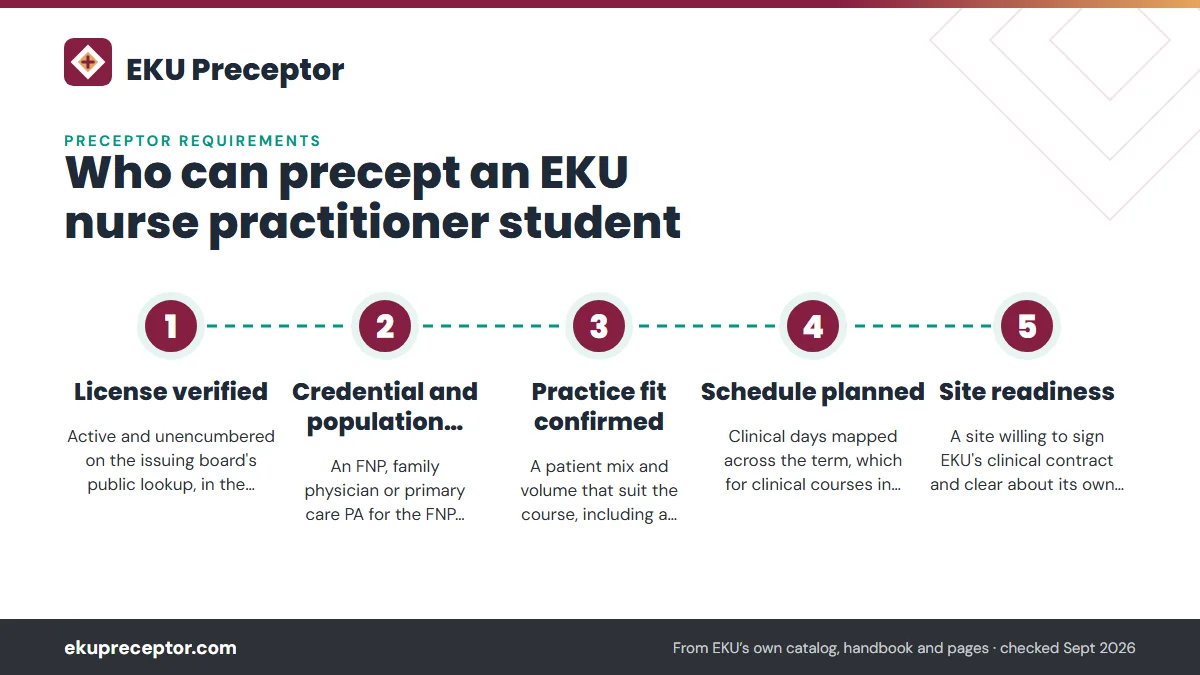
Your placement advisor runs every preceptor through the same checks before you put the name forward, so the details EKU reviews are complete and fit the course on the first pass.
- License verifiedActive and unencumbered on the issuing board's public lookup, in the site's state, including the Kentucky RN and APRN license the Board expects of APRN preceptors in Kentucky.
- Credential and population matchedAn FNP, family physician or primary care PA for the FNP sequence; a PMHNP, psychiatrist or psychiatric PA for the PMHNP sequence; the right organization and leader for DNP hours.
- Practice fit confirmedA patient mix and volume that suit the course, including a rural primary care practice for
NSC 876when that is what you want. - Schedule plannedClinical days mapped across the term, which for clinical courses in EKU's archived plans meant about 16 weeks, not the 7-week core sessions.
- Site readinessA site willing to sign EKU's clinical contract and clear about its own onboarding, from background checks to orientation.
- Paperwork assembledPreceptor and site details organized for EKU's preceptor information form, ready for you to submit.
EKU still makes the call on every preceptor. What changes is that the option you bring has already answered the questions EKU asks. Send us your program and start date and we begin the search in your area.
Questions EKU students ask
Can a physician or physician assistant precept an EKU NP student?
Yes, under Kentucky law. 201 KAR 20:062 counts physicians and physician assistants as preceptors alongside APRNs, and EKU publishes no extra rule about them. Fit carries the weight: a family medicine physician or primary care PA suits the FNP courses, and a psychiatrist suits the PMHNP courses. Your faculty confirm each preceptor when they review your preceptor information.
Does my preceptor need a Kentucky license?
Only when the site is in Kentucky. There, the Board of Nursing expects an APRN preceptor working with an online program's student to be licensed in Kentucky as both an RN and an APRN, while clinical faculty from compact states may rely on the Kentucky APRN license alone. For a site in another state, the preceptor is licensed by that state's board.
How many years of experience does an EKU preceptor need?
EKU has not published a minimum, and Kentucky's APRN regulation sets none. Check the current MSN Student Handbook or ask your faculty before you commit to a preceptor. In our own pre-check we look for a clinician settled in the specialty, with a steady patient load and room in the week to teach, because those shape your hours more than a count of years.
Can my preceptor be someone at my own workplace?
It has happened. In a 2021 EKU Online blog post, an FNP graduate said being able to do her clinicals at her own workplace was one reason she picked EKU. EKU's MSN rules for workplace clinicals, such as a different unit or a different supervisor, are not public. Clinicals where you work covers what makes that option succeed.
Who approves an EKU preceptor?
EKU does, because Kentucky assigns preceptor sourcing to the program itself. In the latest public MSN handbook, a preceptor's details travel to EKU on the clinical contract and preceptor information form; in the DNP handbook, the Clinical Placement Coordinator emails approval to start. Who signs off on MSN preceptors today is not published, so ask your faculty.
Related pages
Last checked 2026-09-25
We check these pages against EKU's own catalog, program pages and handbooks, and Kentucky's regulations. The current MSN Student Handbook, your course and your faculty have the final word.
EKU secures your preceptor. Your input decides how well it fits your life.
Tell us your EKU program, where you live and when your next clinical course starts. We find preceptors in your community who fit the course and prepare everything EKU reviews, so the option you put forward is ready to approve.
- Preceptors matched to the course: family primary care for
NSC 800andNSC 876, psychiatric care forNSC 886 - Preceptor, license and site details organized for EKU's preceptor information form
- In your own community, wherever EKU enrolls students and you hold your RN license
Start your placement plan
Program, city and start date is all we need to begin.