The Clinical Placement Coordinator and who approves EKU clinical sites
In EKU's DNP handbook, a School of Nursing Clinical Placement Coordinator reviews each DNP student's experience site and sends the email that lets hours begin. The MSN handbook speaks of a Clinical Coordinator instead, and course faculty check key documents before any clinical day. EKU has not published who handles MSN placements from week to week, so this page keeps what its documents show apart from what you should ask.
Get your placement plan
Tell us your EKU program and where you live. A placement advisor replies with preceptor and site options in your community that fit your EKU course.
The coordinator in EKU's DNP handbook
The clearest description of the role comes from the DNP Student Handbook revised June 9, 2020, which EKU Online uploaded again in 2024 and which now survives only as an archived copy. It gives the School of Nursing Clinical Placement Coordinator one decisive job: emailing each DNP student once they are cleared to start DNP Experience Hours. Nothing counts before that message arrives.
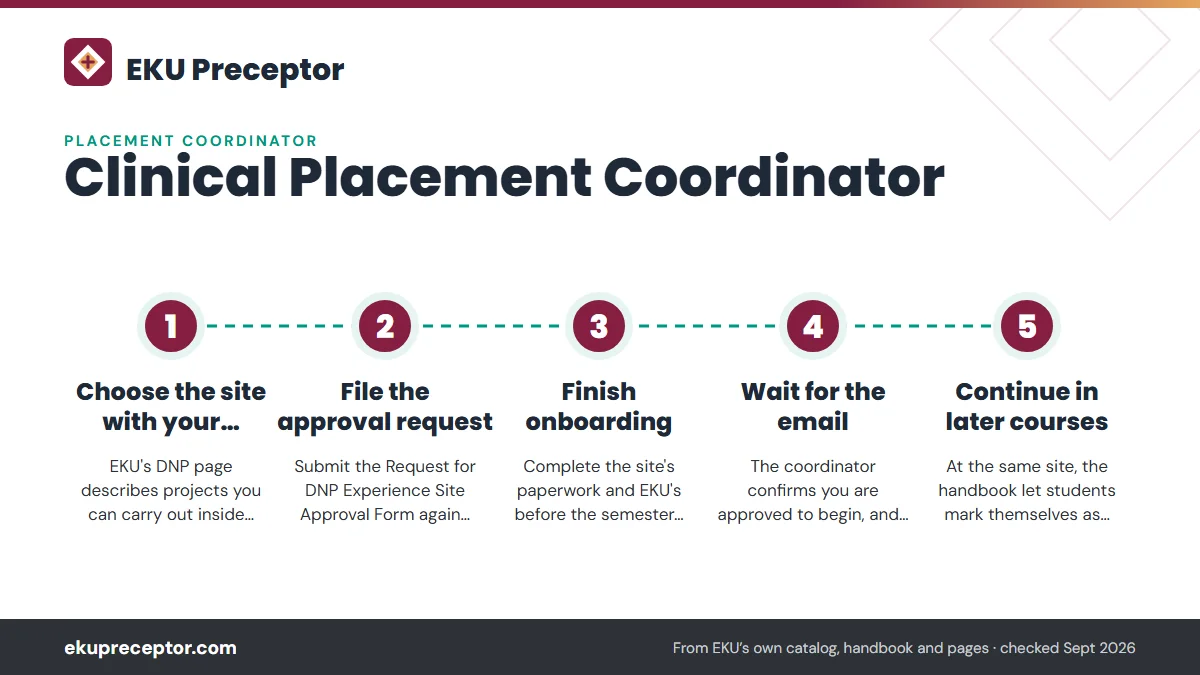
The same handbook says hours cannot start before the semester opens or before all onboarding paperwork is finished, and it has students record every activity in a DNP Experience Log, with the date, the time, what the activity was and which DNP Essentials it serves. The course numbers have changed since 2020, so confirm the current version of these rules with your DNP faculty. Read as a sequence, the handbook's process runs like this:
- Choose the site with your project in mindEKU's DNP page describes projects you can carry out inside your own organization or community, so the experience site often sits where the project will run.
- File the approval requestSubmit the Request for DNP Experience Site Approval Form again with every clinical course.
- Finish onboardingComplete the site's paperwork and EKU's before the semester starts.
- Wait for the emailThe coordinator confirms you are approved to begin, and your log starts from that point.
- Continue in later coursesAt the same site, the handbook let students mark themselves as continuing once onboarding was done.
The MSN side: a Clinical Coordinator and your faculty
The MSN Student Handbook 2021-22, EKU's latest public edition for MSN and post-MSN certificate students, never uses the phrase Clinical Placement Coordinator. It mentions a Clinical Coordinator in one rule: if your nursing license is ever disciplined, you must tell your academic advisor and the Clinical Coordinator right away. Whether that is the same position as the DNP handbook's coordinator, neither document says.
On the MSN side, the visible approval steps belong to faculty. The handbook requires the receipt for liability insurance purchased through EKU to be shown to faculty before you take part in any clinical experience. Each semester you also keep your clinical contract and preceptor information form current, with a Clinical Waiver form and, for FNP students, a Telehealth Checklist. The preceptor details you supply reach EKU through that form, explained on the preceptor information form page.
Two handbooks, two titles: the DNP handbook says Clinical Placement Coordinator and the MSN handbook says Clinical Coordinator. Use whichever title your own course materials use when you write to EKU.
Faculty and program coordinators in clinical approval
Kentucky's APRN regulation, 201 KAR 20:062, requires every Kentucky APRN program to have an APRN program coordinator, a licensed APRN who oversees the program, and an APRN track coordinator licensed in the same role and population as the track. For EKU that means program-level leadership over the FNP and PMHNP tracks, and the DNP handbook adds a DNP Coordinator. EKU does not post who holds these roles.
Closer to your week sit the people you deal with directly. EKU's handbooks describe a course leader, also called the course coordinator, for each course; clinical faculty who supervise the clinical component; and the preceptor, whom the MSN handbook calls the clinical instructor (preceptor). For doctoral students, the DNP Committee pairs each project with a faculty chair who holds a doctorate plus a second team member, and the handbook lists a DNP Preceptor and people from the organization among its stakeholders.
Two other EKU sources show approval sitting with the program. The archived RN to BSN handbook (2023-24) required every preceptor or mentor to be approved by the primary course leader, and EKU's state page makes Missouri sites subject to the EKU program's approval.
The title in EKU's current directory
EKU's online staff directory does not match the handbooks word for word. The College of Health Sciences lists a Coordinator, Clinical Agreement & Compliance, the published title closest to contract and compliance work for clinical sites, and the School of Nursing lists Clinical Faculty and Senior Clinical Faculty positions. People move on, so this site leaves names out and uses titles; the directory is public when you need a current contact.
The title suggests a split worth using. A question about whether a site has a contract with EKU, or which compliance items it needs, points toward that clinical agreement role. A question about whether a preceptor fits your course points toward your course faculty. The agency agreements page covers contracts, and who does what maps every other EKU role you may meet during a clinical course.
Why Kentucky puts this work on the program
The coordinator role exists because of how Kentucky regulates APRN programs. Under 201 KAR 20:062, a Kentucky program secures the preceptors its students need, cannot make a student find one alone, and still lets the student have input. The regulation also lists a failure to provide enough clinical learning opportunities, securing preceptors included, among the warning signs that can bring a Board site visit and threaten the program's approval. The exact text is on the Kentucky preceptor rule page.
Kentucky's regulation places the job of securing preceptors with the program itself. Your input works inside that system: a preceptor you already know, a site near home, a schedule that fits your job. Using your input shows how to present that option so the coordinator and faculty can act on it quickly.
What EKU has not published about MSN placements
Much of the day-to-day handling of MSN and post-MSN placements is described in no public EKU document. Ask your faculty or program coordinator about these before your first clinical course, and keep the answers in your EKU email:
- Which office or person handles NP placements from week to week
- Whether EKU assigns sites directly, and how often students propose their own
- Any deadline for putting a site or preceptor forward before
NSC 800 - The tracking system for graduate students: EKU's BSN and associate pages name Complio and an override guide names CastleBranch, but no source names one for MSN students
- How long a new site's contract takes and who signs it for EKU
- The preceptor qualification rules EKU applies
One historical note shows how the wording has moved. EKU's 2009-10 MSN handbook said the program would arrange practitioner clinical experiences around the region, depending on which agencies and preceptors were available and on faculty coverage. The 2020-21 and 2021-22 editions dropped that sentence and added the preceptor information form that students keep current themselves.
Getting a site approved on the first review
Approval moves fastest when nothing is missing. Your placement advisor readies the preceptor and site information for whichever route your program uses, the preceptor information form for MSN and certificate students or the site approval request for DNP students, and checks them against EKU's published rules before you submit.
We start well ahead of your clinical course, so the site's onboarding and EKU's review can both finish before the term opens. If a site will need a new contract with EKU, we raise it in the first conversation rather than the first week of class. The coordinator and your faculty make the decision; our part is handing them a complete, accurate file. Request your placement plan with your program and start term.
Questions EKU students ask
Who is the Clinical Placement Coordinator at EKU?
The title appears in EKU's DNP Student Handbook as the School of Nursing Clinical Placement Coordinator, and the College of Health Sciences has a related directory title, Coordinator, Clinical Agreement & Compliance. This site uses titles rather than staff names. Your faculty or advisor can confirm who currently reviews sites for your program.
How long does DNP site approval take at EKU?
EKU has not published a turnaround time. Under the archived DNP handbook, no hour counts until three things are true: the semester has started, onboarding paperwork is finished and the coordinator's approval email has arrived. A late request costs you clinical time. File the site approval request as early as your course allows. The DNP clinical hours guide covers the hour rules.
Do EKU MSN students fill out a site approval form?
Not under that name. In EKU's most recent public MSN handbook, the equivalent for MSN and post-MSN certificate students is the clinical contract and preceptor information form, renewed every semester along with the Clinical Waiver form and, in the FNP track, the Telehealth Checklist. Ask your faculty whether the current handbook renames or replaces any of these.
Can I start clinical hours before EKU approves my site?
EKU's documents point to no. DNP hours begin only after the coordinator's email, and the MSN handbook requires your liability insurance receipt to reach faculty, and your clinical documents to be current, before you take part in clinicals. Plan for your first clinical day to fall after approval, and confirm the current rule with your faculty.
Does the Clinical Placement Coordinator find my preceptor?
Under Kentucky's regulation, securing preceptors is the program's job. Which EKU staff carry out that work day to day is not public. You still have input, and a preceptor option that arrives complete and well matched gives EKU something ready to approve.
Related pages
Last checked 2026-09-25
We check these pages against EKU's own catalog, program pages and handbooks, and Kentucky's regulations. The current MSN Student Handbook, your course and your faculty have the final word.
EKU secures your preceptor. Your input decides how well it fits your life.
Tell us your EKU program, where you live and when your next clinical course starts. We find preceptors in your community who fit the course and prepare everything EKU reviews, so the option you put forward is ready to approve.
- Preceptors matched to the course: family primary care for
NSC 800andNSC 876, psychiatric care forNSC 886 - Preceptor, license and site details organized for EKU's preceptor information form
- In your own community, wherever EKU enrolls students and you hold your RN license
Start your placement plan
Program, city and start date is all we need to begin.