Clinicals in EKU's on-campus BSN and associate degree programs
In EKU's Pre-RN BSN, Second Degree BSN and Associate of Applied Science in Nursing, the School of Nursing arranges your clinicals: you rotate in small groups through sites chosen to match each semester's content. Your job is to be ready for them, with compliance documents cleared, transportation sorted and a schedule that can absorb clinical days. Here is every clinical course, how the groups work, and what to plan for, including the NP program you may want later.
Thinking ahead to an NP program?
Tell us your program and when you expect to finish.
Three on-campus routes, one clinical model
All three prelicensure programs are taught on EKU's Richmond campus and approved by the Kentucky Board of Nursing. The BSN routes are accredited by CCNE; the AAS holds ACEN accreditation with conditions (accreditation details). EKU's own pages disagree on credit totals for each one, so the table shows every figure.
| Program | Entry and deadline | Credits EKU lists | Clinical courses |
|---|---|---|---|
| Pre-RN BSN | Apply after your first three semesters: March 31 for fall, October 31 for spring | 120 (course list), 121-122 (plan grid), 120-121 (program page) | Seven, 16.5 credits |
| Second Degree BSN | Fall only, once a year; apply by March 1 | 65 (program page), 67 (plan grid), 82-84 with supporting courses | The same seven, 16.5 credits |
| AAS in Nursing | May 15 for fall, October 31 for spring | 61 (catalog), 64-65 (program page) | Six, 13 credits |
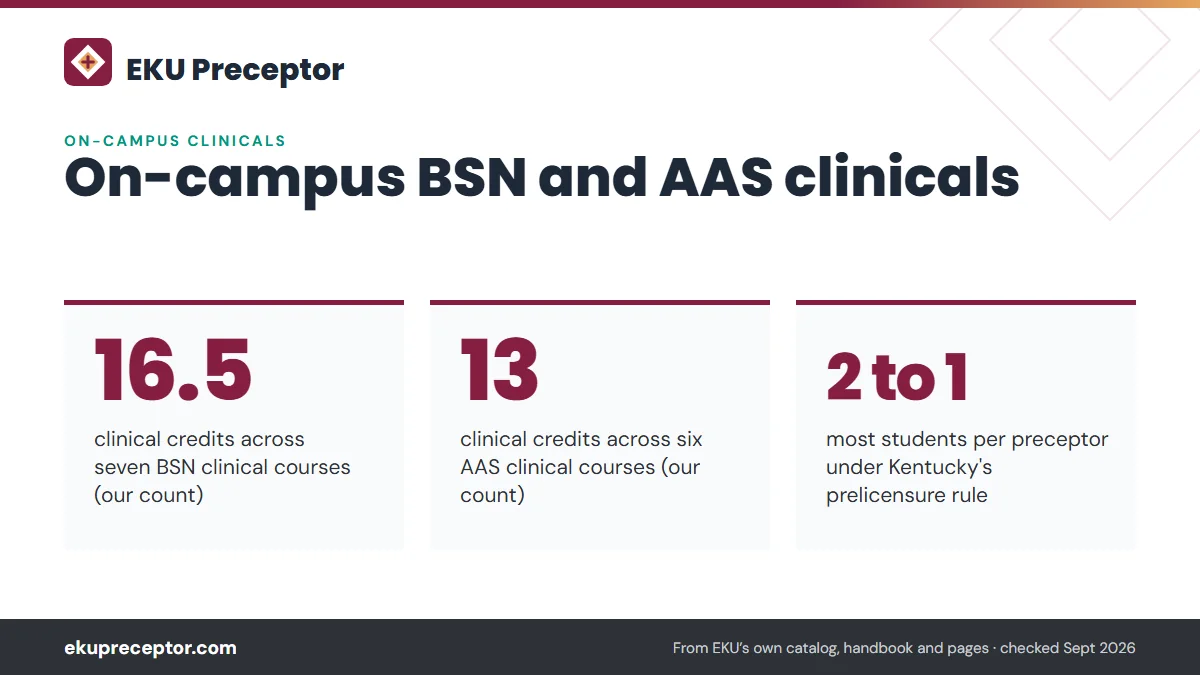
The Second Degree concentration is EKU's accelerated option for people with a non-nursing bachelor's degree: EKU markets it as a new nursing career in less than 2 years, run as five terms. The clinical credit totals are our sums of the catalog's clinical courses; EKU publishes no clock hours for any of them.
The seven BSN clinical courses
Both BSN routes share the same clinical spine. Each clinical shares its number with a lecture course and adds a C. The Second Degree plan swaps NSC 262 Professional Nursing Concepts in for two introductory courses and builds in NSC 378.
| Clinical | Paired course | Clinical credits |
|---|---|---|
NSC 380C | Adult Health Nursing I | 2 |
NSC 386C | Adult Health Nursing II | 2.5 |
NSC 392C | Mental Health Nursing | 2 |
NSC 396C | Family Health Nursing (clinical taken over two parts of term) | 2 |
NSC 484C | Adult Health Nursing III | 2.5 |
NSC 487C | Population Health Nursing | 2.5 |
NSC 492C | Complex Client Health Care | 3 |
| Total | 16.5 (our count) |
Two labs come earlier, with NSC 232L in fundamentals and NSC 332L in health assessment. NSC 378 Short Topics in Clinical Nursing becomes required if your mid-curricular HESI score falls below 900. Progression in the BSN needs a C, or 2.0, or better in every nursing and supporting course.
The six AAS clinical courses
The associate degree packs its clinicals into a shorter plan, with one clinical course beside each of its core nursing courses and an immersion at the end.
| Clinical | Paired course | Clinical credits |
|---|---|---|
NSC 114C | Nursing Concepts I | 3 |
NSC 124C | Medical-Surgical Nursing I | 2 |
NSC 126C | Mental Health Nursing | 1 |
NSC 223C | Medical-Surgical Nursing II | 2 |
NSC 225C | Family Nursing (clinical taken over two parts of term) | 2 |
NSC 240C | Med-Surgical Nursing III: clinical immersion, taken in the last semester | 3 |
| Total | 13 (our count) |
EKU sets an age floor for this route: AAS students must be 18 to take part in clinical placements. Admission also asks for a HESI A2 score from within the past year, and no more than 16 nursing credits can transfer in.
How on-campus clinical groups work
EKU places prelicensure students; you are not asked to find a site. The BSN page describes small clinical groups and a Clinical Skills Lab and Simulation Center on campus. In an EKU news story, an associate chair of the School of Nursing explained that students are placed in areas that reflect the content they are studying that semester, with sites in Corbin, Somerset, Richmond and Lexington and in Rockcastle, Clark and Estill counties.
Kentucky's prelicensure rule, 201 KAR 20:310, shapes the model. A preceptor may be used only after a student has had clinical and didactic instruction from program faculty in all basic areas. The preceptor must hold an RN license in the state of the clinical site, cannot replace clinical instructors, and may take no more than two students at a time. In practice, early rotations run as faculty-led groups, and any precepted experience comes only after that foundation is in place.
The catalog puts transportation to every clinical experience on the student. With sites spread across several counties, a reliable way to reach Corbin or Lexington early in the morning matters as much as your immunization record.
Compliance: Complio, CastleBranch and the documents behind them
Before any clinical, the catalog requires you to meet clinical agency placement requirements, which EKU ties to Joint Commission rules and its contracts with agencies. Tracking is in flux: EKU's 2026 BSN and AAS pages say the School of Nursing uses Complio to manage clinical and compliance documents, while the AAS page also tells students to complete all CastleBranch requirements, and a School of Nursing override guide says clinical sites check students' CastleBranch accounts before classes start. Use whichever system your course and advisor name, and ask if both appear.
What the BSN catalog lists
- Professional liability insurance bought through EKU
- CPR for the Health Care Professional
- Immunity to measles, mumps and rubella, hepatitis B and varicella; adult Tdap; a flu vaccine every year
- A negative TB screen
- A College of Health Sciences approved criminal background check and drug screen
- Personal health insurance, plus anything a particular facility adds
EKU's disclaimers add that agencies may require more, such as OIG searches or fingerprinting, that these tests are at the student's expense, and that an agency may decline a student over a criminal record or a failed drug screen. The compliance guide covers each item.
What on-campus students plan for
- Clinical days that move. Family Health (
NSC 396C) and Family Nursing (NSC 225C) run over two parts of a term, so your schedule can change mid-semester. - The last semester. AAS students take the
NSC 240Cclinical immersion in their final term; keep work and family commitments light then. - Annual renewals. The flu vaccine is yearly, and CPR cards and insurance policies carry end dates, so check your tracker before each term.
- Standards beyond grades. BSN admission to clinical courses applies the Kentucky Nurse Practice Act's character and health standards, not only GPA and prerequisites.
- Timelines for sciences. Anatomy and physiology, microbiology and related sciences must be recent, within 5 years for the BSN routes and the AAS.
Where we fit: planning for your NP clinicals later
Because EKU arranges these clinicals, there is nothing for a placement service to find for you now, and that is how it should be. Where we help is the step after. An AAS graduate can move on to EKU's online RN to BSN, and EKU's MSN tracks ask for at least a year of RN experience before you apply.
When you reach a nurse practitioner program, clinicals change shape. Kentucky's APRN rule makes EKU responsible for securing NP preceptors and gives you input, and EKU's MSN paperwork asks students to supply preceptor details. The clinicians you meet in rotations and your first RN job can become that input. When the time comes, your placement advisor turns those connections, or new ones near home, into a complete preceptor option for EKU to approve; see the MSN FNP guide and reach us through the form below.
Questions EKU students ask
Can I pick my own clinical site in EKU's BSN program?
Not in the prelicensure programs. EKU assigns clinical groups to sites that match each semester's content, and it publishes no process for students to request a particular site. If something affects where you can go, such as transportation or a disability accommodation, raise it with your course faculty before the term begins.
Do Second Degree BSN students do fewer clinicals?
No. The Second Degree concentration uses the same seven clinical courses as the Pre-RN BSN, 16.5 clinical credits by our count, fitted into five terms instead of a longer plan. It also builds NSC 378 Short Topics in Clinical Nursing into the plan rather than requiring it only after a low HESI score.
Is EKU's associate degree in nursing still accredited?
Yes, with conditions. ACEN lists EKU's associate program as accredited with conditions, with its most recent action dated September 12, 2024 and the next visit planned for spring 2032. EKU's page calls it continuing accreditation with conditions, and the Kentucky Board of Nursing approves the program. Neither page explains the conditions, so ask the School of Nursing if they matter to your plans.
Can EKU AAS graduates finish a BSN online?
Yes. EKU's online RN to BSN admits nurses with an associate degree from an ACEN or NLN CNEA accredited program and a current, unencumbered RN license. EKU awards 39 credits for prior learning on admission, and the EKU plan of study is 25 nursing credits with one clinical course, NSC 442C, which EKU says can be completed at your current place of employment.
Related pages
Last checked 2026-09-25
We check these pages against EKU's own catalog, program pages and handbooks, and Kentucky's regulations. The current MSN Student Handbook, your course and your faculty have the final word.
EKU secures your preceptor. Your input decides how well it fits your life.
Tell us your EKU program, where you live and when your next clinical course starts. We find preceptors in your community who fit the course and prepare everything EKU reviews, so the option you put forward is ready to approve.
- Preceptors matched to the course: family primary care for
NSC 800andNSC 876, psychiatric care forNSC 886 - Preceptor, license and site details organized for EKU's preceptor information form
- In your own community, wherever EKU enrolls students and you hold your RN license
Start your placement plan
Program, city and start date is all we need to begin.