South Dakota and EKU: what is open and how clinicals work
Every one of EKU's online nursing programs accepts South Dakota residents. EKU lists the state among SARA members without restrictions, its MSN licensure table (FNP, PMHNP and both post-MSN certificates) and its RN to BSN table both say Meets Requirements, and it publishes no DNP restriction. South Dakota's Board of Nursing leaves placement agreements to the program and the site, with one licensing expectation aimed at EKU's faculty.
Find a South Dakota preceptor
Tell us where in South Dakota you live, your EKU program and your clinical term.
Program-by-program status for South Dakota
EKU's programs require no campus visits, so an EKU student in Sioux Falls, Rapid City or Aberdeen completes the clinical side at home in South Dakota. Kentucky's APRN program rule assigns EKU the job of securing preceptors while leaving room for your input; the Kentucky rule page explains how that works.
| EKU program | South Dakota status | EKU licensure table |
|---|---|---|
| FNP (MSN) | Open | Meets Requirements |
| PMHNP (MSN) | Open | Meets Requirements |
| Post-MSN certificates, FNP and PMHNP | Open | Meets Requirements |
| Post-master's DNP | Open, no state restriction | None published; the DNP leads to no license |
| RN to BSN | Open | Meets Requirements |
How South Dakota's board handles programs based elsewhere
South Dakota's Board of Nursing says in its out-of-state education FAQ, last revised in June 2020, that it does not approve schools based elsewhere. EKU and the South Dakota clinician or facility work out each direct-care placement between themselves. The Board's single request is that EKU keep one faculty member able to practice in South Dakota, by license or by privilege, holding APRN standing when the students are APRN students. The state's distance-education rule (ARSD 20:48:07:49) carries the same expectation into online teaching of APRN students who live there. That burden is EKU's to carry, not yours.
ARSD 20:48:07:34, written for South Dakota's own schools, sets the bar for preceptors: licensure at least equal to what the student is studying for and, for an APRN preceptor, a practice that resembles the student's role, focus or specialty. It makes a sound test for anyone you propose: an FNP or family physician for FNP courses, a psychiatric NP or psychiatrist for PMHNP work.
Hours, courses and practice after graduation
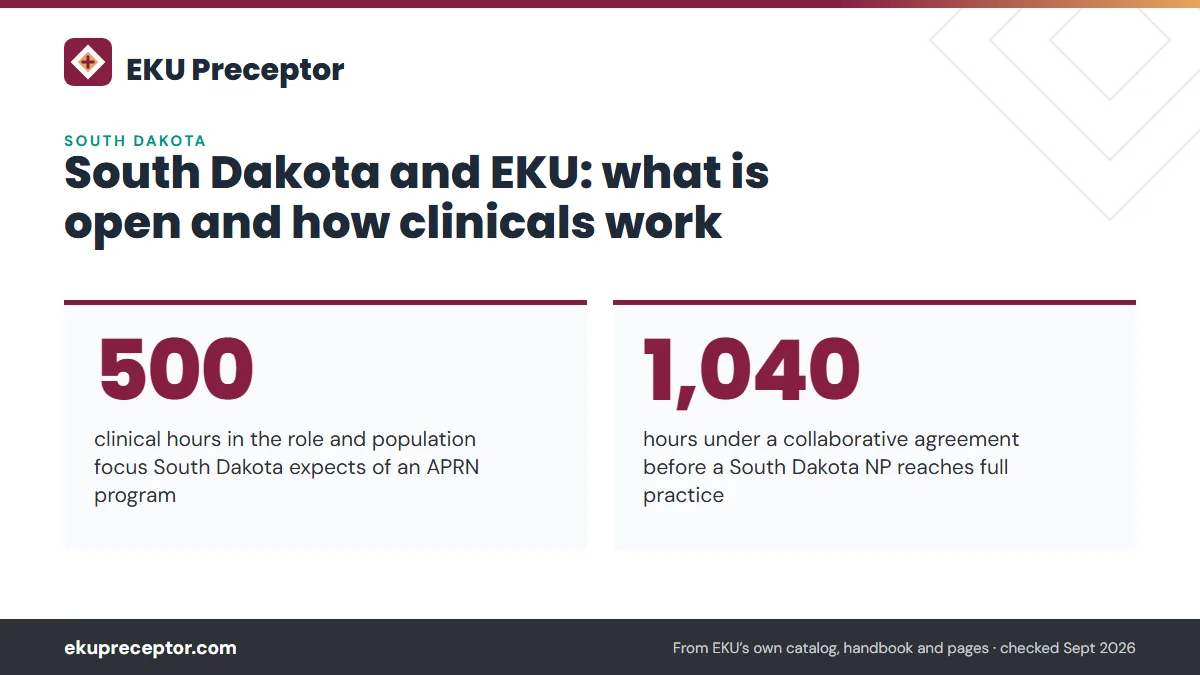
An APRN applicant in South Dakota must show a graduate program that included at least 500 hours of clinical time in their own role and population, along with graduate-level pharmacology, pathophysiology, and health and physical assessment. EKU says its FNP graduates obtain 750 direct patient care hours (how the 750 break down), and the courses required before the first clinical, NSC 830, NSC 832 and NSC 834, cover pharmacology, health assessment and pathophysiology. EKU publishes no PMHNP hour total, so PMHNP students should ask faculty for the figure.
After licensure, AANP counts a South Dakota NP as full practice once they log 1,040 hours in a written collaborative arrangement with a collaborating physician, certified nurse midwife or certified NP. South Dakota enacted the APRN Compact in February 2024, but the compact has never started operating, and NCSBN said in May 2026 that it is being redesigned.
Sioux Falls, Rapid City and the Minnesota line
Three systems carry much of South Dakota's care: Avera Health, Monument Health and Sanford Health. The Sioux Falls and Rapid City metros are the population centers, and Aberdeen is the largest micropolitan area. None is a published EKU partner, so treat them as a guide to where South Dakota clinicians work, not as open doors.
Watch the eastern edge. A small slice of the Sioux Falls metro sits in Minnesota, one of the eight states whose residents EKU does not enroll in the online MSN, because EKU's licensure table marks it Does Not Meet. EKU's page says nothing about clinicals across that line, so keep your site in South Dakota unless EKU tells you otherwise. The Minnesota guide has the detail.
Why EKU students in South Dakota choose us
We build South Dakota placements around the details that matter here. Your placement advisor looks for someone licensed at your target level or above, in the same focus, within reach of your home, and checks that their clinic days work with yours. We prepare the preceptor and site information EKU asks for, so EKU has what it needs to set up the agreement and review the practice, and we stay with you through the term in case a preceptor drops. Request help on the form below.
Questions EKU students ask
Can part of my South Dakota clinical time be telehealth?
EKU's archived 2021-22 MSN handbook lists a Telehealth Checklist for FNP students in NSC 800 and NSC 876, so telehealth has some place in EKU's FNP clinicals. Its contents, and whether or how telehealth hours count, are not public. Ask your faculty before you build a South Dakota schedule around virtual visits.
What does a South Dakota preceptor agree to?
The contract for a South Dakota placement links the out-of-state school with the preceptor, the clinic, or both, so your preceptor or their practice signs with EKU rather than with the state. EKU's side also includes its clinical contract and preceptor information. Our for preceptors page walks a clinician through what hosting an EKU student involves.
Can I live in South Dakota and do my clinicals in North Dakota?
EKU's public pages set no rule against a site in a neighboring state, but you must tell EKU where any placement outside Kentucky happens, and North Dakota adds its own step: EKU must notify that state's board and pay an annual fee before placing students, and it was not on the board's 2026-2027 recognized list when checked. See the North Dakota guide.
Do I need a South Dakota license for clinicals there?
Your RN license must be good in South Dakota. The state is a compact member for RN licenses, so a multistate license from whichever compact state is your home works there. EKU also expects every RN license you hold to be unencumbered and monitors it through Nursys; see RN license and Nursys.
Related pages
Last checked 2026-09-25
We check these pages against EKU's own catalog, program pages and handbooks, and Kentucky's regulations. The current MSN Student Handbook, your course and your faculty have the final word.
EKU secures your preceptor. Your input decides how well it fits your life.
Tell us your EKU program, where you live and when your next clinical course starts. We find preceptors in your community who fit the course and prepare everything EKU reviews, so the option you put forward is ready to approve.
- Preceptors matched to the course: family primary care for
NSC 800andNSC 876, psychiatric care forNSC 886 - Preceptor, license and site details organized for EKU's preceptor information form
- In your own community, wherever EKU enrolls students and you hold your RN license
Start your placement plan
Program, city and start date is all we need to begin.